

UPSC Mapping
| Important for Prelims | GST, Constitutional Bodies and Fiscal Federalism |
|---|---|
| Important for Mains | GS Paper II: Federalism; GS Paper III: Resource Mobilisation |
| Constitutional Basis | Article 279A |
| Amendment | 101st Amendment, 2016 |
| Chairperson | Union Finance Minister |
| Meeting Date | 8 October 2026 |
Article
What is the GST Council?
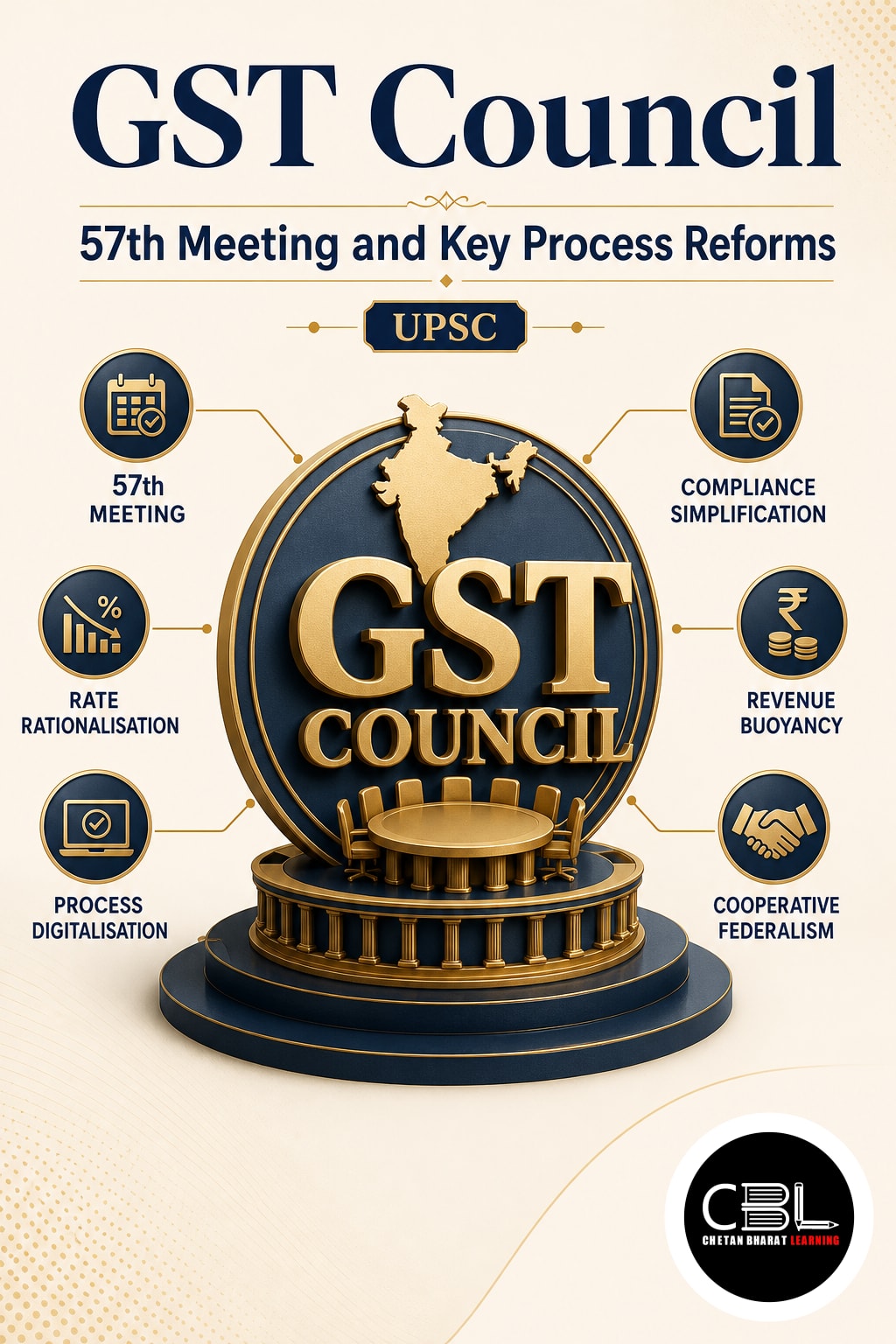
The Council is a constitutional body established under Article 279A through the 101st Constitutional Amendment Act, 2016. It recommends measures to harmonise indirect taxation across the Union and States. Its responsibilities include rates, exemptions, threshold limits, model laws and place-of-supply principles.
The Union Finance Minister chairs the body, which includes the Union Minister of State responsible for Revenue or Finance. Each State nominates its Finance or Taxation Minister, or another minister. This composition gives both levels of government a forum for negotiating common tax policies.
A meeting requires a quorum of half the total membership. Decisions require at least three-fourths of the weighted votes of members present and voting. The Centre holds one-third of the voting weight, while States collectively hold two-thirds.
GST is a destination-based indirect tax on the supply of goods and services. The dual model generally combines CGST and SGST on intra-State supplies, while IGST applies to inter-State supplies. Input tax credit allows eligible businesses to offset tax paid on purchases against their output liability.
Why in News?
The 57th meeting shifted attention towards process reforms covering registration, returns, refunds and adjudication. It also recommended changes involving enforcement and service exports. The Ministry of Finance release records the recommendations and explains their legal status.
Recommendations do not automatically amend existing law. Relevant legislative amendments, rules, notifications or circulars must give effect to individual measures. Businesses should distinguish proposed reforms and intended dates from provisions that have legally commenced.
Key Features
- Simpler registration: Clearer document requirements and better application guidance aim to reduce avoidable queries and uncertainty.
- Faster refund processing: The proposed acknowledgement or deficiency-memo timeline falls from 15 days to 10 days; this is distinct from final refund payment.
- Wider refund eligibility: The proposal covers accumulated credit on input services under an inverted duty structure, for credit availed on or after 1 November 2026.
- Lower-value disputes: A proposed ₹10,000 minimum tax threshold would restrict show-cause notices, with corresponding treatment for pending notices and appeals.
- Decriminalisation: Recommendations include removing GST arrest provisions and raising the prosecution threshold from ₹1 crore to ₹5 crore.
- Goods in transit: Proposed interception requires specific intelligence and authorisation by an officer of at least Joint Commissioner rank.
- Territorial enforcement limits: Proposed inspection and detention powers depend on the supplier or recipient having a relevant connection with the intercepting State, excluding transit-State interception.
- Service exports: Proposed changes would ease export-related treatment for eligible services supplied to or through foreign offices and branches.
An inverted duty structure arises when input tax rates exceed those on output supplies. Eligible businesses can accumulate credit because output liability does not absorb the available balance. Broader refunds can reduce the working capital tied up in this mismatch.
The supplied report also describes a proposed faceless Central GST assessment framework. Such administration seeks to reduce direct interaction and improve consistency. Any implementation would require a defined framework, clear responsibilities and accessible taxpayer remedies.
Service-export reforms concern place-of-supply rules and statutory eligibility, rather than automatic benefits for every foreign-client transaction. Testing, repair or similar activities require examination of the applicable conditions. The official process-reform backgrounder explains the proposed changes.
Challenges
- Legal transition: Different measures require different instruments, making commencement dates and transitional rules important.
- Revenue protection: Reduced procedural burdens must coexist with effective action against deliberate fraud and fabricated transactions.
- Administrative consistency: Central and State authorities need aligned guidance to prevent conflicting interpretations.
- Digital accessibility: Automated systems require reliable portals, clear explanations and assistance for smaller businesses.
- Procedural fairness: Faceless processes must preserve opportunities to respond, receive reasoned decisions and pursue appeals.
Way Forward
The GST Council framework should support coordinated implementation through clear rules and consistent guidance. Authorities should explain eligibility, effective dates and transitional treatment in accessible language. Taxpayer outreach can help smaller firms adapt without unnecessary dependence on repeated clarifications.
Reform assessment should examine refund timelines, compliance costs and dispute resolution outcomes. Risk-based enforcement should target credible fraud indicators while preserving procedural safeguards. Digital tools should support accountable administration through reliable records and understandable reasons.
The broader significance lies in combining ease of doing business with sustainable resource mobilisation. GST Council deliberations illustrate how shared taxation requires continuing Union-State cooperation. Related economy and governance topics are available on the CBL current affairs portal.
Punjab & Haryana PCS Angle
For Punjab PCS and Haryana HCS, the topic connects State finances, cooperative federalism and tax administration. Registration, refunds and inter-State goods movement are relevant to industrial and trading businesses in both States. Answers can examine coordination between State GST authorities and Central agencies without assuming unverified revenue gains.
Prelims Package
Prelims Practice Corner
- Q1. Which constitutional provision establishes the body responsible for Union-State recommendations on GST?
(a) Article 280 (b) Article 279A (c) Article 263 (d) Article 110
Answer: (b) Article 279A provides for this constitutional body. - Q2. Consider these statements about voting: 1. The Centre holds one-third of the total voting weight. 2. States collectively hold two-thirds. 3. Decisions require only a simple majority of weighted votes. Which are correct?
(a) 1 and 3 only (b) 2 and 3 only (c) 1, 2 and 3 (d) 1 and 2 only
Answer: (d) Decisions require at least three-fourths of the weighted votes of members present and voting. - Q3. An inverted duty structure generally occurs when:
(a) Input tax rates exceed output tax rates (b) Output tax rates always exceed input rates (c) Every supply is exempt (d) Only customs duty applies
Answer: (a) Higher input tax rates can lead to accumulated input tax credit. - Q4. Consider these statements: 1. GST is destination-based. 2. IGST generally applies to inter-State supplies. 3. SGST alone generally applies to inter-State supplies. Which are correct?
(a) 2 and 3 only (b) 1 and 3 only (c) 1 and 2 only (d) 1, 2 and 3
Answer: (c) IGST, rather than SGST alone, generally applies to inter-State supplies. - Q5. Which statement correctly describes the legal implementation of the 57th meeting’s recommendations?
(a) Every recommendation immediately changes the statute (b) Relevant legal instruments must give effect to individual measures (c) No legislative amendment can ever be required (d) A press report alone establishes commencement
Answer: (b) Amendments, notifications or circulars implement measures according to their legal requirements.
Mains Package
Mains Practice Questions
- Q1. Explain how India’s GST decision-making framework reflects cooperative federalism. (10 marks)
Answer Structure:
- Intro: Introduce Article 279A and the need for harmonised indirect taxation.
- Body: Discuss Union-State membership, weighted voting, common recommendations and coordination during implementation.
- Conclusion: Emphasise dialogue and predictable administration while respecting constitutional responsibilities.
- Q2. Evaluate how GST process reforms can reduce compliance costs while protecting revenue and taxpayer rights. (15 marks)
Answer Structure:
- Intro: Frame the 57th meeting’s focus on administrative simplification.
- Body: Examine registration, refunds, litigation and enforcement; assess fraud risks, digital accessibility and procedural fairness.
- Conclusion: Recommend coordinated implementation, risk-based scrutiny and measurable service standards.
FAQs
- What was the main focus of the 57th meeting?
The meeting focused on process reforms involving registration, returns, refunds, adjudication and enforcement. It also addressed service-export treatment and trade facilitation. - Does the proposed 10-day timeline guarantee refund payment?
No. The proposed timeline concerns acknowledgement of the application or issuance of a deficiency memo. Final sanction and payment are separate stages. - Are all recommended reforms already legally effective?
The recommendations require the relevant amendments, notifications or circulars. Taxpayers must check each implementing instrument and its commencement provisions.
Related Current Affairs
Preparing for UPSC, PCS or HCS?
Talk to a mentor at Chetan Bharat Learning, Chandigarh. Free guidance on choosing the right exam and building a study plan.
Chat on WhatsAppCall 97793 53345UPSC / IAS / PCS coaching in Chandigarh · Trusted by aspirants across Punjab & Haryana
Leave a Reply
You must be logged in to post a comment.