
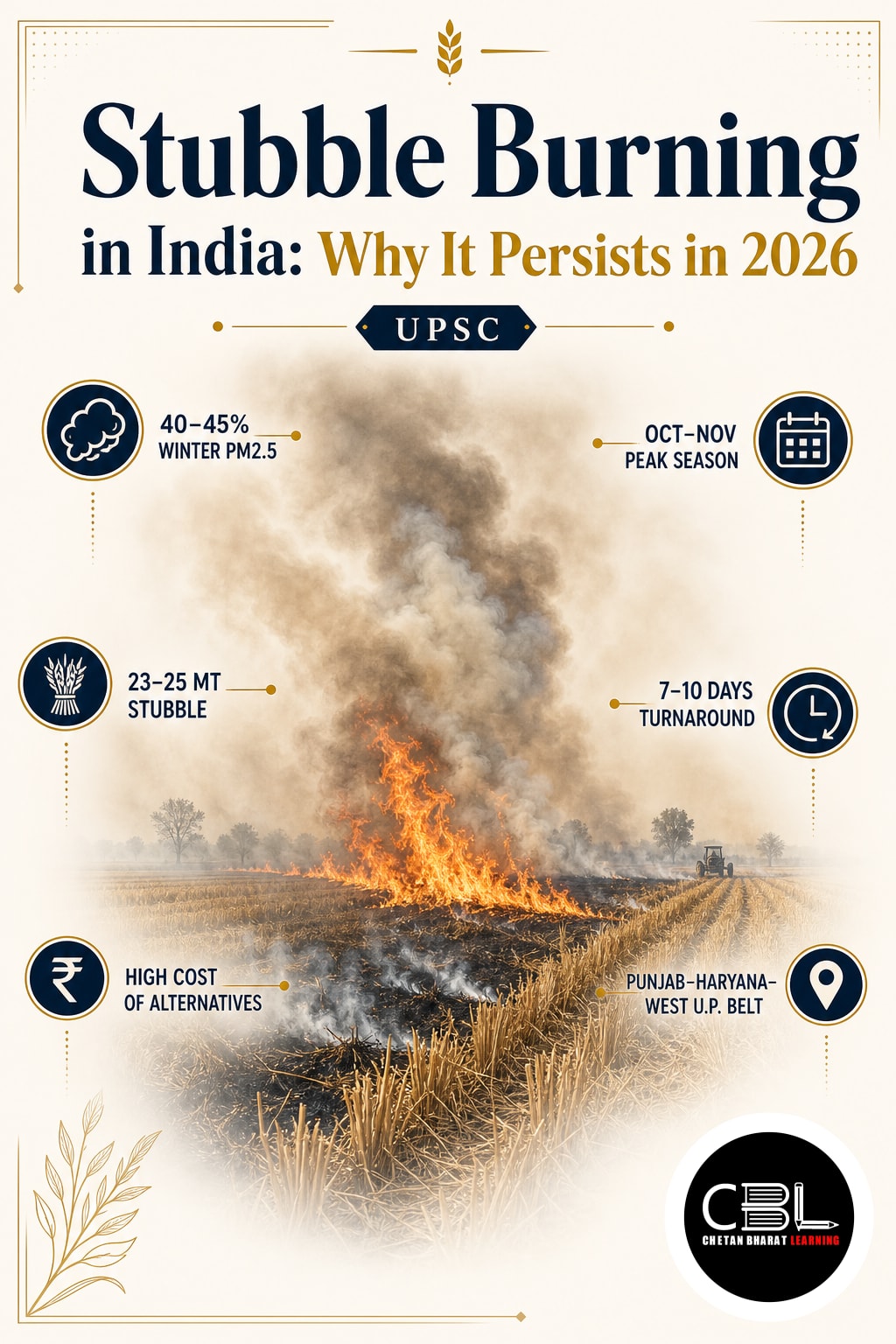

Stubble Burning remains a persistent environmental and agricultural challenge in India despite substantial government investment in crop residue management. By June 2026, more than 3.54 lakh crop residue management machines had been distributed and over 43,500 Custom Hiring Centres established. Yet farmers continue to burn agricultural residue because of short sowing windows, high machinery costs and inadequate markets for paddy straw. The issue is particularly important for Punjab and Haryana, where seasonal crop burning contributes to air pollution across the Indo-Gangetic Plains. Explore related environmental developments through the Chetan Bharat Learning current affairs portal.
What is Stubble Burning?
Stubble Burning, also known as parali burning, is the practice of setting fire to crop residue remaining in agricultural fields after harvesting. It is commonly associated with paddy cultivation, particularly in northwestern India.
Following mechanised paddy harvesting, substantial straw and stubble remain in the field. Farmers sometimes burn this material to prepare the land quickly for the next crop, particularly wheat.
The problem is especially visible between late September and November, when farmers in Punjab, Haryana and neighbouring regions face a relatively short interval between paddy harvesting and wheat sowing.
Crop residue burning releases particulate matter, carbon monoxide, carbon dioxide and other pollutants. It also damages soil organisms and results in the loss of valuable organic matter and plant nutrients.
Stubble burning is therefore both an air-quality problem and an agricultural resource-management issue. Sustainable solutions require alternatives that are technically feasible, affordable and accessible within the short harvesting season.
Why in News?
In June 2026, the Ministry of Agriculture and Farmers Welfare reported that more than 3.54 lakh crop residue management machines had been distributed since 2018–19, supported by government assistance of approximately ₹4,266 crore. More than 43,500 Custom Hiring Centres had also been established.
For FY 2026–27, the Centre announced a provision of ₹544.15 crore, with plans to support the distribution of over 46,000 additional machines and develop 141 crop residue supply-chain projects.
Official satellite-based monitoring recorded a substantial reduction in paddy residue burning incidents during the 2025 harvesting season. Punjab recorded 5,114 incidents and Haryana 662 incidents, representing a 53% decline in each state compared with 2024.
However, the wider regional situation remains significant. Across six monitored states, 33,028 fire events were recorded during the 2025 season, of which Madhya Pradesh accounted for approximately 17,067 incidents, or 52%.
The official reductions are based on the standard satellite monitoring protocol. Independent research has raised concerns that some late-afternoon fires may escape detection during routine polar-orbiting satellite overpasses, meaning recorded incident counts should not automatically be treated as complete measures of actual burning.
On 30 September 2026, the Commission for Air Quality Management (CAQM) reviewed preparedness for the 2026 paddy harvesting season, emphasising field enforcement, residue management and coordinated state action.
The Ministry of Agriculture’s June 2026 statement, the December 2025 fire-count report and the September 2026 CAQM review document these developments.
Key Features
Why Does Stubble Burning Persist?
- Paddy–Wheat Cropping Cycle: Assured procurement of paddy and wheat at Minimum Support Prices encourages farmers to continue a cropping pattern that generates large quantities of seasonal paddy straw.
- Short Sowing Window: The interval between paddy harvesting and wheat sowing is often approximately 15–20 days, making quick field clearance economically attractive.
- Punjab Preservation of Subsoil Water Act, 2009: By regulating the timing of paddy transplantation to conserve groundwater, the legislation contributes to a cropping calendar in which harvesting occurs closer to the wheat sowing season.
- Mechanised Harvesting: Combine harvesters leave substantial residue in fields, requiring additional machines or labour for removal or incorporation.
- High Management Costs: Machinery rental, fuel, baling and transportation involve expenditure, whereas burning offers rapid clearance with limited immediate financial cost.
- Limited Fodder Value: Paddy straw contains relatively high silica and has lower nutritional suitability for cattle than many other fodder materials.
- Weak Biomass Markets: Inadequate demand from industrial users reduces opportunities for farmers to earn revenue from crop residue.
Environmental and Agricultural Impacts
Estimates cited in the current affairs material suggest that burning one tonne of paddy straw may release approximately 3 kg of particulate matter, 60 kg of carbon monoxide and 1,460 kg of carbon dioxide. Actual emissions depend on residue composition, moisture and burning conditions.
Burning can also cause the loss of nitrogen, potassium and soil organic carbon while harming beneficial soil organisms. Smoke reduces visibility, aggravates respiratory problems and contributes to episodic air pollution when combined with unfavourable meteorological conditions and emissions from other sources.
In-Situ and Ex-Situ Crop Residue Management
| Method | Meaning | Examples |
|---|---|---|
| In-Situ | Managing crop residue within the field | Happy Seeder, Super Seeder, mulching, Pusa Decomposer |
| Ex-Situ | Collecting residue for use outside the field | Biomass pellets, compressed biogas, bioethanol, industrial fuel |
In-situ methods can help retain organic matter and avoid the logistical costs of transporting large quantities of straw. Ex-situ methods create potential revenue streams but require collection, storage, transport and reliable buyers.
Government Measures to Control Crop Burning
- Crop Residue Management Scheme: Implemented since 2018–19, it provides financial assistance of 50% for eligible machines purchased by individual farmers and 80% for qualifying Custom Hiring Centre projects.
- Pusa Decomposer: Developed by the Indian Agricultural Research Institute under ICAR, this microbial formulation helps accelerate the decomposition of paddy straw within agricultural fields.
- Biomass Co-Firing: Policy measures promote the use of suitable agricultural biomass pellets alongside coal in thermal power plants to create industrial demand for residue.
- Brick Kiln Fuel Requirements: CAQM Direction No. 92 provides phased use of paddy straw pellets or briquettes in brick kilns across Punjab and non-NCR districts of Haryana, increasing to 30% from November 2026, 40% from November 2027 and 50% from November 2028.
- Compressed Biogas: Paddy straw can serve as feedstock for renewable gas production, creating opportunities for waste-to-energy projects.
- State-Level Measures: Haryana has used incentives and dedicated field-enforcement arrangements, while Punjab deploys district and village-level officers to monitor burning hotspots.
- Environmental Compensation: The CAQM compensation framework, amended in November 2024, prescribes specified financial penalties for crop residue burning according to landholding size.
Environmental Compensation Rates
| Landholding Category | Compensation per Incident |
|---|---|
| Less than 2 acres | ₹5,000 |
| 2 acres to less than 5 acres | ₹10,000 |
| More than 5 acres | ₹30,000 |
These rates were introduced through the CAQM Environmental Compensation Amendment Rules, 2024, which amended the original 2023 rules. In September 2026, the government also published draft replacement rules for consultation; a draft should not be treated as enacted law.
The official Lok Sabha reply on environmental compensation explains the amended rates, while the Ministry of Agriculture’s March 2025 statement details the machinery subsidy structure.
Challenges
- Machinery Availability: Demand for seeders and other equipment peaks during a short harvesting window, making timely rental access difficult for small farmers.
- Financial Constraints: Even subsidised machinery and rental services can impose additional costs, especially where farmers receive little income from straw.
- Collection and Transport: Paddy straw is bulky and seasonal, making storage, baling and movement to industrial facilities expensive.
- Limited Industrial Offtake: Inadequate or inconsistent biomass procurement by power plants and other industries can undermine ex-situ supply chains.
- Monitoring Gaps: Polar-orbiting satellites observe fixed portions of the day and may miss fires occurring outside their overpass windows.
- Jurisdictional Limitations: CAQM’s statutory geographical reach does not extend to every state recording agricultural fires, including Madhya Pradesh.
- Structural Cropping Incentives: The established paddy–wheat procurement system and limited crop diversification can maintain high volumes of straw generation.
- Enforcement Difficulties: Penalties alone may not prevent burning when economically viable alternatives remain unavailable.
The Satellite Detection Problem
A 2026 study published in Remote Sensing found evidence that agricultural fires in northwestern India increasingly occur during the late afternoon. Some fires beginning around 4 PM fall outside the usual observation windows of commonly used polar-orbiting satellites.
Using higher-frequency geostationary observations, researchers identified changes in the timing of fires that were not fully captured by routine monitoring. This creates uncertainty when interpreting long-term trends solely from satellite-detected active fire counts.
The study does not establish that all reported reductions are false. Instead, it demonstrates the importance of combining multiple satellite systems with ground verification and burned-area assessment.
The findings are detailed in the 2026 research paper on late-afternoon stubble fire detection. The government’s February 2026 parliamentary reply also recognises the value of additional satellite observations and evening field patrols.
Way Forward
A sustainable response requires moving beyond seasonal penalties towards economically viable crop residue management. Farmers should have affordable, timely access to equipment and reliable opportunities to sell agricultural residue.
Strengthening Custom Hiring Centres, village-level machinery scheduling and mobile rental services can improve access for small and marginal farmers during peak demand.
Greater industrial use of paddy straw in compressed biogas, biomass pellets, bioethanol and other products can support long-term market demand. Financial incentives should be aligned with dependable procurement arrangements and logistics infrastructure.
Crop diversification towards suitable, less water-intensive alternatives can help reduce the structural dependence on paddy cultivation. Such changes require assured markets, agronomic support and policies that protect farmer livelihoods.
Fire monitoring should combine polar-orbiting satellite data, geostationary observations, burned-area mapping and ground inspections. Public reporting should distinguish detected active fires from estimates of the total area burned.
The persistence of Stubble Burning shows that air pollution control is closely linked with agricultural economics and rural infrastructure. Lasting reductions will depend on farmer-centred solutions, accessible technology, reliable biomass markets and coordinated implementation across states.
Further developments concerning agriculture, environment and governance can be followed through the daily current affairs archive.
Frequently Asked Questions
Why does stubble burning continue in Punjab and Haryana despite machinery subsidies?
Farmers face a short period between paddy harvesting and wheat sowing, while machinery rental, straw collection and transport involve additional costs. Limited access during peak demand and inadequate markets for paddy straw make burning an immediately convenient option even when subsidised alternatives exist.
What is the difference between in-situ and ex-situ stubble management?
In-situ management retains and processes crop residue within the agricultural field through practices such as mulching, Happy Seeder use or microbial decomposition. Ex-situ management involves collecting residue for external uses such as biomass pellets, compressed biogas, bioethanol or industrial fuel.
What progress was recorded in controlling stubble burning by 2026?
By June 2026, more than 3.54 lakh crop residue management machines had been distributed and over 43,500 Custom Hiring Centres established. Official data recorded a 53% reduction in detected fires in both Punjab and Haryana during the 2025 paddy season compared with 2024, although research highlights limitations in satellite monitoring of late-afternoon fires.
Related Current Affairs
Preparing for UPSC, PCS or HCS?
Talk to a mentor at Chetan Bharat Learning, Chandigarh. Free guidance on choosing the right exam and building a study plan.
Chat on WhatsAppCall 97793 53345UPSC / IAS / PCS coaching in Chandigarh · Trusted by aspirants across Punjab & Haryana
Leave a Reply
You must be logged in to post a comment.