
UPSC Mapping
| Prelims | Indian Art and Culture, Classical Languages and Educational Institutions |
|---|---|
| Mains | GS Paper I – Indian Culture and Heritage; GS Paper II – Education |
Article
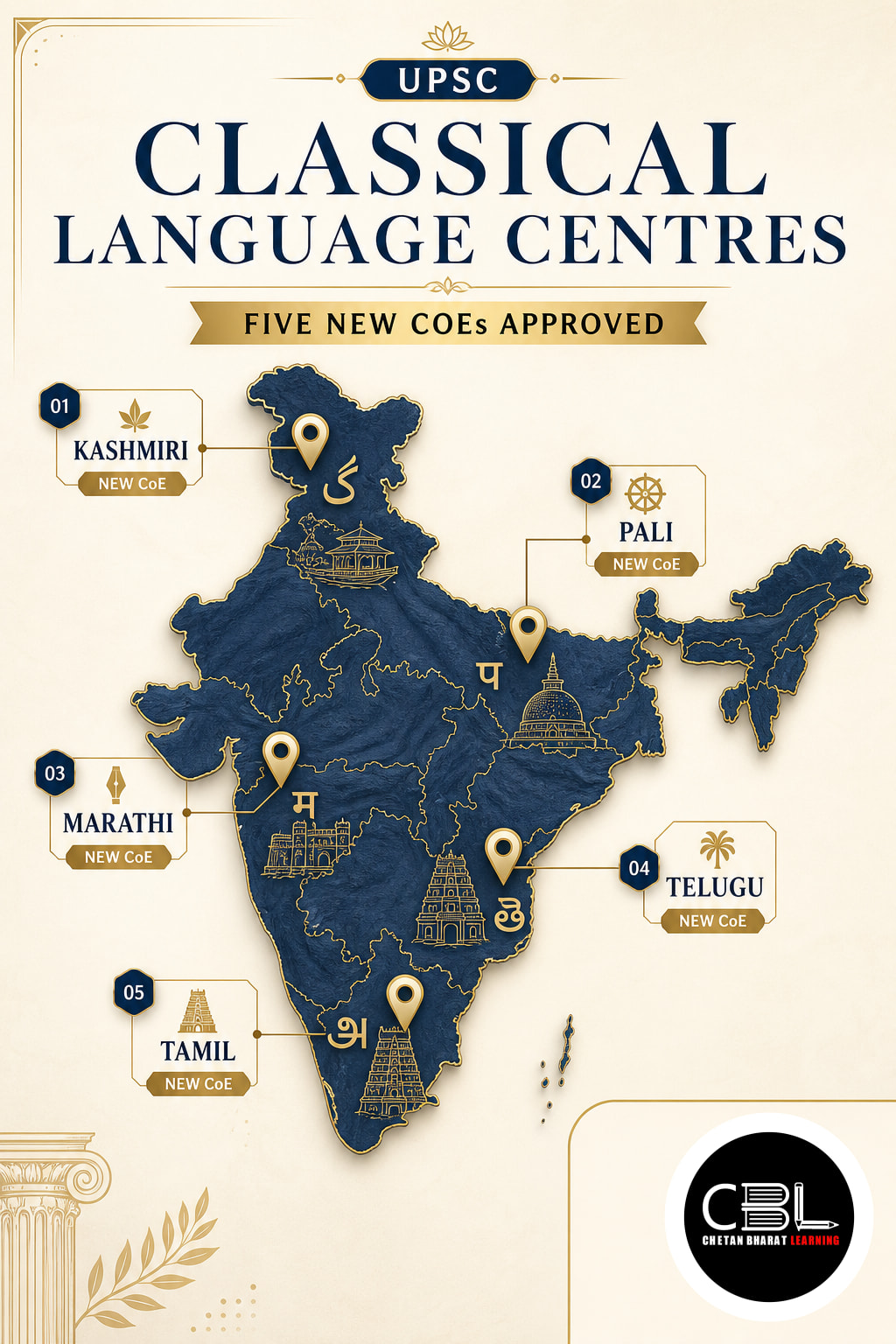
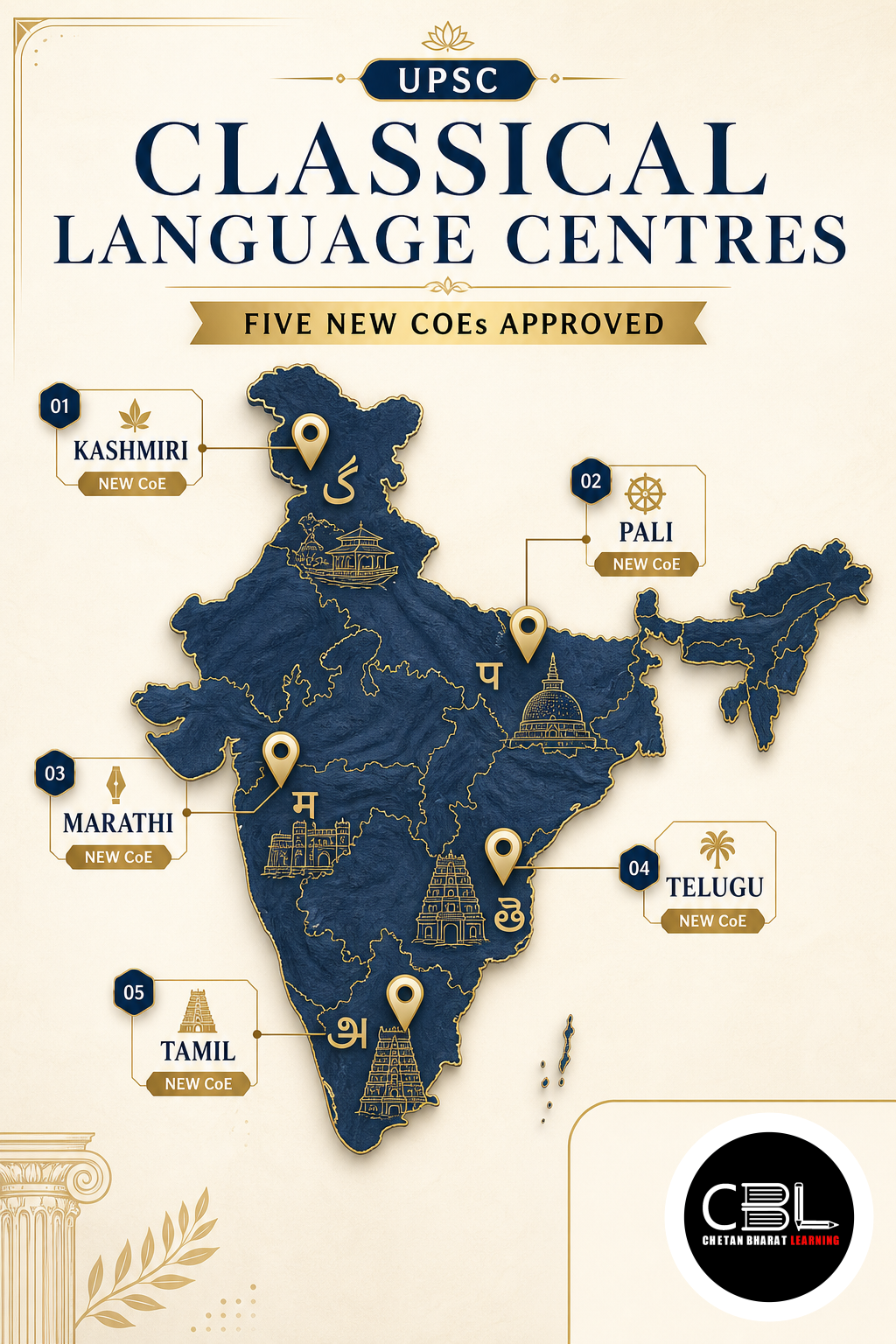
Classical Language Centres have received a major institutional boost, with the Ministry of Education approving five new Centres of Excellence (CoEs) for the study of Classical Assamese, Bengali, Marathi, Pali and Prakrit. Announced on 3 October 2026, the initiative aims to strengthen academic research, preserve ancient manuscripts, digitise literary resources and promote India’s linguistic heritage. The centres will operate through selected higher educational institutions across five states. The development is significant for Indian art and culture, higher education and cultural preservation.
What are Classical Language Centres of Excellence?
Classical Language Centres of Excellence are specialised academic institutions established to promote the systematic study, research, preservation and dissemination of India’s classical linguistic and literary traditions.
They support advanced scholarship, documentation of historical texts, digitisation of manuscripts and wider access to ancient literary and knowledge traditions. Such centres can bring together researchers, linguists, historians, translators and manuscript specialists.
In India, Classical Language status recognises a language’s historical antiquity, literary heritage and contribution to cultural and intellectual traditions. This recognition is distinct from inclusion in the Eighth Schedule of the Constitution.
Tamil became India’s first recognised classical language in 2004. Sanskrit, Telugu, Kannada, Malayalam and Odia subsequently received classical status. In October 2024, the Union Cabinet approved recognition for Marathi, Pali, Prakrit, Assamese and Bengali, bringing the total to eleven.
The establishment of dedicated centres provides institutional support for these five newly recognised languages. It is intended to convert formal recognition into sustained academic activity and accessible research resources.
Why in News?
On 3 October 2026, the Department of Higher Education under the Ministry of Education announced approval for five Centres of Excellence dedicated to Classical Assamese, Classical Bengali, Classical Marathi, Classical Pali and Classical Prakrit.
The initiative follows the Union Cabinet’s decision of 3 October 2024 to confer classical status on these five languages. The new centres will be established at designated higher educational institutions in Assam, West Bengal, Maharashtra, Odisha and Gujarat.
According to the Ministry of Education’s official announcement dated 3 October 2026, the centres will focus on academic research, heritage preservation, digitisation, wider dissemination and strengthening regional academic ecosystems.
The announcement concerns approval for establishing the centres. It does not establish that every centre has completed infrastructure development or commenced its full range of academic activities.
Key Features
The five centres are assigned to specific universities and research institutions based in different parts of India.
| Classical Language | Centre of Excellence / Host Institution | State |
|---|---|---|
| Assamese | Tezpur University | Assam |
| Bengali | Visva-Bharati University | West Bengal |
| Marathi | Deccan College Post-Graduate and Research Institute, Pune | Maharashtra |
| Pali | Central University of Odisha | Odisha |
| Prakrit | Central University of Gujarat | Gujarat |
- Academic research and scholarship: The centres will provide platforms for advanced linguistic research, scholarly publications and academic collaboration.
- Preservation of manuscripts: Documentation and conservation of historical texts will help safeguard vulnerable linguistic and literary resources.
- Digitisation: Converting eligible manuscripts and literary materials into digital formats can improve preservation and accessibility.
- Wider dissemination: Research publications, educational initiatives and accessible resources can expand awareness of classical literary and knowledge traditions.
- Regional academic development: Establishing centres across five states can strengthen local research institutions and encourage collaboration among scholars.
- Interdisciplinary studies: Classical texts offer opportunities for research connecting languages with history, archaeology, philosophy, religion and cultural studies.
Challenges
- Manuscript deterioration: Historical documents may be damaged by humidity, insects and ageing materials.
- Limited specialist availability: Advanced research requires scholars trained in historical linguistics, palaeography and manuscript studies.
- Digitisation complexity: Different scripts, damaged texts and limited OCR resources can complicate accurate digital transcription.
- Institutional capacity: New centres require qualified faculty, research infrastructure and sustainable funding.
- Public accessibility: Specialist academic resources may remain inaccessible without translations and searchable catalogues.
- Preservation standards: Digital copies require reliable metadata, authenticity checks and long-term maintenance.
Way Forward
The government should ensure adequate research infrastructure and sustained institutional support so that approved centres can undertake meaningful preservation and scholarship.
Universities should collaborate with archives, museums, libraries and research institutions to identify, preserve and document historical language resources.
Training programmes for young scholars can help address shortages in manuscript studies, historical linguistics and specialised research methodologies.
The centres should also support public accessibility and wider dissemination through educational materials, translations and responsible online access to digitised texts.
The approval of five Classical Language Centres strengthens the institutional framework for preserving India’s linguistic and literary heritage. Their long-term success will depend on scholarly quality, preservation outcomes and sustained public access.
Prelims Practice Corner
Q1. Which institution has been selected to establish the Centre of Excellence for Classical Assamese?
(a) Gauhati University (b) Tezpur University (c) Assam University (d) Dibrugarh University
Answer: Tezpur University in Assam has been selected to host the Centre of Excellence for Classical Assamese under the October 2026 announcement.
Q2. Consider the following pairs: 1. Classical Bengali – Visva-Bharati University 2. Classical Marathi – Deccan College, Pune 3. Classical Pali – Central University of Gujarat 4. Classical Prakrit – Central University of Odisha. Which pairs are correctly matched?
(a) 1, 3 and 4 only (b) 2 and 4 only (c) 1, 2, 3 and 4 (d) 1 and 2 only
Answer: Pairs 1 and 2 are correct. The Classical Pali centre is assigned to the Central University of Odisha, while the Classical Prakrit centre is assigned to the Central University of Gujarat.
Q3. How many languages have been officially recognised as Classical Languages by the Government of India following the additions approved in October 2024?
(a) 11 (b) 8 (c) 14 (d) 22
Answer: Five languages were added in 2024 to the six previously recognised classical languages, increasing the total to eleven.
Q4. Which of the following is NOT among the criteria considered for Classical Language status under the revised 2024 framework?
(a) Antiquity of early texts or recorded history (b) A significant body of ancient literature (c) Mandatory inclusion in the Eighth Schedule of the Constitution (d) Knowledge texts and epigraphic evidence
Answer: Eighth Schedule inclusion is not mandatory for classical language recognition. Pali and Prakrit have classical status but are not separately included in the Eighth Schedule.
Q5. Consider the following statements: 1. Tamil was the first Indian language to receive Classical Language status. 2. The five new Centres of Excellence were approved by the Department of Higher Education. 3. The Centres are intended to promote research, preservation and digitisation of classical literary resources. Which statements are correct?
(a) 1 and 2 only (b) 2 and 3 only (c) 1, 2 and 3 (d) 1 and 3 only
Answer: All three statements are correct. Tamil received classical status in 2004, and the Ministry of Education approved five new centres in October 2026 to strengthen research, preservation and digitisation.
Mains Practice Questions
Q1. India’s classical languages represent an important component of its cultural and intellectual heritage. Examine the significance of establishing dedicated Centres of Excellence for their preservation and promotion. (15 marks)
Answer Structure:
- Introduction: Introduce classical language recognition and the approval of five new Centres of Excellence in October 2026.
- Body: Discuss the role of advanced research, manuscript conservation, digitisation, translation, accessibility, regional universities and challenges involving institutional capacity and trained scholars.
- Conclusion: Emphasise sustained academic support, collaboration and public access to ensure the long-term preservation of linguistic heritage.
Q2. Explain the criteria for granting Classical Language status in India. How does this recognition differ from inclusion in the Eighth Schedule of the Constitution? (10 marks)
Answer Structure:
- Introduction: Explain the significance of classical language recognition and the current total of eleven recognised languages.
- Body: Describe antiquity, ancient literary heritage, knowledge texts and historical evidence; distinguish the cultural recognition framework from the constitutional list of 22 Eighth Schedule languages.
- Conclusion: Highlight the complementary but distinct roles of cultural preservation and constitutional language recognition.
Frequently Asked Questions
Which five Classical Languages received new Centres of Excellence in 2026?
The Ministry of Education approved new centres for Classical Assamese, Bengali, Marathi, Pali and Prakrit. They will be established at Tezpur University, Visva-Bharati University, Deccan College Pune, Central University of Odisha and Central University of Gujarat, respectively.
How many Classical Languages are recognised in India?
India has eleven officially recognised classical languages: Tamil, Sanskrit, Telugu, Kannada, Malayalam, Odia, Marathi, Assamese, Bengali, Pali and Prakrit. The five most recent additions were approved in October 2024.
What is the main objective of the Centres of Excellence for Classical Languages?
Their principal objectives are to strengthen advanced academic research, preserve and digitise classical linguistic and literary resources, and improve access to traditional knowledge and scholarship. They are also intended to strengthen regional higher education and research ecosystems.
Related Current Affairs
Preparing for UPSC, PCS or HCS?
Talk to a mentor at Chetan Bharat Learning, Chandigarh. Free guidance on choosing the right exam and building a study plan.
Chat on WhatsAppCall 97793 53345UPSC / IAS / PCS coaching in Chandigarh · Trusted by aspirants across Punjab & Haryana
Leave a Reply
You must be logged in to post a comment.