
UPSC Mapping
- Prelims: Modern Indian History, Personalities and Post-Independence India
- Mains: GS Paper I – Post-Independence India and GS Paper IV – Ethics
Who was Lal Bahadur Shastri?
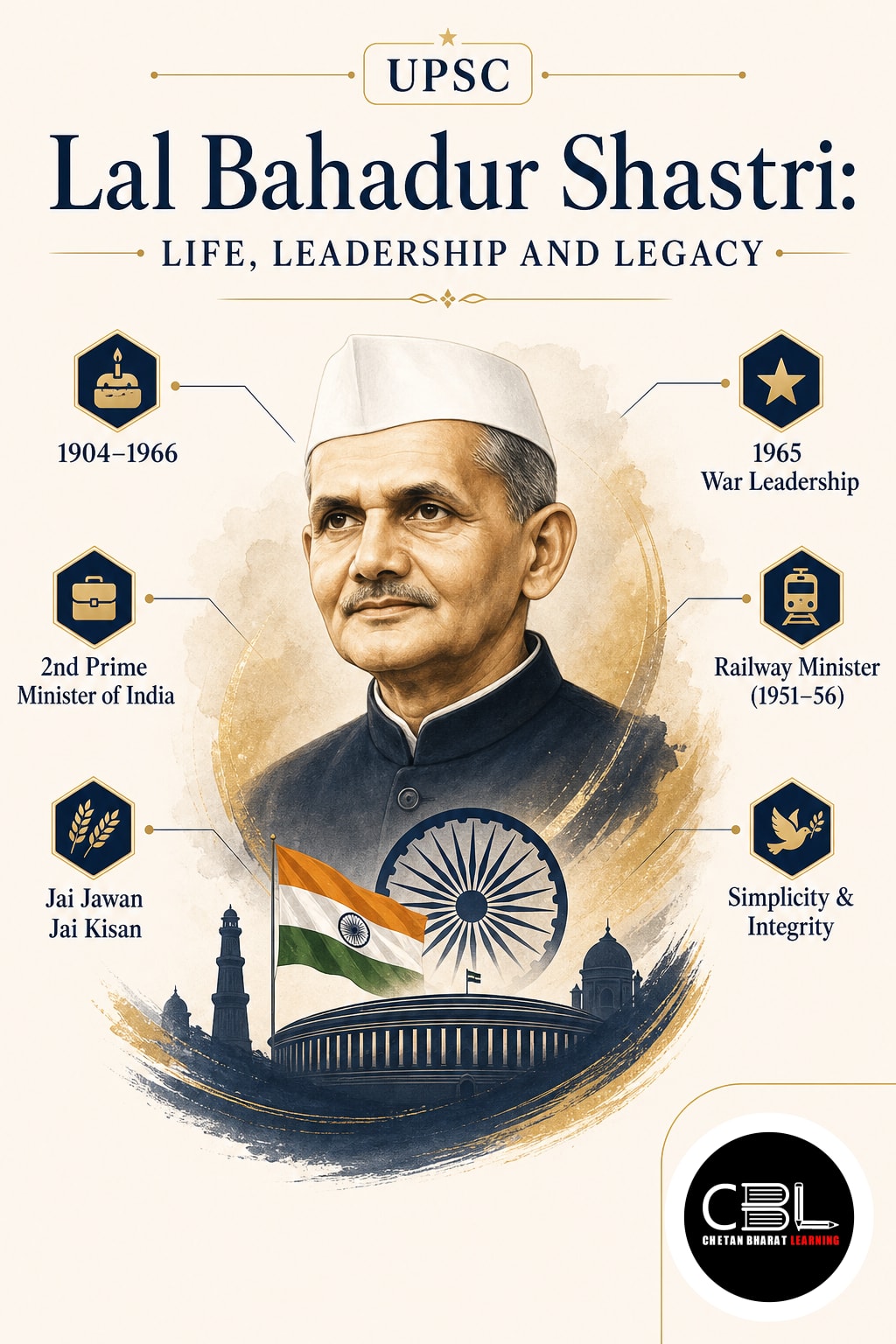
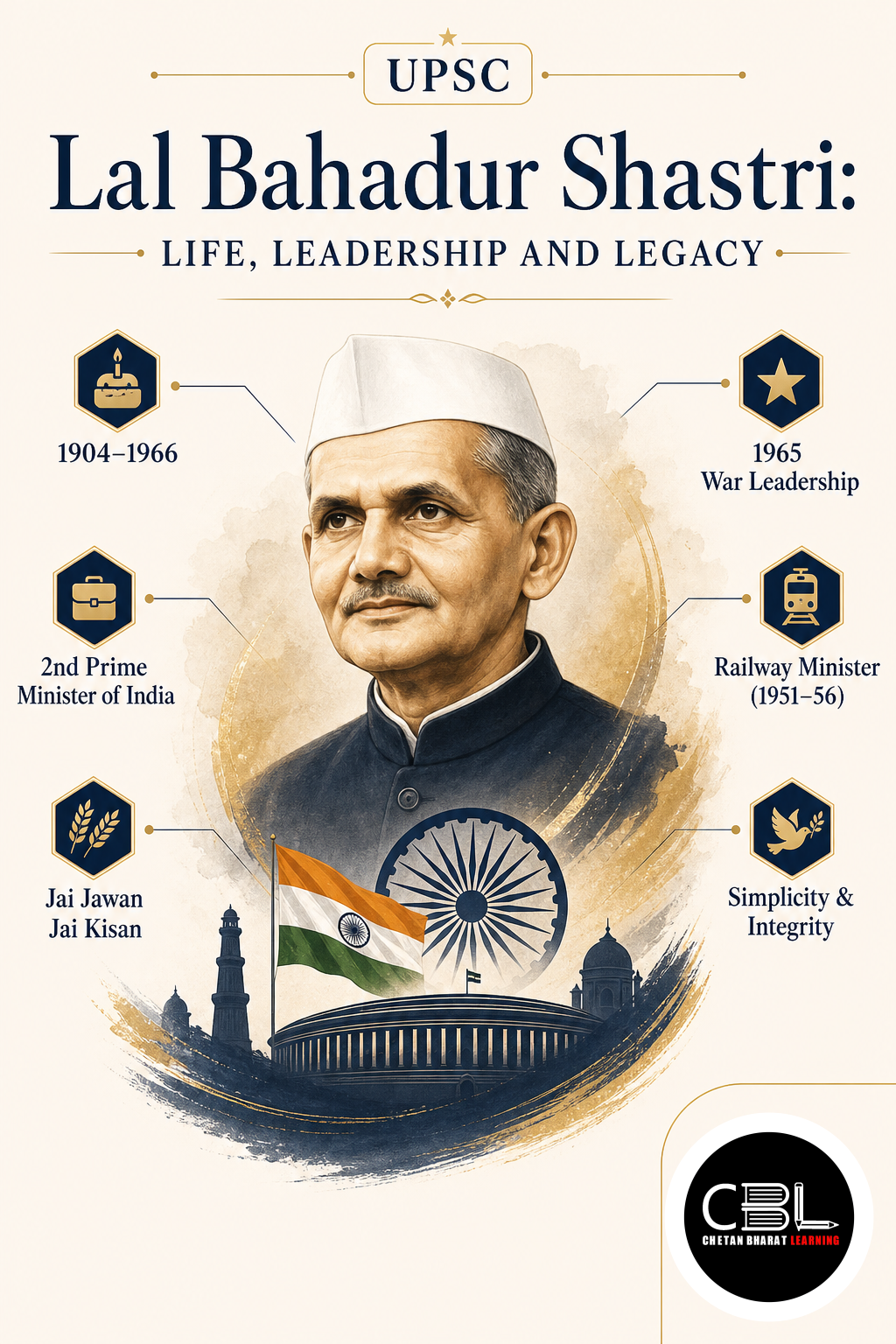
Born on 2 October 1904 in Mughalsarai, Uttar Pradesh, Lal Bahadur Shastri became an important figure in India’s freedom struggle and post-independence political leadership. He was deeply influenced by Mahatma Gandhi’s principles of simplicity, non-violence and public service.
At the age of sixteen, he left his studies to participate in the Non-Cooperation Movement following Gandhi’s call. He later studied at Kashi Vidyapeeth in Varanasi, where he received the title Shastri, which subsequently became associated with his name.
He joined the Servants of the People Society and participated in important phases of the national movement, including the Civil Disobedience Movement and Quit India Movement, leading to repeated imprisonment under British rule.
After independence, Shastri held key administrative roles: Railway Minister, Transport and Communications Minister, Commerce and Industry Minister, and Home Minister before becoming India’s second Prime Minister on 9 June 1964. His tenure lasted until 11 January 1966, during which he confronted major security and agricultural challenges.
Why in News?
India observed the 122nd birth anniversary of its second Prime Minister on 2 October 2026. Prime Minister Narendra Modi paid homage to Shastri, highlighting his simplicity, determination and commitment to the nation.
The tribute renewed public attention to Shastri’s leadership during the 1965 war, agricultural reforms and institution-building in independent India. His birth anniversary coincides with Mahatma Gandhi’s birthday, underscoring their shared legacy of public service.
Major Contributions
Shastri’s political career spanned India’s freedom struggle, administrative development, national security and agricultural transformation. Key events include:
| Year | Event |
|---|---|
| 1904 | Born on 2 October in Mughalsarai, Uttar Pradesh. |
| 1921 | Joined the Non-Cooperation Movement. |
| 1930 | Participated in Civil Disobedience Movement and Salt Satyagraha. |
| 1942 | Imprisoned during Quit India Movement. |
| 1956 | Resigned as Railway Minister accepting moral responsibility for an accident. |
| 1964 | Sworn in as India’s second Prime Minister on 9 June. |
| 1965 | Led India in the India–Pakistan War; popularised “Jai Jawan Jai Kisan.” |
| 1966 | Signed the Tashkent Declaration on 10 January; died next day; awarded Bharat Ratna posthumously. |
Role in the Freedom Struggle
He organised campaigns and mobilised support during the Non-Cooperation, Civil Disobedience and Quit India Movements. Multiple imprisonments under British rule shaped his discipline and dedication to public service.
Leadership During the 1965 India–Pakistan War
Shastri directed India’s military response to Pakistan’s Operation Gibraltar and preserved national unity during the conflict, which concluded with a UN-brokered ceasefire in September 1965.
Jai Jawan Jai Kisan
The slogan emphasised the dual importance of soldiers defending the nation and farmers ensuring food security, linking defence and agricultural self-reliance during a period of external threat and domestic shortages.
Agricultural and Dairy Development
He established the Food Corporation of India and Agricultural Prices Commission in 1965 to strengthen procurement and price policy. He also supported the Anand dairy cooperative model and set up the National Dairy Development Board, laying groundwork for the White Revolution.
Tashkent Declaration
Signed on 10 January 1966 between Shastri and Ayub Khan under Soviet mediation, it restored diplomatic relations and mandated withdrawal to pre-conflict positions. Shastri died in Tashkent the following day.
Legacy and Present-Day Relevance
Shastri’s integrity, simplicity and accountability remain benchmarks of public life. His 1956 resignation exemplifies ministerial responsibility. His agricultural policies inform ongoing debates on food security, procurement and rural development.
Prelims Practice Corner
Q1. Lal Bahadur Shastri became the Prime Minister of India in which year?
(a) 1962 (b) 1964 (c) 1965 (d) 1966
Answer: (b) 1964.
Q2. Statements regarding Shastri: 1. Participated in Non-Cooperation Movement. 2. Associated with Servants of the People Society. 3. Became first PM after independence. Which are correct?
(a) 1 & 3 only (b) 2 & 3 only (c) 1 & 2 only (d) All three
Answer: (c) 1 & 2 only.
Q3. The Tashkent Declaration of 1966 was signed between:
(a) Shastri & Ayub Khan (b) Nehru & Jinnah (c) Indira Gandhi & Bhutto (d) Shastri & Yahya Khan
Answer: (a) Shastri & Ayub Khan.
Q4. Institutions established in 1965 during Shastri’s term: 1. Food Corporation of India 2. Agricultural Prices Commission 3. NDDB. Which?
(a) 1 only (b) 1 & 2 only (c) 2 & 3 only (d) All three
Answer: (d) All three.
Q5. Statements: 1. Bharat Ratna posthumously. 2. Resigned as Railway Minister in 1956. 3. Signed Tashkent in 1971. Which?
(a) 1 & 2 only (b) 2 & 3 only (c) 1 & 3 only (d) All three
Answer: (a) 1 & 2 only.
Mains Practice Questions
Q1. Examine Shastri’s leadership reflecting national security and agricultural self-reliance. (15 marks)
Answer Structure:
- Intro: Shastri as PM and challenges faced.
- Body: 1965 war, Jai Jawan Jai Kisan, FCI, APC, NDDB, Tashkent.
- Conclusion: Contributions to resilience and food security.
Q2. Discuss ministerial accountability and integrity with reference to Shastri’s conduct. (10 marks)
Answer Structure:
- Intro: Define accountability in governance.
- Body: 1956 resignation, moral responsibility, public trust.
- Conclusion: Ethical leadership as governance foundation.
Frequently Asked Questions
What were the major contributions of Lal Bahadur Shastri?
He led India during the 1965 war, popularised Jai Jawan Jai Kisan, and supported food procurement institutions and cooperative dairy development.
What was the significance of the Tashkent Declaration?
Signed on 10 January 1966 under Soviet mediation, it restored relations with Pakistan and called for withdrawal to pre-conflict positions; Shastri died the next day.
Why is Lal Bahadur Shastri associated with ministerial accountability?
In 1956, he resigned as Railway Minister accepting moral responsibility for an accident, exemplifying ethical leadership and constitutional propriety.
Related Current Affairs
Preparing for UPSC, PCS or HCS?
Talk to a mentor at Chetan Bharat Learning, Chandigarh. Free guidance on choosing the right exam and building a study plan.
Chat on WhatsAppCall 97793 53345UPSC / IAS / PCS coaching in Chandigarh · Trusted by aspirants across Punjab & Haryana
Leave a Reply
You must be logged in to post a comment.