

UPSC Mapping
| Prelims | International Relations |
|---|---|
| Mains | GS Paper 2 (International Relations) |
Quick Facts
| Original Members | Brazil, Russia, India, China, South Africa |
|---|---|
| New Additions | Egypt, Ethiopia, Iran, Saudi Arabia, UAE, Indonesia |
| Core Objective | Reformed Multilateralism |
What is BRICS Expansion?
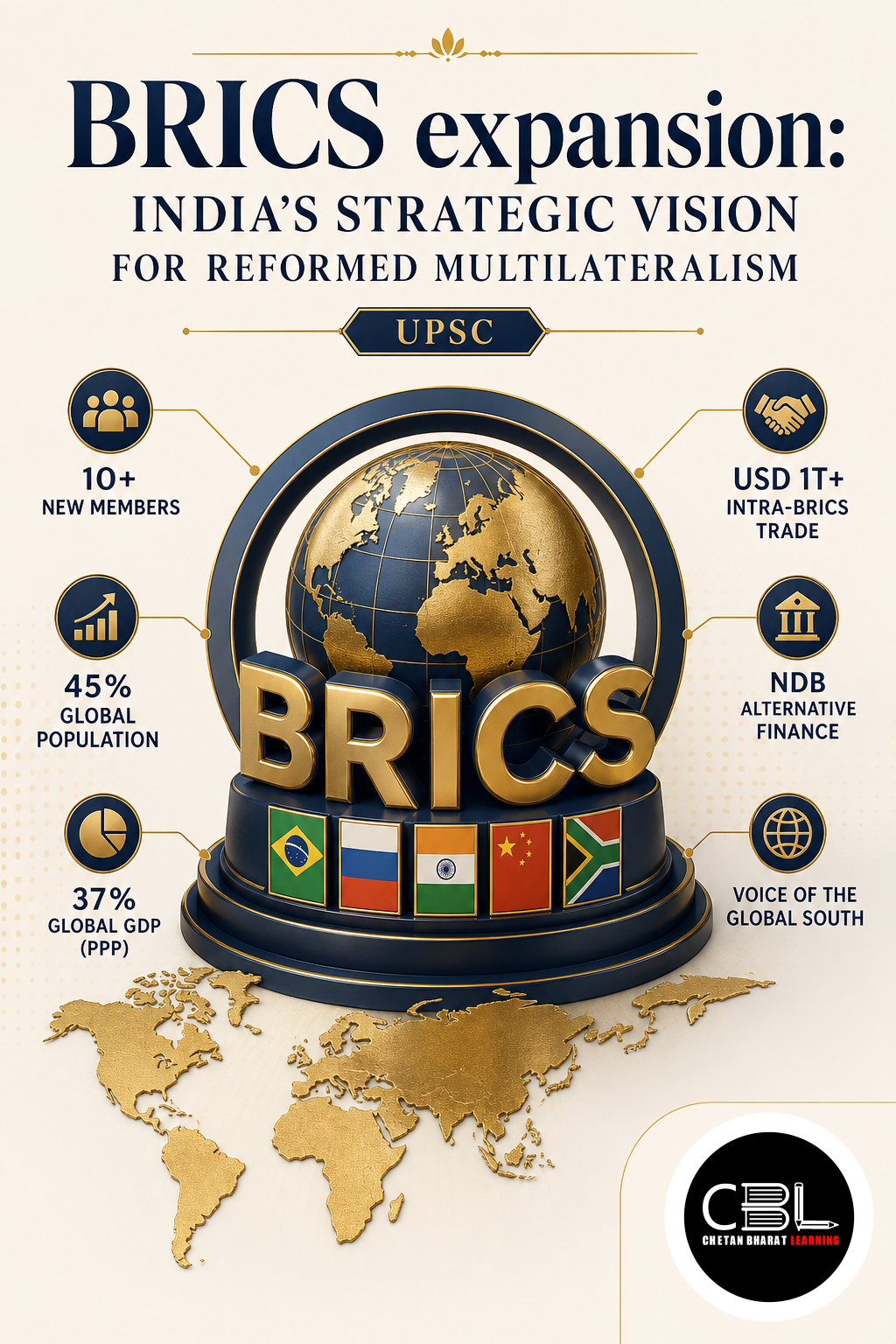
The BRICS expansion refers to the strategic inclusion of new member states into the original bloc of Brazil, Russia, India, China, and South Africa. Originally formed to advocate for the reform of global financial and political institutions, the grouping has grown substantially. The addition of nations like Egypt, Ethiopia, Iran, Saudi Arabia, the UAE, and Indonesia transforms its demographic and economic weight. This enlargement aims to create a more representative platform for developing nations.
However, this growth is not merely numerical. It fundamentally shifts the geopolitical orientation of the organization. While India has consistently favored reforming the existing international order, other members have viewed the bloc as a mechanism to counterbalance Western dominance. The BRICS expansion thus represents a critical juncture where the grouping must define its core identity and strategic objectives.
Why is BRICS Expansion in News?
The recent inclusion of multiple new members has sparked intense diplomatic discussions regarding the future trajectory of the alliance. China strongly pushed for this rapid enlargement and the concurrent expansion of the New Development Bank, despite initial reservations from India. This divergence highlights differing strategic priorities within the grouping. You can verify India’s official diplomatic stance through the MEA official statements on multilateral cooperation.
Furthermore, the expansion has brought nations with existing bilateral disputes into the same forum. This introduces new layers of complexity to consensus-building. India has explicitly articulated that the bloc must remain a non-West platform rather than evolving into an anti-West ideological bloc. The current discourse revolves around how India can leverage its leadership role to maintain internal stability and foster genuine cooperation among middle-power countries.
Key Features of BRICS Expansion
- Enhanced Economic Weight: The inclusion of major energy producers and emerging markets significantly boosts the collective GDP and resource control of the grouping.
- Geographic Diversity: New members from the Middle East, Africa, and Southeast Asia provide a truly global footprint for the organization.
- Institutional Growth: The expansion is accompanied by efforts to strengthen the New Development Bank as an alternative source of infrastructure financing.
- Focus on Reformed Multilateralism: India advocates for using this enlarged platform to push for structural reforms in the UN Security Council and Bretton Woods institutions.
- Strategic Autonomy: The grouping emphasizes the right of member states to pursue independent foreign policies without aligning strictly with any major power bloc.
Challenges in BRICS Expansion
Despite its ambitious scope, the BRICS expansion faces several structural and geopolitical hurdles that require careful diplomatic navigation.
- Internal Cohesion: The influx of new members with diverse geopolitical priorities and bilateral disputes complicates the process of reaching unanimous consensus.
- Divergent Strategic Visions: China’s desire to counterbalance Western influence often clashes with India’s preference for reforming existing multilateral institutions.
- Institutional Overstretch: Rapid enlargement risks diluting the effectiveness of the New Development Bank and other cooperative mechanisms.
- Identity Crisis: There is a persistent risk of the grouping transforming from a constructive economic forum into a polarized anti-Western ideological bloc.
- Coordination Deficits: Managing the logistical and diplomatic complexities of a much larger summit requires robust institutional frameworks that are currently underdeveloped.
Addressing these bottlenecks requires proactive diplomatic engagement and sustained dialogue among all stakeholders. Aspirants should review our UPSC prelims strategy guide to understand how such international relations topics are frequently framed in examinations.
Way Forward
To maximize the strategic impact of the BRICS expansion, India must prioritize the revival of reformed multilateralism as the core agenda. New Delhi should actively leverage its relationships with countries like Brazil and South Africa to build consensus on moderate, constructive goals. Focusing on tangible areas of cooperation, such as climate finance, digital public infrastructure, and supply chain resilience, will yield practical benefits for all members.
Moreover, establishing clear criteria for future expansions and dispute resolution mechanisms will enhance the grouping’s long-term viability. The NITI Aayog has consistently emphasized the importance of India leading Global South initiatives. This comprehensive strategy will ultimately ensure that the expanded bloc serves as a stabilizing force in the global order rather than a source of fragmentation.
Prelims Practice Corner
Q1. Consider the following statements regarding BRICS expansion:
1. It aims to strengthen the collective voice of the Global South.
2. India views the bloc primarily as an anti-West ideological platform.
Which of the statements given above is/are correct?
(a) 1 only (b) 2 only (c) Both 1 and 2 (d) Neither 1 nor 2
Answer: (a) India explicitly wants BRICS to remain a non-West platform, not an anti-West ideological bloc.
Q2. Which of the following countries was recently added to the BRICS grouping?
(a) Turkey (b) Indonesia (c) Argentina (d) Nigeria
Answer: (b) Indonesia is among the new members, alongside Egypt, Ethiopia, Iran, Saudi Arabia, and the UAE.
Q3. What is the primary financial institution associated with the BRICS grouping?
(a) Asian Infrastructure Investment Bank (b) New Development Bank (c) World Bank (d) Asian Development Bank
Answer: (b) The New Development Bank serves as the primary financial institution for infrastructure financing within BRICS.
Q4. How does China’s approach to BRICS differ from India’s, according to the text?
(a) China opposes the New Development Bank (b) China views it as a mechanism to counterbalance Western dominance (c) China wants to reduce the number of members (d) China supports UNSC reform for India
Answer: (b) China increasingly views BRICS as a mechanism to counterbalance Western dominance, unlike India’s focus on reformed multilateralism.
Q5. Which original BRICS member has often cooperated with India and South Africa on reforming multilateral institutions?
(a) Russia (b) China (c) Brazil (d) None of the above
Answer: (c) India, Brazil, and South Africa have often cooperated on the reform of multilateral institutions.
Mains Practice Questions
Q1. Discuss the strategic implications of BRICS expansion for India’s foreign policy and its vision for global governance. (150 words, 10 marks)
Answer Structure:
- Intro: Briefly introduce the recent BRICS expansion and India’s historical stance on the grouping.
- Body: Implications (enhanced Global South representation, economic opportunities via NDB); Challenges (internal cohesion, divergent visions with China, risk of anti-West polarization); India’s vision (reformed multilateralism, strategic autonomy).
- Conclusion: Emphasize India’s role in steering the expanded bloc toward constructive, consensus-driven global governance.
Q2. ‘BRICS must remain a platform for reformed multilateralism rather than an anti-West bloc.’ Critically examine this statement in the context of recent geopolitical shifts. (250 words, 15 marks)
Answer Structure:
- Intro: Contextualize the original purpose of BRICS and the recent rapid expansion of its membership.
- Body: Arguments for reformed multilateralism (strengthening UN/WTO, inclusive growth, Global South voice); Risks of anti-West bloc formation (China’s strategic push, bilateral disputes among new members, dilution of core objectives); India’s balancing act (maintaining ties with West while leading Global South).
- Conclusion: Summarize that India must actively champion moderate, constructive agendas to prevent the grouping’s ideological polarization.
FAQs on BRICS Expansion
What is the primary objective of BRICS expansion?
The primary objective is to create a more representative platform for developing nations, thereby strengthening the collective voice of the Global South in reforming global financial and political institutions.
How does India’s vision for BRICS differ from China’s?
India favors using BRICS to reform existing multilateral institutions like the UN and Bretton Woods systems. Conversely, China increasingly views the bloc as a mechanism to counterbalance Western dominance and create alternative geopolitical structures.
What challenges does the new BRICS expansion face?
The expansion faces challenges such as maintaining internal cohesion among diverse members, resolving bilateral disputes, preventing institutional overstretch of the New Development Bank, and avoiding transformation into a polarized anti-Western bloc.
Related Current Affairs
Preparing for UPSC, PCS or HCS?
Talk to a mentor at Chetan Bharat Learning, Chandigarh. Free guidance on choosing the right exam and building a study plan.
Chat on WhatsAppCall 97793 53345UPSC / IAS / PCS coaching in Chandigarh · Trusted by aspirants across Punjab & Haryana
Leave a Reply
You must be logged in to post a comment.