

UPSC Mapping
| Prelims | Mains |
|---|---|
| Science & Tech | GS Paper 3 |
Quick Facts
| Predicted By | QED |
|---|---|
| Observed Around | Magnetars |
| Satellite | IXPE |
| Key Effect | Polarisation Change |
What is Vacuum Birefringence?
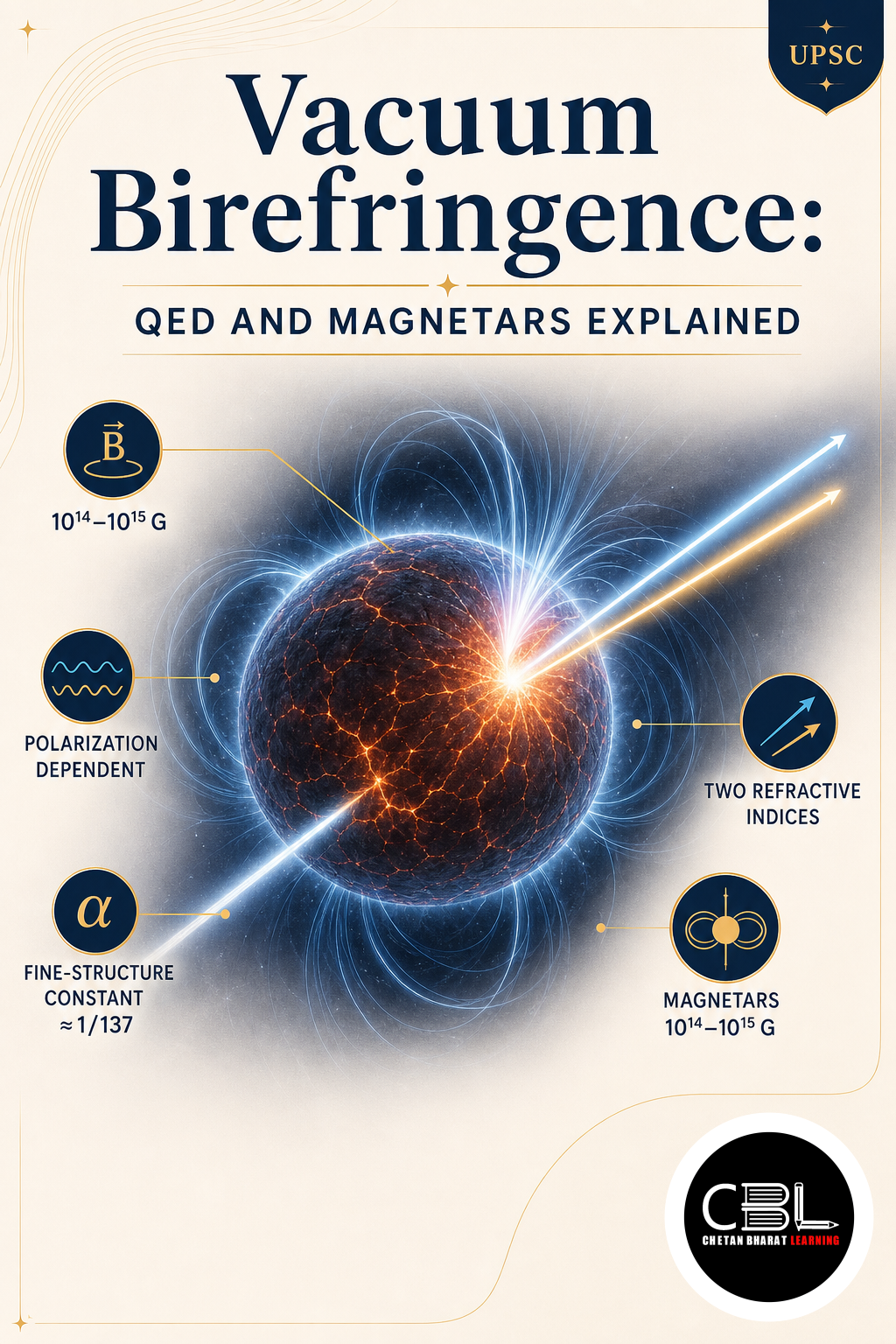
Vacuum Birefringence is a phenomenon in which vacuum behaves like a birefringent medium under an extremely strong electromagnetic field. In ordinary understanding, vacuum is treated as empty space through which light travels without alteration. However, Quantum Electrodynamics predicts that intense magnetic fields can modify how light propagates through vacuum.
In normal birefringent materials, different polarisation components of light travel at different speeds because they experience different refractive indices. Similarly, under very strong electromagnetic fields, even vacuum may cause different polarisation components of light to behave differently. This leads to a measurable change in the light’s polarisation.
The explanation lies in the quantum nature of vacuum. According to QED, vacuum is not truly empty but filled with fleeting virtual particle–antiparticle pairs. Extremely strong magnetic fields can influence these virtual particles, producing non-linear optical properties in what appears to be empty space.
Why is Vacuum Birefringence in News?
Scientists are currently studying whether a magnetar can provide direct evidence for Vacuum Birefringence. Magnetars are dead stars with extraordinarily powerful magnetic fields, making them natural laboratories for testing predictions of Quantum Electrodynamics. Their extreme environments cannot be recreated easily in Earth-based laboratories.
The IXPE satellite, or Imaging X-ray Polarimetry Explorer, had already hinted at possible evidence of Vacuum Birefringence around the magnetar 4U 0142+61 in 2022. Such observations involve studying how X-ray light from magnetars becomes polarised while passing through extremely strong magnetic fields.
The renewed scientific interest is important because confirmation would strongly support QED in extreme-field conditions. It would also help scientists understand the behaviour of light, matter and vacuum under conditions far beyond ordinary terrestrial physics. For UPSC aspirants, the topic is relevant for concepts linking quantum physics, space science and observational astronomy.
Key Features
- Quantum Prediction: It is predicted by Quantum Electrodynamics, the theory describing interactions between light and charged particles.
- Vacuum Effect: It shows that vacuum can behave like an optical medium under extremely strong electromagnetic fields.
- Polarisation Change: Different polarisation components of light experience slightly different refractive indices.
- Magnetar Link: Magnetars possess magnetic fields strong enough to make this effect potentially observable.
- Astrophysical Evidence: X-ray polarimetry from satellites like IXPE can provide indirect observational evidence.
Challenges
- Weak Signal: The change in light polarisation is extremely small and difficult to isolate from other astrophysical effects.
- Extreme Conditions: The required magnetic field strengths are generally found only near compact objects like magnetars.
- Instrument Sensitivity: Observatories need advanced X-ray polarimeters capable of measuring tiny polarisation changes accurately.
- Data Interpretation: Scientists must distinguish Vacuum Birefringence from plasma effects, scattering and emission mechanisms near stars.
- Limited Sources: Only a small number of suitable magnetars are observable with adequate signal quality.
Way Forward
Future confirmation of Vacuum Birefringence will require more precise X-ray polarimetry missions and repeated observations of magnetars. Scientists must combine astronomical data with advanced theoretical modelling to isolate the quantum vacuum effect from other distortions. Better instruments will significantly improve confidence in interpreting polarisation signals.
India can benefit from strengthening research in quantum optics, high-energy astrophysics and space instrumentation. Collaborations between institutions working on quantum technologies and astronomy can create new research opportunities. A coordinated Department of Science and Technology approach can support advanced training in fundamental physics and observational astronomy.
In the long term, such research enhances scientific capacity beyond immediate applications. It improves our understanding of the universe, validates fundamental theories and supports the development of sensitive measurement technologies. For India, building expertise in this area also complements the National Quantum Mission and space science programmes.
Prelims Practice Corner
-
Q1. Vacuum Birefringence is primarily predicted by which theory?
- (a) General Relativity
- (b) Quantum Electrodynamics
- (c) Plate Tectonics
- (d) Classical Thermodynamics
Answer: (b) Quantum Electrodynamics predicts that vacuum can behave like a birefringent medium under extremely strong electromagnetic fields.
-
Q2. Magnetars are important for studying this phenomenon because they possess:
- (a) Very weak gravitational fields
- (b) Extremely strong magnetic fields
- (c) Thick atmospheres similar to Earth
- (d) Liquid water oceans
Answer: (b) Magnetars have extraordinarily strong magnetic fields, making them natural laboratories for testing Vacuum Birefringence.
-
Q3. Which satellite hinted at Vacuum Birefringence around magnetar 4U 0142+61?
- (a) IXPE
- (b) Chandrayaan-3
- (c) AstroSat
- (d) Voyager 2
Answer: (a) The Imaging X-ray Polarimetry Explorer, or IXPE, hinted at this phenomenon in 2022.
-
Q4. In Vacuum Birefringence, what property of light is mainly altered?
- (a) Electrical resistance
- (b) Polarisation
- (c) Chemical composition
- (d) Radioactivity
Answer: (b) Different polarisation components of light experience slightly different refractive indices, changing the light’s polarisation.
-
Q5. Why is confirmation of Vacuum Birefringence scientifically significant?
- (a) It would prove that sound travels through vacuum
- (b) It would support QED and the quantum nature of vacuum
- (c) It would disprove magnetism
- (d) It would confirm life on neutron stars
Answer: (b) Its detection would provide strong evidence for Quantum Electrodynamics and the quantum nature of vacuum.
Mains Practice Questions
Q1. Explain the concept of Vacuum Birefringence and discuss why magnetars are considered natural laboratories for testing predictions of Quantum Electrodynamics. (150 words)
Answer Structure:
- Intro: Define Vacuum Birefringence as a QED-predicted phenomenon where vacuum behaves like an optical medium under extreme electromagnetic fields.
- Body: Explain virtual particle–antiparticle pairs, polarisation changes and why magnetars provide extremely strong magnetic fields unavailable in laboratories.
- Conclusion: Conclude that its detection would validate fundamental physics in extreme astrophysical conditions.
Q2. Space-based observatories are expanding the frontiers of fundamental physics. Discuss with reference to X-ray polarimetry and compact astrophysical objects. (150 words)
Answer Structure:
- Intro: Mention how space observatories study phenomena impossible to recreate on Earth.
- Body: Discuss IXPE, magnetars, polarisation data and testing of quantum theories like QED under extreme magnetic fields.
- Conclusion: Link advanced space instrumentation with scientific capability-building and future quantum research.
FAQs on Vacuum Birefringence
What does Vacuum Birefringence mean?
It means vacuum behaves like a birefringent optical medium under extremely strong electromagnetic fields. Different polarisation components of light experience slightly different refractive indices, changing the light’s polarisation.
Why are magnetars useful for studying this phenomenon?
Magnetars have extraordinarily strong magnetic fields, far stronger than anything easily produced on Earth. These fields can make subtle quantum vacuum effects observable through X-ray polarisation measurements.
Why would its detection be important?
Detection would provide strong evidence for Quantum Electrodynamics in extreme-field conditions. It would also confirm that vacuum has measurable quantum properties rather than being completely empty space.
Related Current Affairs
Preparing for UPSC, PCS or HCS?
Talk to a mentor at Chetan Bharat Learning, Chandigarh. Free guidance on choosing the right exam and building a study plan.
Chat on WhatsAppCall 97793 53345UPSC / IAS / PCS coaching in Chandigarh · Trusted by aspirants across Punjab & Haryana
Leave a Reply
You must be logged in to post a comment.