

UPSC Mapping
| Prelims | Economy |
|---|---|
| Mains | GS Paper 3 |
Article
What is Grain Storage Plan?
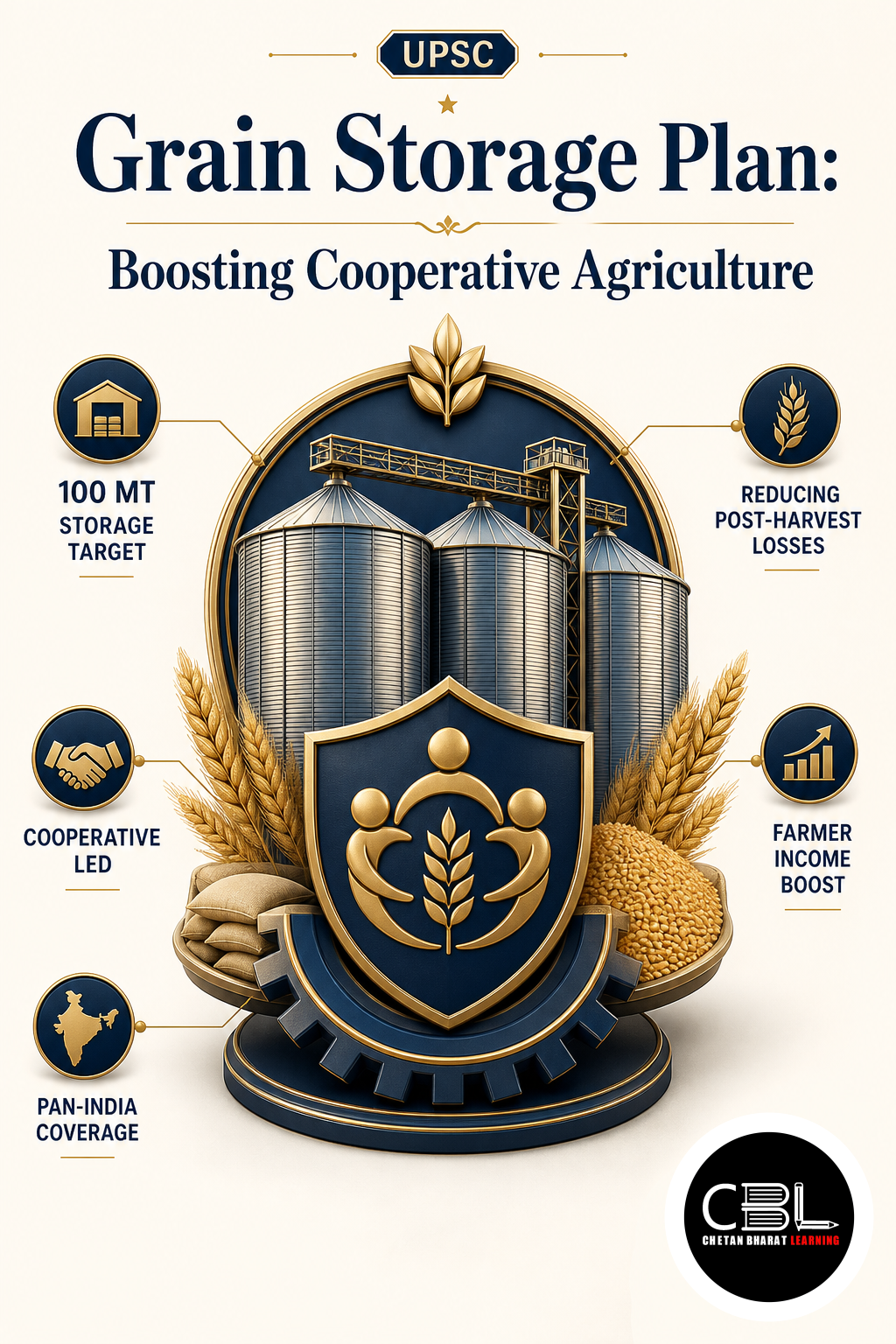
The Grain Storage Plan represents a strategic push to create integrated agricultural infrastructure at the village level. Primary Agricultural Credit Societies manage these decentralized facilities to provide essential financial and storage services. This process completely eliminates the need for farmers to transport produce to distant centralized warehouses immediately.
This initiative primarily operates through the convergence of four major central agricultural schemes, including the Agriculture Infrastructure Fund and the Agricultural Marketing Infrastructure scheme. The government aims to establish a complete ecosystem covering modern silos, custom hiring centres, and primary processing units.
Industry experts consider decentralized storage the cornerstone of future rural economic empowerment and food security globally. Heavy reliance on centralized state procurement creates massive logistical bottlenecks and transport losses across long distances. Replacing distant storage with localized village infrastructure provides the only viable pathway to eliminate stubborn post-harvest losses entirely.
Why is Grain Storage Plan in News?
The Ministry recently highlighted substantial progress in expanding the Grain Storage Plan across multiple states. Over three hundred Primary Agricultural Credit Societies have successfully completed modern godown construction recently. A recent PIB release detailed the creation of massive decentralized storage capacity under this framework.
Record national foodgrain production estimates simultaneously highlight the urgent need for expanded rural storage infrastructure. Global supply chain disruptions continue to emphasize the critical necessity of domestic food buffer stocks. Expanding the Grain Storage Plan further remains crucial for scaling up decentralized cooperative operations rapidly.
Key Features
The comprehensive Grain Storage Plan framework introduces several targeted interventions to stimulate rapid sectoral growth.
- Scheme Convergence: Integrates funding from four major central agricultural schemes to maximize resource utilization.
- Financial Incentives: Participating cooperatives receive enhanced capital subsidies and highly concessional effective interest rates around one percent.
- Infrastructure Integration: Establishes modern silos alongside custom hiring centres and fair price shops at the village level.
- Quality Assurance: All constructed storage structures must comply with Warehousing Development and Regulatory Authority norms.
- Institutional Oversight: District and state cooperative committees meticulously evaluate and approve participating village-level institutions.
Challenges
Implementing the Grain Storage Plan across remote rural areas faces several critical hurdles within the current cooperative structure.
- Land Acquisition: Securing owned land or negotiating long-term twenty-year leases remains a persistent logistical challenge for many societies.
- Credit Access: Smaller village cooperatives frequently struggle to secure the remaining upfront capital despite generous central financial assistance.
- Maintenance Deficits: Rural institutions often lack the technical expertise to manage advanced modern silos and mechanical drying equipment.
- Digital Integration: Connecting thousands of decentralized village godowns to the central national food security grid requires massive IT upgrades.
- Financial Viability: Generating sufficient operational revenue to sustain the infrastructure without perpetual state subsidies challenges many weaker societies.
Way Forward
The government must aggressively pursue technological partnerships to localize advanced grain preservation and moisture control capabilities. Establishing specialized training programs will rapidly bridge existing skill gaps in rural cooperative management. A comprehensive NCDC strategy should also prioritize digital integration to connect village silos directly with national procurement portals.
Developing robust market linkages will provide initial revenue certainty for participating cooperatives. Simultaneously, policymakers must streamline regulatory approvals for establishing primary processing and value-addition units nationwide. Long-term success ultimately depends on transforming these storage facilities into profitable, self-sustaining rural agribusiness hubs.
Prelims Practice Corner
Q1. Which institution acts as the primary implementing agency for this cooperative initiative?
- a) Food Corporation of India
- b) National Cooperative Development Corporation
- c) NABARD
- d) NITI Aayog
Answer: The National Cooperative Development Corporation coordinates implementation through state and district committees.
Q2. What is the effective interest rate for participating cooperatives under the converged financial support?
- a) 3%
- b) 5%
- c) 1%
- d) 7%
Answer: Combining NABARD refinance with AIF interest subvention reduces the effective loan interest rate to 1%.
Q3. Which authority sets the quality and safety norms for the constructed storage structures?
- a) FSSAI
- b) Warehousing Development and Regulatory Authority
- c) Bureau of Indian Standards
- d) FCI
Answer: Storage structures must strictly comply with the norms established by the Warehousing Development and Regulatory Authority.
Q4. If a Primary Agricultural Credit Society uses leased land for construction, what is the minimum lease period required?
- a) 5 years
- b) 10 years
- c) 15 years
- d) 20 years
Answer: The guidelines mandate a minimum lease period of more than 20 years if the society does not own the land.
Q5. Which of the following facilities is NOT explicitly integrated at the village level under this framework?
- a) Custom Hiring Centres
- b) Fair Price Shops
- c) Large-scale ethanol refineries
- d) Primary processing units
Answer: The plan integrates silos, hiring centres, fair price shops, and primary processing, but not large-scale ethanol refineries.
Mains Practice Questions
Q1. Discuss the potential of decentralized cooperative storage in reducing post-harvest losses and improving farmer incomes. What are the key infrastructural bottlenecks hindering its immediate success? (250 words)
Answer Structure:
- Intro: Define the initiative and its objective to shift from centralized FCI godowns to village-level PACS infrastructure.
- Body: Discuss potential in reducing transport losses, enabling local procurement, and providing rental machinery. Highlight bottlenecks like land acquisition hurdles, maintenance deficits, and digital integration challenges.
- Conclusion: Emphasize the need for specialized skilling and technological upgrades to ensure commercial viability of rural cooperatives.
Q2. The convergence of multiple agricultural schemes is crucial for the financial viability of rural infrastructure projects. Analyze this statement in the context of cooperative credit societies. (150 words)
Answer Structure:
- Intro: Explain the concept of scheme convergence combining AIF, AMI, SMAM, and PMFME to reduce capital burden.
- Body: Link enhanced subsidies and 1% effective interest rates to the de-risking of private cooperative investments. Discuss how integrated facilities create multiple revenue streams for PACS.
- Conclusion: Conclude that a unified financial framework acts as the foundational launchpad for transforming PACS into profitable agribusiness hubs.
FAQs on Grain Storage Plan
What is the main role of Primary Agricultural Credit Societies in this initiative?
PACS act as the foundational village-level institutions that own, manage, and operate the decentralized storage and processing facilities. They also facilitate short-term credit and grain procurement for state agencies.
How does the scheme ensure financial support for participating cooperatives?
The initiative converges multiple central schemes to provide enhanced capital subsidies and reduce margin money requirements. Combined with interest subventions, this lowers the effective loan interest rate to just 1%.
Why is decentralized storage preferred over centralized FCI godowns?
Decentralized storage at the village level drastically reduces transportation costs and post-harvest spoilage. It also empowers local farmers to store produce and sell when market prices are more favorable.
Related Current Affairs
Preparing for UPSC, PCS or HCS?
Talk to a mentor at Chetan Bharat Learning, Chandigarh. Free guidance on choosing the right exam and building a study plan.
Chat on WhatsAppCall 97793 53345UPSC / IAS / PCS coaching in Chandigarh · Trusted by aspirants across Punjab & Haryana
Leave a Reply
You must be logged in to post a comment.