
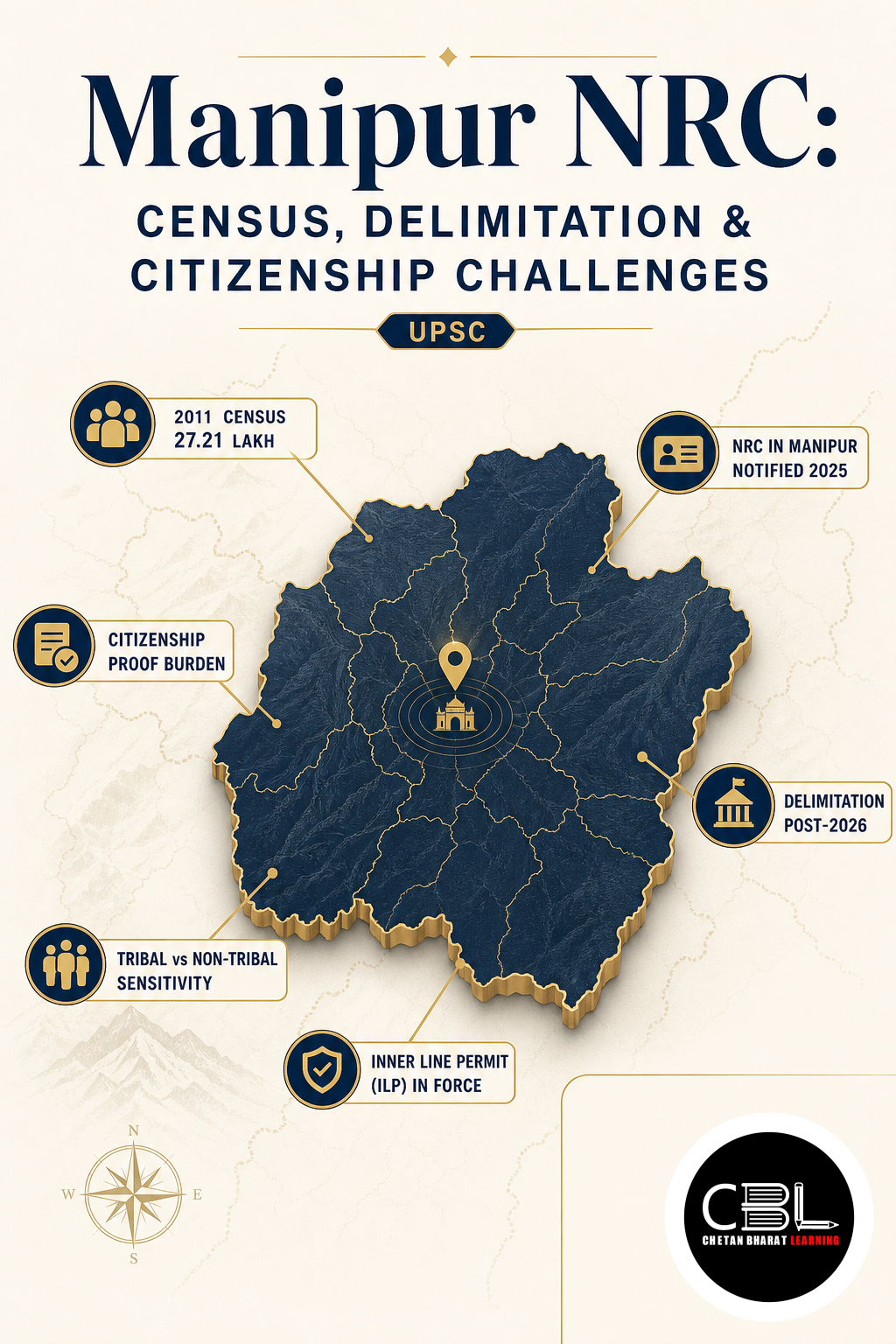

UPSC Mapping
| Exam | Syllabus |
|---|---|
| Prelims | Polity and Governance |
| Mains | GS Paper 2 (Polity) |
| Item | Purpose |
|---|---|
| Census Purpose | Population enumeration |
| NRC Purpose | Citizenship determination |
| Delimitation Purpose | Constituency redrawing |
Article
The Manipur NRC demand has become intricately linked with the ongoing national Census exercise. This convergence raises complex administrative and socio-political questions for the region. Aspirants must thoroughly understand this dynamic for the upcoming civil services examination. You can explore more such vital topics in our daily current affairs archive. This situation highlights the delicate balance between population enumeration and citizenship verification. It demands a nuanced approach to internal security and governance.
What is the Manipur NRC?
The concept of a Manipur NRC refers to the proposed creation of a National Register of Citizens specifically for the state. Civil-society groups demand this mechanism to identify genuine Indian citizens and regulate cross-border migration. The national Census enumerates the entire resident population regardless of their citizenship status. Conversely, the NRC is intended strictly to determine and register legal Indian citizens. Delimitation uses this population data to redraw constituencies and determine political representation. These three exercises possess entirely distinct constitutional purposes and separate legal frameworks.
Historically, the Census has functioned as a purely demographic exercise without citizenship verification. Introducing citizenship checks into this process fundamentally alters its administrative scope. The demand for a state-specific register stems from deep-seated anxieties over demographic changes. Local communities fear that unchecked migration dilutes their indigenous identity and political representation. The institutional framework requires absolute clarity to prevent the conflation of these distinct administrative tasks.
Why is the Manipur NRC in News?
The Manipur NRC discourse recently gained prominence as the Centre prepared for the upcoming Census exercise. Various civil-society groups have raised urgent concerns regarding migration and the identification of citizens. Manipur shares a porous international boundary with Myanmar, making migration and border management politically sensitive. You can verify the latest administrative guidelines on the MHA portal. The issue directly affects debates over population composition, land rights, and indigenous identity.
Furthermore, recent political developments have linked the Census directly to future delimitation exercises. Communities fear that population enumeration without prior citizenship verification will skew electoral boundaries. This perception has fueled demands to halt the Census until a comprehensive citizenship register exists. Policymakers view this linkage as a potential trigger for severe administrative delays and social unrest. The government must navigate these demands while upholding constitutional mandates for regular population counts.
Key Features of the Manipur NRC Debate
The framework surrounding the Manipur NRC debate incorporates several critical administrative and legal dimensions.
- Distinct Constitutional Purposes: The Census counts people, the NRC verifies citizenship, and delimitation redraws electoral boundaries independently.
- Border State Sensitivity: Manipur’s international boundary with Myanmar makes migration a highly volatile political and security issue.
- Indigenous Identity Protection: Local groups seek the register to safeguard demographic composition and protect native land rights.
- Separate Legal Frameworks: There is no general constitutional rule requiring an NRC completion before every Census exercise.
- Civil Society Engagement: The debate heavily involves local stakeholders demanding transparency and participation in the verification process.
This comprehensive structure ensures that various stakeholders can understand the specific scope of each exercise. The emphasis on distinct purposes distinguishes the Census from citizenship verification initiatives. By clarifying these boundaries, the policy fosters informed public discourse. The institutional framework relies heavily on the Registrar General of India. This office maintains strict protocols to ensure the Census remains a demographic tool.
Challenges in Manipur NRC Implementation
Despite clear distinctions, the Manipur NRC demand faces several structural and operational hurdles requiring immediate attention.
- Wrongful Exclusion Risks: Marginalized communities often lack proper documentation, leading to potential exclusion from the citizen register.
- Documentation Difficulties: Generational poverty and displacement make producing legacy documents extremely challenging for many residents.
- Ethnic Polarisation: The process risks deepening existing ethnic fault lines and triggering severe communal unrest across the state.
- Administrative Burden: Conducting a state-specific register requires massive logistical coordination and diverts resources from other governance priorities.
- Legal Ambiguity: The absence of a uniform national legal framework for state-specific registers creates procedural confusion.
Addressing these bottlenecks is crucial for long-term social stability and administrative credibility. Aspirants can study related governance issues in our polity current affairs updates. Policymakers must remain vigilant against the weaponization of citizenship verification for political gains. The verification of legacy documents requires robust, empathetic, and transparent mechanisms. Introducing comprehensive legal aid for vulnerable populations will help alleviate some of these operational difficulties significantly.
Way Forward for Manipur NRC
To address the Manipur NRC complexities, the government must prioritize clear, non-discriminatory legal criteria. Establishing transparent verification processes with robust appeal mechanisms is absolutely vital for public trust. Strengthening the administrative capacity of local authorities will ensure fair and accurate data collection. Policymakers should actively engage with civil-society groups to build consensus and reduce ethnic tensions. For detailed legislative analysis on citizenship laws, refer to the PRS Legislative Research database.
A balanced approach requires separating the Census exercise from citizenship verification entirely. The government must communicate this distinction clearly to prevent public misinformation and panic. Continuous academic research will further refine the operational guidelines for border management. Future iterations of citizenship policy must remain adaptable to the unique socio-cultural realities of border states. Protecting indigenous rights must go hand-in-hand with upholding constitutional due process.
Prelims Practice Corner
Question 1
With reference to the Census and NRC, consider the following statements:
1. The Census enumerates the population regardless of citizenship status.
2. The NRC is intended to determine and register Indian citizens.
3. The Constitution mandates an NRC before every Census exercise.
Which of the statements given above is/are correct?
(a) 1 only (b) 1 and 2 only (c) 2 and 3 only (d) 1, 2 and 3
Answer: (b) Statement 3 is incorrect because there is no constitutional rule requiring an NRC before every Census.
Question 2
Manipur shares an international boundary with which country, making migration a sensitive issue?
(a) Bangladesh (b) Myanmar (c) Bhutan (d) Nepal
Answer: (b) Manipur shares a porous international boundary with Myanmar, complicating border management.
Question 3
What is the primary purpose of the delimitation exercise?
(a) To verify the citizenship status of all residents
(b) To redraw constituencies and determine political representation
(c) To count the total number of households
(d) To issue Aadhaar cards to rural populations
Answer: (b) Delimitation uses population data to redraw constituencies and determine political representation.
Question 4
Which of the following is a major challenge in implementing a state-specific citizenship register?
(a) Lack of digital infrastructure for Census
(b) Wrongful exclusion risks due to documentation difficulties
(c) Absence of any legal framework for Census
(d) Overpopulation in urban centers
Answer: (b) Marginalized communities often lack proper documentation, leading to potential exclusion from the citizen register.
Question 5
Consider the following distinct exercises: 1. Census 2. NRC 3. Delimitation. Which of these are constitutionally distinct with separate purposes?
(a) 1 and 2 only (b) 2 and 3 only (c) 1 and 3 only (d) 1, 2 and 3
Answer: (d) All three are separate exercises with distinct constitutional purposes and legal frameworks.
Mains Practice Questions
Question 1
Discuss the distinction between the Census, NRC, and delimitation exercises. Why is conflating them problematic? (150 words, 10 marks)
Answer Structure:
- Intro: Briefly define the three distinct exercises and their primary constitutional purposes.
- Body: Explain the distinction (Census for enumeration, NRC for citizenship, delimitation for representation) and the problems of conflation (administrative delays, ethnic polarization, wrongful exclusion).
- Conclusion: Emphasize the need for clear legal frameworks and transparent communication to maintain public trust.
Question 2
The demand for a state-specific citizenship register in border states like Manipur presents unique administrative and social challenges. Critically analyze. (250 words, 15 marks)
Answer Structure:
- Intro: Contextualize the demand within the broader framework of border management and indigenous identity protection.
- Body: Analyze administrative challenges (documentation difficulties, logistical burden) and social challenges (ethnic polarization, wrongful exclusion risks). Discuss the need for balancing security concerns with constitutional due process.
- Conclusion: Conclude that a balanced approach requires clear legal criteria, robust appeal mechanisms, and non-discriminatory safeguards.
FAQs on Manipur NRC
What is the difference between the Census and the NRC?
The Census enumerates the entire resident population regardless of citizenship status for demographic planning. The NRC is specifically intended to determine and register legal Indian citizens based on documentary evidence.
Is an NRC required before conducting a Census?
No, there is no general constitutional rule or legal mandate requiring an NRC to be completed before every Census exercise. They are separate processes with distinct objectives.
Why is the citizenship issue particularly sensitive in Manipur?
Manipur shares a porous international boundary with Myanmar, making migration a highly volatile political issue. Local communities fear that unchecked migration dilutes their indigenous identity and political representation.
Related Current Affairs
Preparing for UPSC, PCS or HCS?
Talk to a mentor at Chetan Bharat Learning, Chandigarh. Free guidance on choosing the right exam and building a study plan.
Chat on WhatsAppCall 97793 53345UPSC / IAS / PCS coaching in Chandigarh · Trusted by aspirants across Punjab & Haryana
Leave a Reply
You must be logged in to post a comment.