
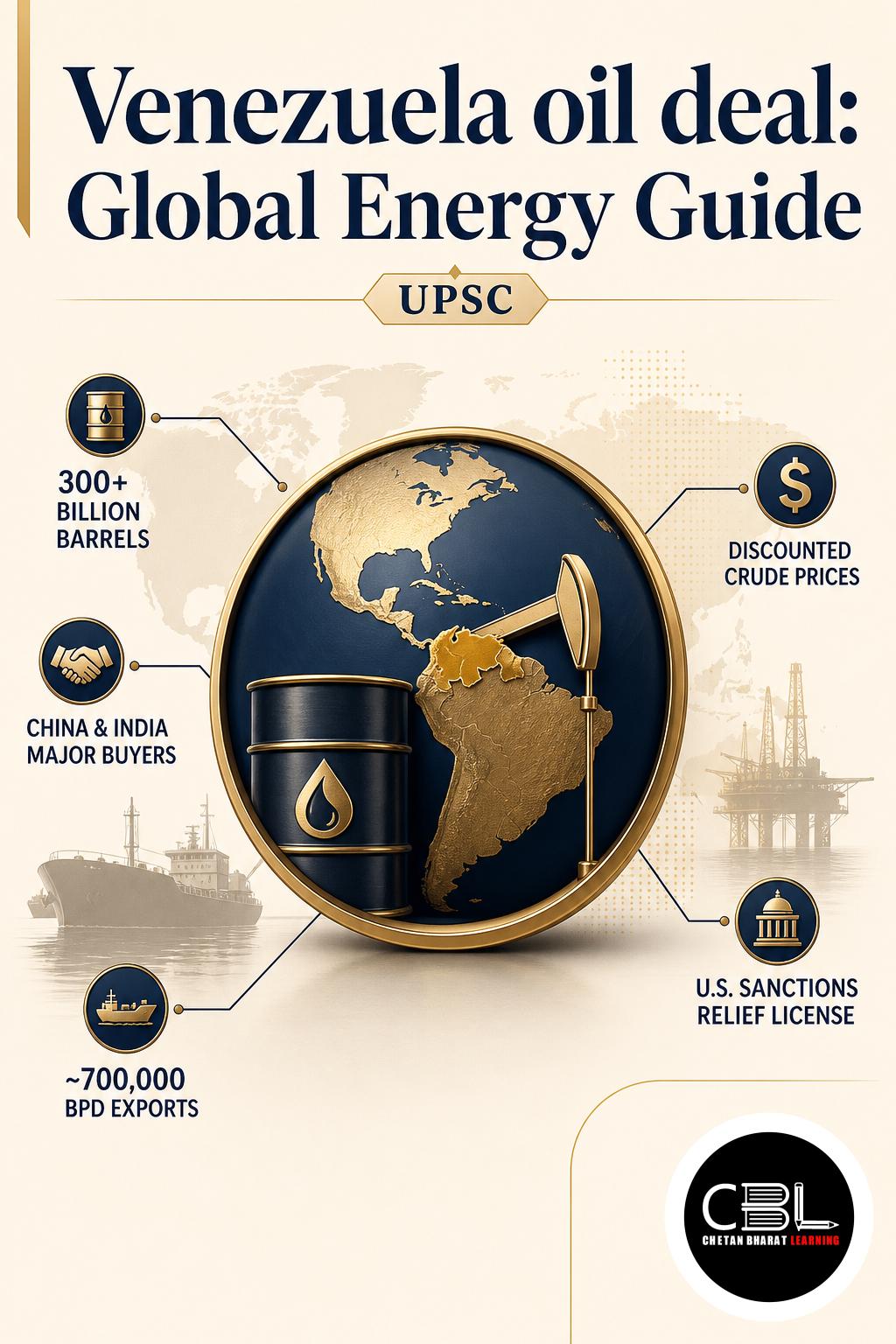

UPSC Mapping
Prelims
- International Relations
Mains
- GS Paper 2
Quick Facts
| Reserves Controlled | 65 Billion Barrels |
|---|---|
| Crude Type | Heavy Sour |
| Primary Driver | Refinery Economics |
| Geopolitical Target | China & Russia |
What is Venezuela oil deal?
The Venezuela oil deal represents a massive bilateral partnership granting American entities operational control over 20 per cent of proven reserves. Washington structured this agreement through a private consortium to develop 17 specific oil fields, deliberately bypassing direct taxpayer funding to secure these critical energy assets.
Unlike standard market purchases, this strategic pivot addresses a severe technical mismatch in domestic refining capabilities. American shale production yields light sweet crude, while Gulf Coast refineries require heavy sour crude. This structural dependency forces the world’s top producer to continuously import specific viscous grades.
The strategic pivot recognizes that controlling the underlying energy sources guarantees long-term national security. The government provides substantial financial incentives to domestic startups developing indigenous extraction technologies. Local engineers can now access advanced drilling tools through dedicated state-backed support mechanisms.
Why is Venezuela oil deal in News?
The Trump administration recently formalized this partnership following the capture of Nicolás Maduro in January 2026. The agreement projects over 100 billion dollars in private investment to rehabilitate dilapidated extraction infrastructure. You can review global energy statistics via the US Energy Information Administration portal for precise market data.
Simultaneously, the ongoing crisis around the Strait of Hormuz has effectively taken a large portion of traditional Gulf supplies offline. Securing alternative heavy crude sources drastically reduces American vulnerability to Middle Eastern chokepoint disruptions. Geopolitical analysts view this consensus as a vital tool to counter rival influence in Latin America.
The central administration recently launched dedicated initiatives to connect academic energy research directly with commercial refining requirements. This technological intervention will drastically reduce the historical gap between university laboratories and factory floors. Industry experts anticipate a massive surge in registered energy patents over the coming financial quarters.
Key Features
The current geopolitical landscape relies on several strategic mechanisms to enforce energy dominance and promote strategic resilience. Policymakers incorporated multiple safeguards to maintain the operational integrity of critical supply chains.
- Refinery Compatibility: The agreement secures the exact heavy sour crude required by complex Gulf Coast processing facilities.
- Geopolitical Containment: Washington explicitly designed this framework to displace growing Chinese and Russian investments in the region.
- Private Financing: A newly formed corporate consortium assumes the massive capital expenditure without burdening the national exchequer.
- Price Stabilization: Flooding the market with rehabilitated barrels helps suppress global inflation amid ongoing maritime conflicts.
Furthermore, the administration integrates advanced digital payment architectures to maintain absolute transparency during delicate financial interventions. This technological capability ensures seamless coordination during high-stakes emergency energy scenarios across the region. The robust command center allows naval officers to monitor multiple maritime operations simultaneously without losing valuable resources.
Challenges
Despite its strategic ambition, implementing the Venezuela oil deal faces several severe structural and political hurdles. Addressing these deep-rooted limitations remains crucial for maximizing actual economic outcomes across the region.
- Infrastructure Decay: Decades of mismanagement and sanctions left the national oil grid completely dilapidated and non-functional.
- Legal Ambiguity: The interim administration’s constitutional authority to sign long-term sovereign resource contracts remains highly contested.
- Massive Capital: Restoring historical production levels requires over 180 billion dollars spanning the next fifteen years.
- Domestic Resistance: Local political factions strongly oppose the perceived foreign colonization of their most valuable national assets.
You can explore similar geopolitical strategies in our international relations section for deeper insights. Furthermore, the immense financial burden of importing expensive foreign hardware strains the annual national exchequer significantly. Regular upgrades to the strategic petroleum reserves require massive sustained investments spanning multiple years before generating commercial returns.
Moreover, the highly seasonal nature of regional weather severely limits the continuous operational capacity of rural transit routes. Engineers must continuously develop specialized all-terrain vehicles to transport heavy drilling equipment during prolonged monsoons. The rigorous maintenance schedules often keep the extraction sites dormant for extended periods, reducing overall financial viability.
Way Forward
The international community must establish transparent regulatory frameworks to ensure that resource extraction benefits local populations. Reviving multilateral diplomatic frameworks remains the only viable method to stabilize this volatile energy market. Providing neutral mediation will drastically reduce the likelihood of catastrophic regional conflicts.
Check the latest IMF reports for strategic macroeconomic stabilization mandates. The global community must periodically review the baseline methodologies to ensure they reflect current maritime security realities. Continuous diplomatic engagement regarding the Venezuela oil deal will guarantee that the region avoids complete economic collapse.
State governments must actively align their local industrial policies with central guidelines to maximize regional synergies. Coordinated efforts between different administrative tiers will eliminate redundant paperwork for aspiring domestic manufacturers. This unified approach will significantly accelerate the continental transition towards a self-reliant economic powerhouse.
Policymakers must also focus heavily on creating a robust domestic market for alternative green technologies. Mandating the use of local components in government solar projects will guarantee initial demand for startups. This assured market access will provide the necessary confidence for private investors to fund ambitious renewable ventures.
Prelims Practice Corner
Q1. Which specific technical requirement drives the US demand for this particular crude grade?
- (a) Low sulphur content
- (b) Heavy sour viscosity
- (c) High API gravity
- (d) Low extraction cost
Answer: (b) Gulf Coast refineries were specifically built to process heavy sour crude.
Q2. What primary geopolitical objective does this specific agreement serve for Washington?
- (a) Funding space research
- (b) Countering Chinese and Russian influence
- (c) Promoting green energy
- (d) Isolating European allies
Answer: (b) The deal explicitly aims to displace rival investments and secure hemispheric dominance.
Q3. Which maritime chokepoint crisis accelerated the urgency of securing these alternative supplies?
- (a) Suez Canal
- (b) Bab-el-Mandeb
- (c) Strait of Hormuz
- (d) Malacca Strait
Answer: (c) The ongoing crisis around the Strait of Hormuz took traditional Gulf supplies offline.
Q4. How is the massive capital expenditure for this project primarily structured?
- (a) Direct US taxpayer funding
- (b) UN grants
- (c) Private consortium partnership
- (d) World Bank loans
Answer: (c) A private consortium assumes the capital expenditure without burdening the national exchequer.
Q5. What historical event originally crippled the South American nation’s oil output?
- (a) Earthquakes
- (b) Nationalization and underinvestment
- (c) Nuclear accidents
- (d) Trade unions
Answer: (b) Chávez-era nationalization and subsequent sanctions crippled the extraction infrastructure.
Mains Practice Questions
Q1. Discuss the intersection of refinery economics and geopolitical strategy in shaping global energy alliances. (10 marks)
Answer Structure
- Intro: Define the technical mismatch between domestic light sweet shale production and the heavy sour requirements of Gulf Coast refineries.
- Body: Explain how securing specific crude grades drives foreign policy, displaces rival investments, and stabilizes global prices amid maritime chokepoint disruptions.
- Conclusion: Conclude that modern energy diplomacy is fundamentally dictated by industrial infrastructure constraints rather than mere geographic proximity.
Q2. Securing critical energy resources often requires navigating complex domestic legal ambiguities and dilapidated infrastructure. Analyze. (15 marks)
Answer Structure
- Intro: Introduce the massive capital requirements and political risks associated with rehabilitating nationalized resource sectors.
- Body: Analyze the challenges of interim government legitimacy, the sheer scale of infrastructural decay requiring 180 billion dollars, and the threat of local political resistance.
- Conclusion: Suggest that establishing transparent multilateral regulatory frameworks is essential to protect private investments and ensure sustainable resource extraction.
FAQs on Venezuela oil deal
Why does the US import oil despite being the world’s largest producer?
The US shale revolution primarily produces light sweet crude, while its complex Gulf Coast refineries were historically built to process heavy sour grades. This technical mismatch forces the nation to export its domestic light crude while importing heavier varieties to maintain operational efficiency.
How does this deal impact global crude prices?
Rehabilitating these massive reserves could eventually flood the global market with millions of additional barrels per day. This increased supply would help suppress global inflation and counter the price spikes triggered by ongoing conflicts in the Middle East.
What are the primary risks for private investors in this region?
Investors face severe legal ambiguity regarding the interim government’s authority to sign binding contracts. Additionally, the sheer scale of infrastructure decay requires over 180 billion dollars and 15 years to restore historical production levels.
Related Current Affairs
Preparing for UPSC, PCS or HCS?
Talk to a mentor at Chetan Bharat Learning, Chandigarh. Free guidance on choosing the right exam and building a study plan.
Chat on WhatsAppCall 97793 53345UPSC / IAS / PCS coaching in Chandigarh · Trusted by aspirants across Punjab & Haryana
Leave a Reply
You must be logged in to post a comment.