
UPSC Mapping
- Prelims: Economy
- Mains: GS Paper 3
Quick Facts
| Indicator | Value |
|---|---|
| Q1 CAD Value | $4.2 Billion |
| CAD to GDP | 0.5 Per Cent |
| Trade Deficit | $86.1 Billion |
| Services Receipts | $51.6 Billion |
The widening Current Account Deficit reflects India’s growing merchandise imports despite robust domestic economic expansion. The Reserve Bank recently released quarterly data highlighting this crucial macroeconomic trend. Students can track similar updates in our daily current affairs archive regularly. Policymakers continuously monitor these external balances to ensure long-term national financial stability.
What is Current Account Deficit?
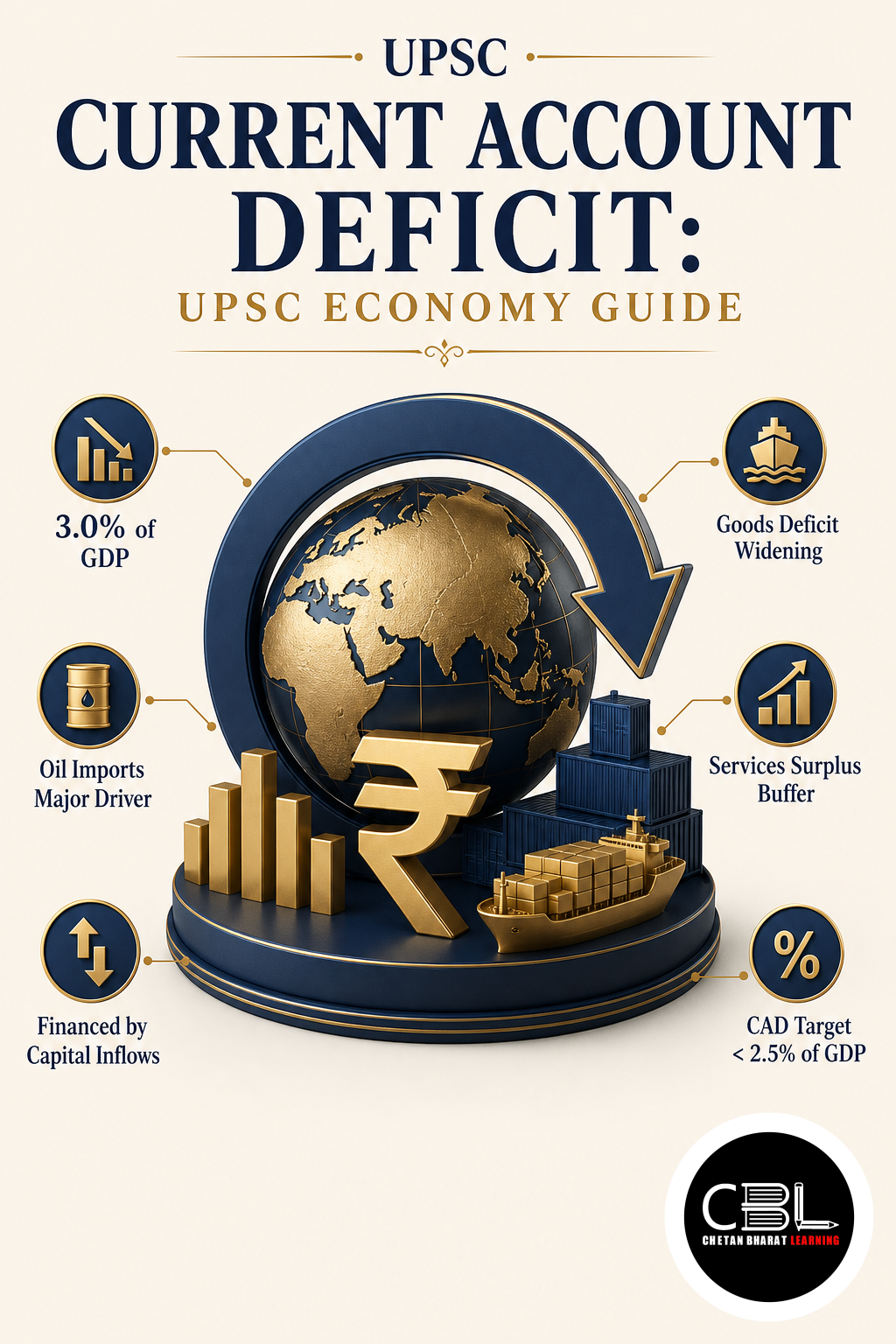
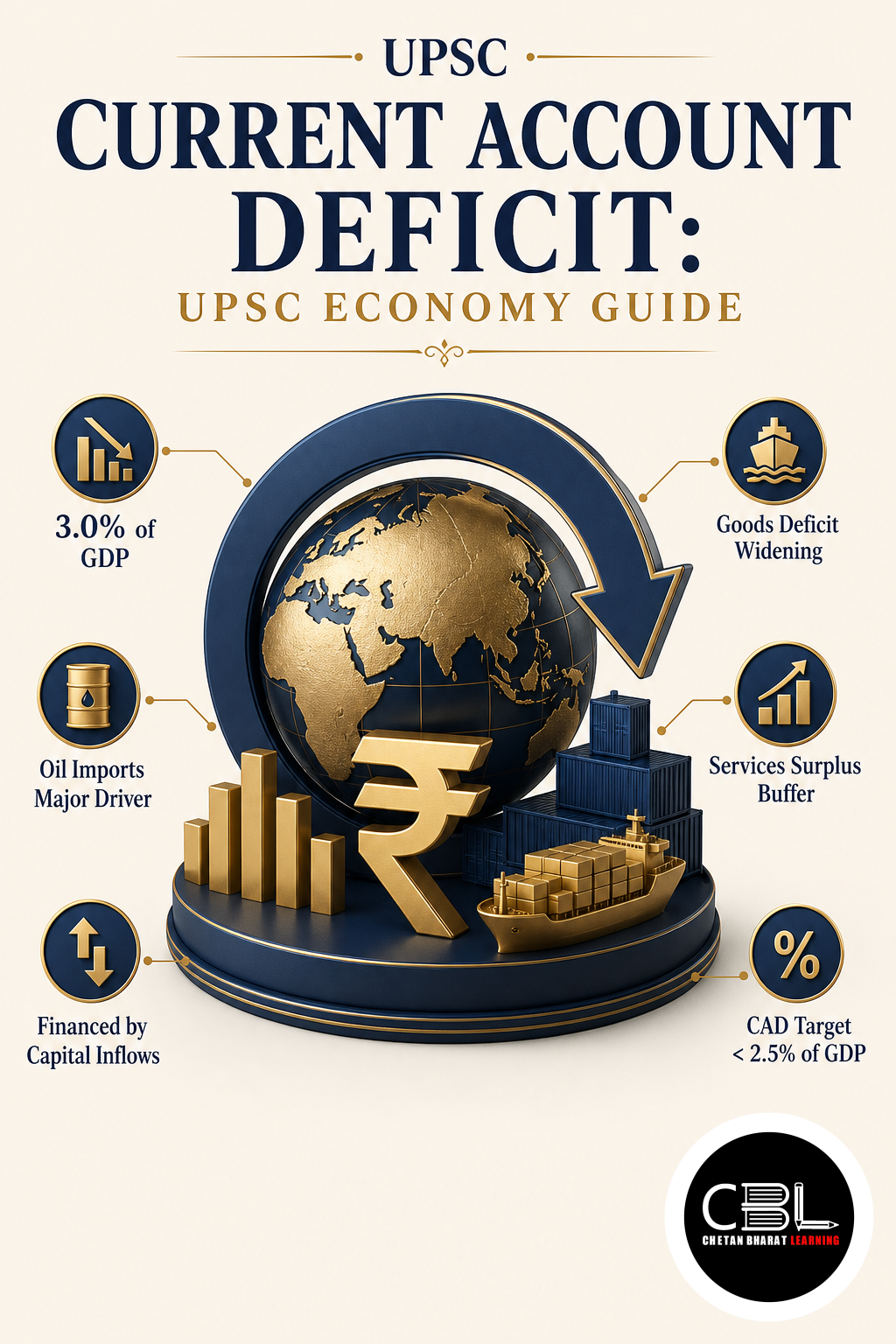
The Current Account Deficit occurs when a country’s total payments to foreign nations exceed its total receipts. This metric tracks the cross-border flow of goods, services, and primary income. A persistent gap forces the economy to rely heavily on foreign capital inflows to finance the shortfall.
India typically runs a massive merchandise trade deficit due to its enormous energy import requirements. The nation consistently generates a strong surplus in services exports and remittances. These structural strengths frequently cushion the broader economy against severe external financial shocks.
Historically, developing nations experience chronic shortfalls as they import heavy machinery to build domestic infrastructure. India followed this classic developmental trajectory for several decades after economic liberalization. The rapid industrialization phase naturally demanded massive quantities of foreign capital goods and intermediate components.
Why is Current Account Deficit in News?
The central bank recently reported that the gap widened to 4.2 billion dollars during the first quarter. The merchandise trade deficit expanded sharply as domestic industrial demand drove higher import volumes. You can review the official macroeconomic data via this RBI portal for precise statistical details.
Economists note that this modest widening remains well within manageable limits for the national exchequer. Strong earnings from the technology sector and robust global remittance flows successfully offset the rising import bill. The resilient external balance underscores the fundamental strength of the domestic growth engine.
Global geopolitical conflicts recently disrupted international shipping routes and drastically increased maritime insurance premiums. These external shocks artificially inflated the landed cost of essential commodities and bulk raw materials. Domestic importers absorbed these higher logistical expenses, directly widening the physical trade gap.
Key Features
The latest quarterly Current Account Deficit data reveals several critical structural components shaping the national balance of payments.
- Merchandise Gap: The physical trade deficit expanded significantly as domestic factories imported more raw materials and capital goods.
- Services Surplus: Net receipts from the technology and business services sectors rose substantially to offset the physical trade losses.
- Remittance Inflows: The primary and secondary income accounts provided crucial relief through massive diaspora transfers and investment returns.
- Gold Imports: Rural distress and fluctuating domestic equity markets frequently drive massive retail investments in physical bullion.
- Electronics Surge: The rapid adoption of smartphones and digital infrastructure drastically increased the import bill for advanced telecom components.
- GDP Ratio: The overall shortfall remained at a highly comfortable 0.5 per cent of the gross domestic product.
Challenges
Managing the Current Account Deficit presents several persistent structural vulnerabilities for policymakers attempting to maintain macroeconomic stability.
- Energy Dependence: The massive reliance on imported crude oil constantly exposes the trade balance to volatile global commodity prices.
- Export Stagnation: Weak global demand and rising protectionism frequently restrict the rapid expansion of domestic merchandise exports.
- Capital Flight: A widening gap forces the nation to attract volatile foreign portfolio investments to finance the shortfall.
- Currency Pressure: Persistent external deficits naturally exert continuous depreciation pressure on the domestic currency in global markets.
- Geopolitical Shocks: Sudden international conflicts frequently disrupt established supply chains and trigger massive spikes in global freight rates.
- Imported Inflation: A depreciating domestic currency automatically translates into higher retail prices for essential imported commodities.
Way Forward
The administration must aggressively promote domestic manufacturing to substitute expensive foreign imports and boost local value addition. Expanding the production-linked incentive schemes will drastically reduce the structural reliance on overseas capital goods. Providing dedicated export incentives will help domestic firms capture larger shares of global markets.
Policymakers must actively prioritize foreign direct investment over volatile portfolio flows to finance the external gap sustainably. Long-term industrial capital creates domestic employment and generates future export capacity. This strategic approach fundamentally transforms the structural composition of the national capital account.
Check the latest Government of India portal for strategic trade policy recommendations. The government must periodically review the baseline methodologies to ensure they reflect current global supply chain realities. Continuous refinement of export strategies will guarantee that the Current Account Deficit remains sustainable.
Prelims Practice Corner
Q1. What primarily caused the widening of the gap in the first quarter?
- (a) Drop in remittances
- (b) Sharper merchandise trade deficit
- (c) Fall in services exports
- (d) Decrease in FDI
Show answer
The physical trade deficit expanded sharply as domestic industrial demand drove higher import volumes.
Q2. Which sector provided the strongest offset to the merchandise deficit?
- (a) Agriculture exports
- (b) Tourism receipts
- (c) Services exports
- (d) Foreign aid
Show answer
Net receipts from the technology and business services sectors rose substantially to offset physical trade losses.
Q3. What was the CAD as a percentage of GDP in the reported quarter?
- (a) 0.5 per cent
- (b) 1.2 per cent
- (c) 2.5 per cent
- (d) 3.0 per cent
Show answer
The overall shortfall remained at a highly comfortable 0.5 per cent of the gross domestic product.
Q4. What does the secondary income account primarily include?
- (a) Foreign direct investment
- (b) Remittances and transfers
- (c) Interest payments
- (d) Dividend payouts
Show answer
The secondary income account provides crucial relief through massive diaspora transfers and unilateral gifts.
Q5. Which institution releases the official Balance of Payments data in India?
- (a) NITI Aayog
- (b) Ministry of Finance
- (c) Reserve Bank of India
- (d) SEBI
Show answer
The central bank regularly publishes the official macroeconomic data regarding external sector balances.
Mains Practice Questions
Q1. Discuss the structural components of India’s Balance of Payments and how services exports cushion the merchandise trade deficit. (10 marks)
Answer Structure
Intro: Define the Balance of Payments and highlight India’s historical structural deficit in merchandise trade due to energy imports.
Body: Explain the massive surplus generated by IT and business services, alongside robust remittance inflows, and how they finance the physical trade gap.
Conclusion: Conclude that maintaining a competitive edge in global services is crucial for India’s macroeconomic stability.
Q2. “A moderate external shortfall is not inherently problematic for a rapidly growing developing economy.” Critically analyze this statement. (15 marks)
Answer Structure
Intro: Introduce the concept of external deficits as a natural byproduct of capital goods imports required for rapid industrialization.
Body: Analyze the benefits of importing technology for long-term capacity building, while discussing the risks of currency depreciation and imported inflation.
Conclusion: Suggest that prioritizing foreign direct investment over volatile portfolio flows ensures sustainable financing of the gap.
FAQs on Current Account Deficit
Is a high external deficit always bad for the economy?
A moderate deficit is normal for developing nations importing capital goods for infrastructure creation. However, a persistently high gap financed by volatile short-term portfolio investments creates severe macroeconomic vulnerabilities and currency instability.
How do remittances help manage the national balance?
Remittances form a massive component of the secondary income account, bringing in billions of dollars in foreign exchange. These stable, unilateral transfers from the diaspora successfully offset a significant portion of the physical merchandise trade gap.
What is the difference between this and Fiscal Deficit?
The external deficit tracks a country’s cross-border transactions with the rest of the world, including trade and services. In contrast, the fiscal deficit measures the domestic government’s borrowing requirement to meet its internal expenditure commitments.
Related Current Affairs
Preparing for UPSC, PCS or HCS?
Talk to a mentor at Chetan Bharat Learning, Chandigarh. Free guidance on choosing the right exam and building a study plan.
Chat on WhatsAppCall 97793 53345UPSC / IAS / PCS coaching in Chandigarh · Trusted by aspirants across Punjab & Haryana
Leave a Reply
You must be logged in to post a comment.