
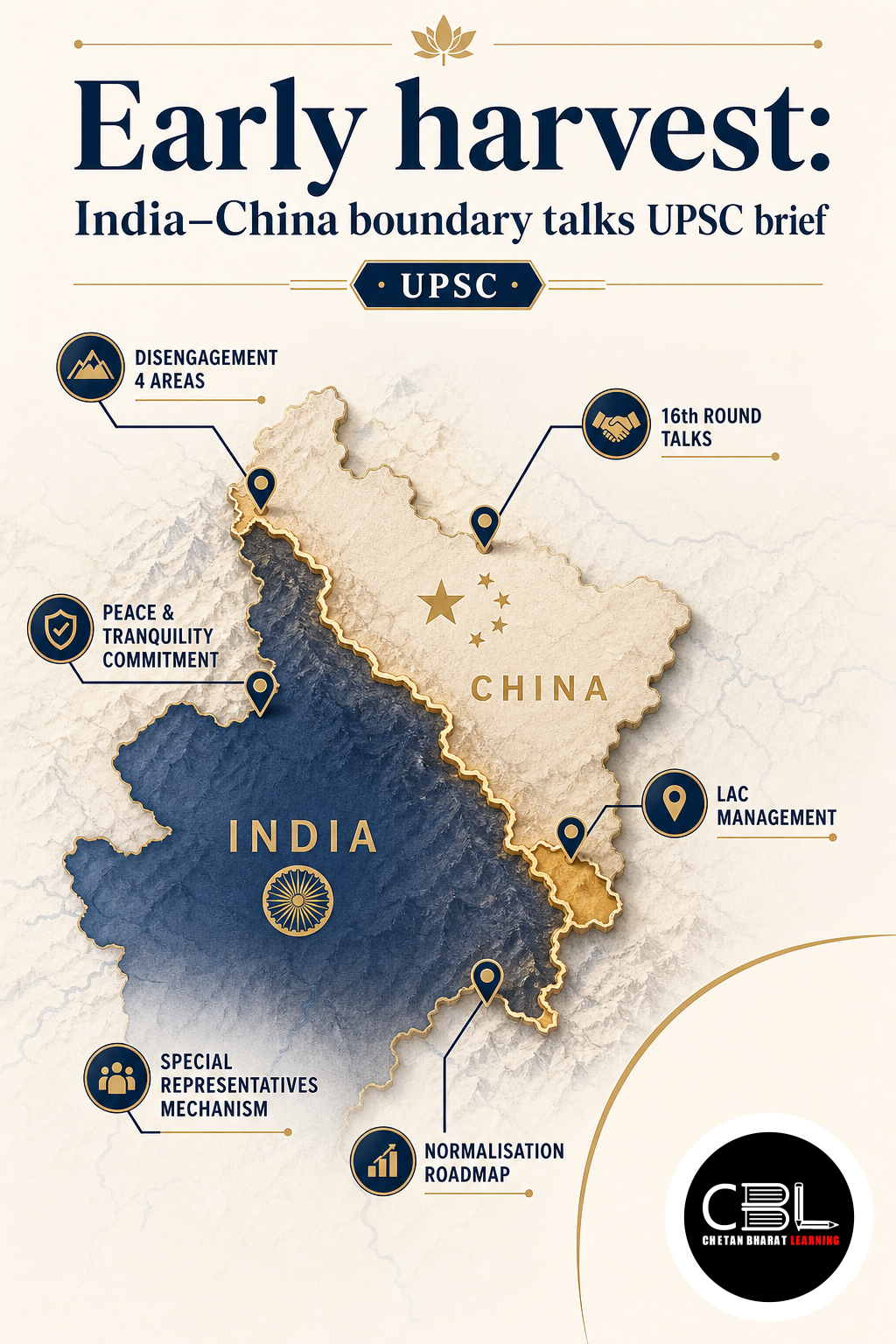

UPSC Mapping
| Prelims | International Relations |
|---|---|
| Mains | GS Paper II (India and its Neighbourhood) |
Quick Facts
| SR talks | Special Representatives mechanism (since 2003) |
|---|---|
| WMCC | Working Mechanism for Consultation & Coordination (since 2012) |
| Core line | LAC (not mutually demarcated on ground) |
| Goal of talks | Peace, stability, and incident prevention |
What is Early harvest?
Early harvest is a negotiating approach where parties seek limited, verifiable deliverables first, while leaving the hardest issues for later rounds. In diplomacy, it signals a preference for outcomes that reduce immediate friction, even when a comprehensive agreement remains distant.
In the India–China boundary context, early steps can include clearer crisis communication, more predictable patrolling protocols, or additional channels that prevent local incidents from escalating. The concept does not replace boundary settlement; it aims to stabilise the situation along the LAC and create space for wider engagement.
Why is Early harvest in News?
India and China have signalled intent to advance boundary-related discussions with an emphasis on achievable near-term actions, often described as an early harvest. Reports also mention steps like adding meeting points and strengthening hotlines to manage face-offs and prevent misunderstandings at the tactical level.
For UPSC, this is a governance and strategy story: it tests whether both sides can rebuild routine communication while protecting their stated positions. Candidates should follow formal readouts from official channels such as a PIB release and compare them with how border incidents are managed on the ground.
Key Features
In answers, treat the India–China boundary issue as both a territorial dispute and a border-management challenge.
- India–China boundary dispute and sectors where disagreements span the western, middle, and eastern sectors, each with different historical and operational complexities.
- LAC as an operational line because the Line of Actual Control reflects current deployments and differing perceptions, which can create overlapping patrol routes.
- Multiple dialogue tracks including political-level engagement, the Special Representatives mechanism for the boundary question, and working-level platforms like WMCC.
- Border management mechanisms such as flag meetings, Border Personnel Meetings, and commander-level interactions aimed at local de-escalation.
- Crisis communication tools including hotlines and agreed points of contact that reduce reaction time during stand-offs and clarify intent.
The analytical value of early harvest lies in its sequencing. It prioritises safety and predictability first, then pushes harder questions into structured, longer negotiations.
Challenges
The core difficulty is aligning tactical stability with strategic trust, especially when perceptions of the LAC differ.
- Trust deficit after crises can limit risk-taking in negotiations, so both sides prefer narrow commitments that are easier to verify.
- Different LAC perceptions create recurring friction points, since patrols may enter areas the other side claims as its own.
- Operational complexity at high altitude because terrain, weather, and logistics raise the probability of accidents and misreading local moves.
- Domestic political sensitivity makes compromise costly, pushing negotiators towards wording that can be defended at home.
- Verification and compliance remain challenging without mutually accepted maps or clear demarcation, even if both sides agree on restraint.
To write sharper Mains answers, connect these challenges to institutional pathways already used in practice and track updates under India’s IR current affairs notes. Use this to show continuity: India often combines dialogue, deterrence, and crisis protocols rather than relying on only one tool.
Early harvest can also face a sequencing risk: small steps may stabilise the border without resolving the underlying dispute. UPSC expects you to mention this as a policy trade-off, not as a binary success or failure.
Way Forward
India and China can improve outcomes by tightening incident prevention before pursuing bigger political bargains. This includes standard operating procedures for patrol encounters, predictable disengagement templates where feasible, and stronger commander-level communication to reduce tactical surprises.
A credible early harvest should be measurable: fewer close contacts, quicker clarification during face-offs, and consistent adherence to existing agreements. Aspirants should track official statements and agreements through the MEA website, and map them to GS-II themes like bilateral relations, border management, and diplomacy under constraints.
Prelims Practice Corner
Q1. The Line of Actual Control (LAC) is best described as:
- (a) A permanently demarcated international boundary
- (b) The line reflecting current deployment positions and differing perceptions
- (c) A UN-administered buffer line
- (d) A maritime boundary line
Answer: (b) The LAC reflects actual control on ground and is not mutually demarcated.
Q2. The Special Representatives (SR) mechanism between India and China primarily relates to:
- (a) Maritime piracy coordination
- (b) Boundary question and political parameters
- (c) WTO negotiations
- (d) Nuclear arms control
Answer: (b) SR talks address the boundary question at a political-strategic level.
Q3. WMCC is relevant to India–China relations because it:
- (a) Adjudicates territorial disputes like a court
- (b) Coordinates consultation and management of border affairs
- (c) Controls customs tariffs
- (d) Serves as a defence alliance
Answer: (b) WMCC is a working-level mechanism for consultation and coordination on border affairs.
Q4. Which is the most direct purpose of border hotlines?
- (a) To sign trade treaties
- (b) To prevent escalation through quick clarification and communication
- (c) To replace diplomatic missions
- (d) To conduct election monitoring
Answer: (b) Hotlines reduce misperception and help manage incidents quickly.
Q5. In diplomatic usage, the term ‘early harvest’ most closely means:
- (a) Ending talks without any outcome
- (b) Achieving small, practical deliverables early
- (c) Converting talks into arbitration immediately
- (d) Only discussing cultural exchanges
Answer: (b) Early harvest refers to limited, feasible steps achieved before a comprehensive agreement.
Mains Practice Questions
Q1. What does the term ‘early harvest’ imply in diplomatic negotiations? Discuss its relevance and limits in India–China boundary management. (10 marks)
Answer Structure:
- Intro: Define early harvest as sequencing small, verifiable outcomes ahead of a final settlement.
- Body: Explain relevance for de-escalation, crisis communication, and predictability on the LAC; then discuss limits such as trust deficit, verification problems, and risk of postponing core dispute resolution.
- Conclusion: Argue for measurable deliverables alongside continued boundary talks and confidence-building.
Q2. Describe the key border management mechanisms between India and China. Evaluate how these mechanisms can reduce the risk of escalation without compromising strategic interests. (15 marks)
Answer Structure:
- Intro: State that the LAC requires continuous management due to differing perceptions and patrol patterns.
- Body: Cover SR talks, WMCC, commander-level meetings, BPM/flag meetings, hotlines, and adherence to existing agreements; then evaluate strengths (communication, deconfliction) and constraints (verification, political trust, compliance).
- Conclusion: Recommend layered deterrence plus institutionalised communication and rules-based restraint.
FAQs on Early harvest
Does ‘early harvest’ mean a final settlement of the India–China boundary?
No. It usually means small, implementable steps that reduce immediate friction and improve stability. The comprehensive boundary settlement remains a separate, longer process.
Why do meeting points and hotlines matter on the LAC?
They reduce the time taken to clarify intent and manage local stand-offs. Faster communication can prevent tactical incidents from escalating into political crises.
What should a UPSC answer emphasise on India–China border management?
Explain the LAC’s operational nature, list key mechanisms like SR talks and WMCC, and then evaluate how communication and SOPs reduce risk. Add limits such as differing perceptions, verification constraints, and trust deficit for balance.
Related Current Affairs
Preparing for UPSC, PCS or HCS?
Talk to a mentor at Chetan Bharat Learning, Chandigarh. Free guidance on choosing the right exam and building a study plan.
Chat on WhatsAppCall 97793 53345UPSC / IAS / PCS coaching in Chandigarh · Trusted by aspirants across Punjab & Haryana
Leave a Reply
You must be logged in to post a comment.