

UPSC Mapping
| Prelims | Economy / International Trade |
|---|---|
| Mains | GS Paper III – Economy, External Sector |
Quick Facts
| US move | Tariff action |
|---|---|
| Canada response | Retaliatory tariffs |
| Region | North America |
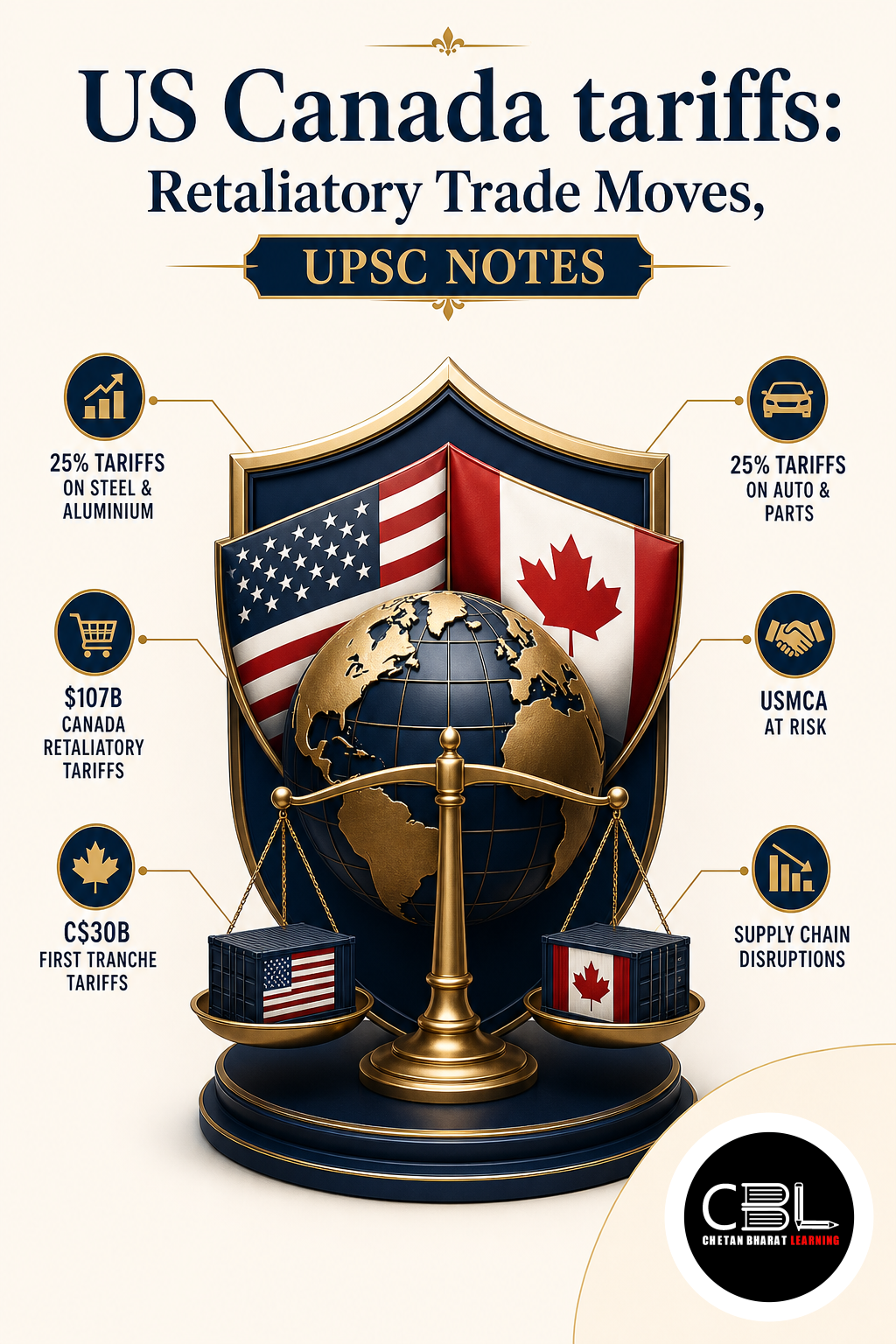
US Canada tariffs have led to retaliatory trade measures after Canada announced counter tariffs following fresh US trade moves. The dispute affects bilateral trade, supply chains and North American economic stability. Aspirants can track such economic developments in the daily current affairs archive.
What is US Canada Tariffs?
US Canada tariffs refer to a trade conflict in which the United States has imposed tariff measures and Canada has responded with retaliatory tariffs on American goods. Tariffs are taxes on imported products that raise their price and are often used to protect domestic industry or to exert trade pressure. Such measures can depart from negotiated free trade commitments between the two neighbours.
The United States and Canada are deeply integrated through cross-border supply chains in automobiles, agriculture, energy and manufacturing. When tariffs increase, manufacturers face higher input costs, and consumers may pay more for goods. The present exchange signals renewed friction in a relationship that has long been governed by trade agreements.
Why is US Canada Tariffs in News?
US Canada tariffs are in news because Canada announced retaliatory tariffs following the latest US trade action. The announcement indicates that the dispute is entering a more serious phase as both sides adopt protectionist measures. Businesses in both countries now face uncertainty over future costs and market access.
The Al Jazeera report frames the Canadian move as a direct response to US trade steps. Such tit-for-tat measures can disrupt integrated industries and affect global trade sentiment even beyond North America.
Key Features
- US tariff action: The United States has introduced new trade measures that prompted Canada to respond.
- Retaliatory tariffs: Canada announced counter tariffs on American goods to protect its trade interests.
- Bilateral friction: The dispute strains one of the largest trading relationships in the world.
- Supply chain risk: Integrated industries such as automobiles and agriculture face higher costs and delays.
- Investor uncertainty: Exporters and manufacturers may pause investment decisions until trade rules become clearer.
Challenges
- Higher consumer prices: Import duties tend to increase costs for households and businesses.
- Disrupted trade: Retaliatory tariffs reduce market access and can shrink bilateral export volumes.
- Job impact: Sectors dependent on cross-border trade may face production cuts and layoffs.
- Negotiation breakdown: Escalating measures make it harder to return to cooperative trade talks.
- Global spillover: Trade disputes between major economies can weaken investor confidence worldwide.
For more trade policy updates, check the economy current affairs section.
Way Forward
Both sides should resume structured trade talks to resolve tariff disputes through negotiation rather than escalation. A mutually agreed dispute settlement process can restore predictability for businesses and protect integrated supply chains. Trade agreements should be reviewed with a focus on compliance and balanced market access.
Multilateral institutions can also help by reinforcing rule-based trade norms. The World Trade Organization provides a forum for resolving such differences and preventing prolonged trade wars.
Prelims Practice Corner
Q1. A retaliatory tariff is imposed by a country in response to which type of measure?
- (a) Foreign aid
- (b) Tariff or trade restriction by another country
- (c) Diplomatic visit
- (d) Climate accord
Answer: (b) Tariff or trade restriction by another country.
Q2. Which country announced retaliatory tariffs following US trade moves?
- (a) Mexico
- (b) Canada
- (c) United Kingdom
- (d) Japan
Answer: (b) Canada.
Q3. Tariffs are taxes on which category?
- (a) Income
- (b) Exports only
- (c) Imports
- (d) Domestic property
Answer: (c) Imports.
Q4. The US and Canada share deep integration in which sector?
- (a) Textiles
- (b) Automobiles
- (c) Handicrafts
- (d) Tea
Answer: (b) Automobiles and cross-border manufacturing.
Q5. Which institution is most relevant for settling trade disputes between countries?
- (a) IMF
- (b) World Bank
- (c) WTO
- (d) UNDP
Answer: (c) World Trade Organization.
Mains Practice Questions
Q1. Examine the reasons for US-Canada tariff disputes and their impact on global trade. (15 marks)
- Intro: Define tariffs and mention the current US-Canada exchange.
- Body: Cover US protectionism, Canadian retaliation, supply chains, consumer costs, jobs and investor sentiment.
- Conclusion: Suggest rule-based multilateral resolution.
Q2. How do trade disputes between developed economies affect developing countries like India? (10 marks)
- Intro: Link global trade sentiment and tariffs to emerging economies.
- Body: Discuss commodity prices, export competitiveness, supply chain shifts and investment flows relevant to India.
- Conclusion: Recommend diversification and trade diplomacy.
FAQs on US Canada Tariffs
What are US Canada tariffs?
US Canada tariffs refer to tariff measures by the United States and Canada’s retaliatory tariffs on American goods.
Why did Canada announce retaliatory tariffs?
Canada announced retaliatory tariffs in response to fresh trade moves by the United States.
What is the main risk of retaliatory tariffs?
The main risk is higher consumer prices, disrupted supply chains and reduced bilateral trade.
Related Current Affairs
Preparing for UPSC, PCS or HCS?
Talk to a mentor at Chetan Bharat Learning, Chandigarh. Free guidance on choosing the right exam and building a study plan.
Chat on WhatsAppCall 97793 53345UPSC / IAS / PCS coaching in Chandigarh · Trusted by aspirants across Punjab & Haryana
Leave a Reply
You must be logged in to post a comment.