

UPSC Mapping
Prelims
International Relations
Mains
GS Paper II – International Relations, Energy Security
Quick Facts
| US action | Intense financial sanctions |
|---|---|
| Iran threat | Disrupt shipping |
| Region | Strait of Hormuz |
Article
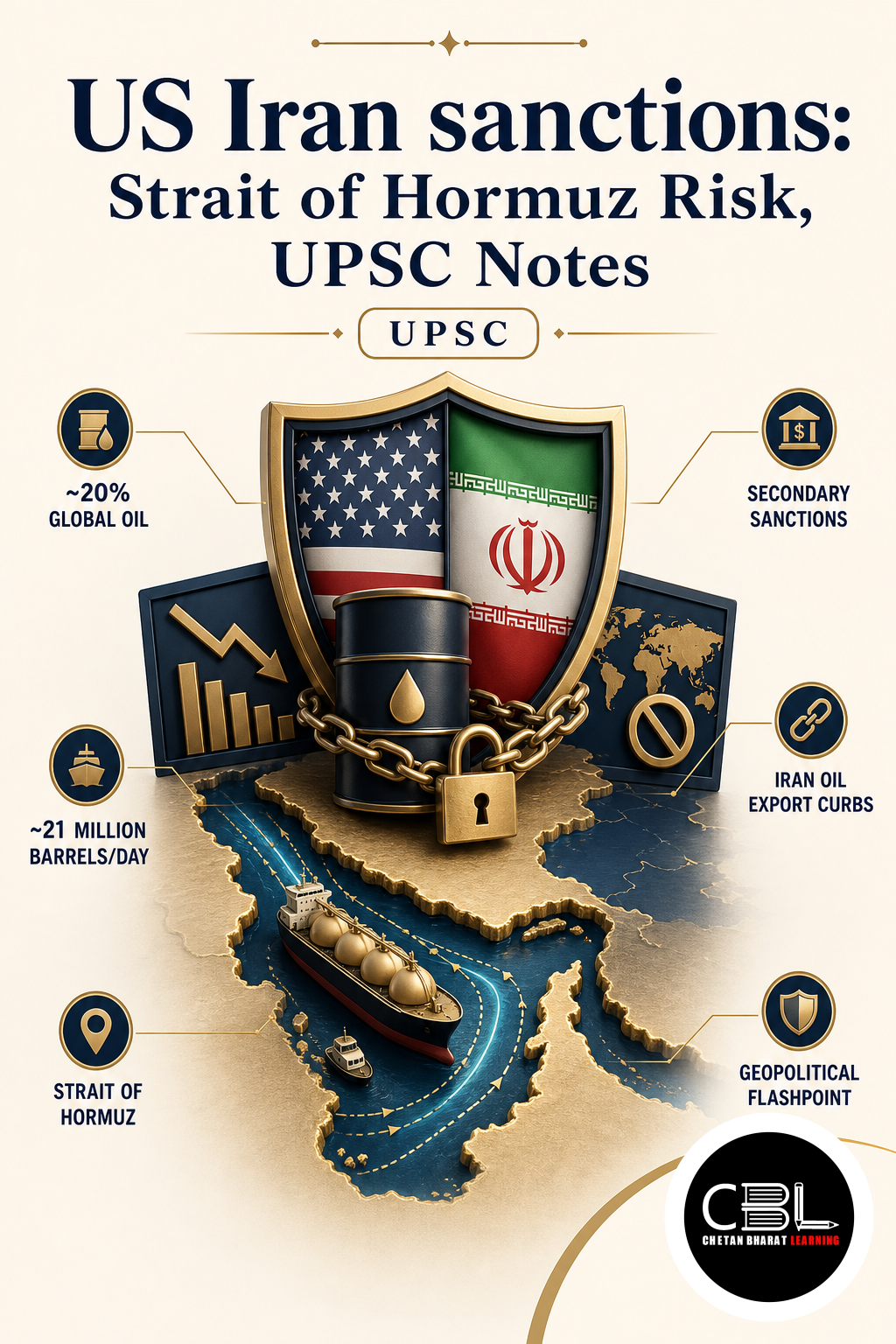
US Iran sanctions have escalated after the United States began rolling out intense financial curbs while Iran threatened to disrupt shipping in the Strait of Hormuz. The move raises immediate concern for global oil supplies and regional stability. Aspirants can track such developments in the daily current affairs archive.
What is US Iran Sanctions?
US Iran sanctions refer to the expanding set of financial restrictions imposed by the United States on Iranian entities, banks and trade networks. These measures aim to reduce Iran’s revenue and limit its missile, nuclear and regional activities. The latest round is described as intense because it targets broader financial channels through which Iran earns foreign exchange.
The Strait of Hormuz is central to this standoff because it connects the Persian Gulf with the Gulf of Oman and the open sea. A significant share of global crude oil and liquefied natural gas passes through this narrow waterway. Any disruption there can push energy prices higher and affect importing countries, including India.
Why is US Iran Sanctions in News?
US Iran sanctions are in news because the United States is rolling out a new wave of financial measures while Iran has threatened to disrupt shipping in the Strait of Hormuz. This simultaneous escalation increases the prospect of a direct security clash and threatens the free movement of oil tankers. Markets are watching the situation closely because supply risks can trigger global inflation.
The standoff also affects broader West Asian stability and diplomatic efforts involving multiple countries. The Al Jazeera report highlights that the latest US move adds pressure at a time when regional negotiations remain fragile.
Key Features
The ongoing situation has several features that are relevant for UPSC international relations preparation.
- Financial sanctions: The United States is imposing intense financial curbs on Iranian networks to reduce revenue flows.
- Shipping disruption threat: Iran has threatened to disrupt shipping in the Strait of Hormuz, a crucial passage for global energy trade.
- Oil transit route: The Strait serves as a main channel for crude oil from the Persian Gulf to Asian and European markets.
- Escalation risk: Sanctions combined with threats raise the possibility of military or logistical confrontation at sea.
- Global economic impact: Higher insurance costs and supply concerns can push up oil prices and widen inflation in energy-importing countries.
Challenges
The crisis poses diplomatic, security and economic challenges for the international community and for India.
- Energy supply risk: Disruption at the Strait can delay crude shipments and raise India’s import bill.
- Regional instability: Fresh sanctions may harden Iran’s position and increase hostilities with the United States and its partners.
- Diplomatic gridlock: Mediation becomes harder when both sides use coercive instruments instead of dialogue.
- Maritime security: Naval and commercial vessels face higher risk from mines, drone threats or asymmetric attacks.
- Multilateral strain: Divergent positions among global powers can weaken consensus at international forums.
For more strategic affairs, visit the international relations current affairs section.
Way Forward
De-escalation should begin with direct and indirect diplomatic channels to address US and Iranian security concerns without further military threats. India and other energy buyers need a transparent mechanism to ensure freedom of navigation and continued oil flows through the Strait. Regional forums and the United Nations can support maritime confidence-building measures.
Economic pressure alone is unlikely to produce a durable solution without a parallel political track. The United Nations can play a role in facilitating dialogue and preventing miscalculation at sea.
Prelims Practice Corner
Q1. The Strait of Hormuz connects which two water bodies?
(a) Red Sea and Arabian Sea (b) Persian Gulf and Gulf of Oman (c) Black Sea and Mediterranean Sea (d) Gulf of Aden and Gulf of Oman
Answer: (b) Persian Gulf and Gulf of Oman.
Q2. Iran threatened to disrupt shipping in which waterway?
(a) Strait of Malacca (b) Bab el Mandeb (c) Strait of Hormuz (d) Suez Canal
Answer: (c) Strait of Hormuz.
Q3. Which country is rolling out intense financial sanctions against Iran?
(a) United Kingdom (b) United States (c) France (d) Saudi Arabia
Answer: (b) United States.
Q4. The Strait of Hormuz is critical mainly for the transport of which resource?
(a) Coal (b) Crude oil (c) Iron ore (d) Natural rubber
Answer: (b) Crude oil and natural gas.
Q5. India’s interest in the Strait of Hormuz is mainly related to which sector?
(a) Textiles (b) Energy security (c) Pharmaceuticals (d) Tourism
Answer: (b) Energy security.
Mains Practice Questions
Q1. Evaluate the strategic significance of the Strait of Hormuz for global energy security and for India. (15 marks)
Intro: Locate the Strait and state its role in oil transit.
Body: Cover global energy share, India’s import dependence, sanctions risks, alternative routes and maritime security.
Conclusion: Recommend diplomatic and energy diversification measures.
Q2. Discuss the impact of US-Iran tensions on regional stability and India’s foreign policy options. (10 marks)
Intro: Mention the current sanctions and shipping threat.
Body: Analyse regional instability, oil prices, diaspora concerns, India’s balancing relations with US, Iran and Gulf states.
Conclusion: End with calibrated diplomacy and maritime cooperation.
FAQs on US Iran Sanctions
Why did the US impose fresh sanctions on Iran?
The United States is rolling out intense financial sanctions to reduce Iran’s revenue and limit its strategic activities.
What did Iran threaten in response?
Iran threatened to disrupt shipping in the Strait of Hormuz, a key channel for global oil movement.
Why does the Strait of Hormuz matter for India?
India depends heavily on crude oil passing through the Strait, so any disruption can raise energy costs and affect the economy.
Related Current Affairs
Preparing for UPSC, PCS or HCS?
Talk to a mentor at Chetan Bharat Learning, Chandigarh. Free guidance on choosing the right exam and building a study plan.
Chat on WhatsAppCall 97793 53345UPSC / IAS / PCS coaching in Chandigarh · Trusted by aspirants across Punjab & Haryana
Leave a Reply
You must be logged in to post a comment.