
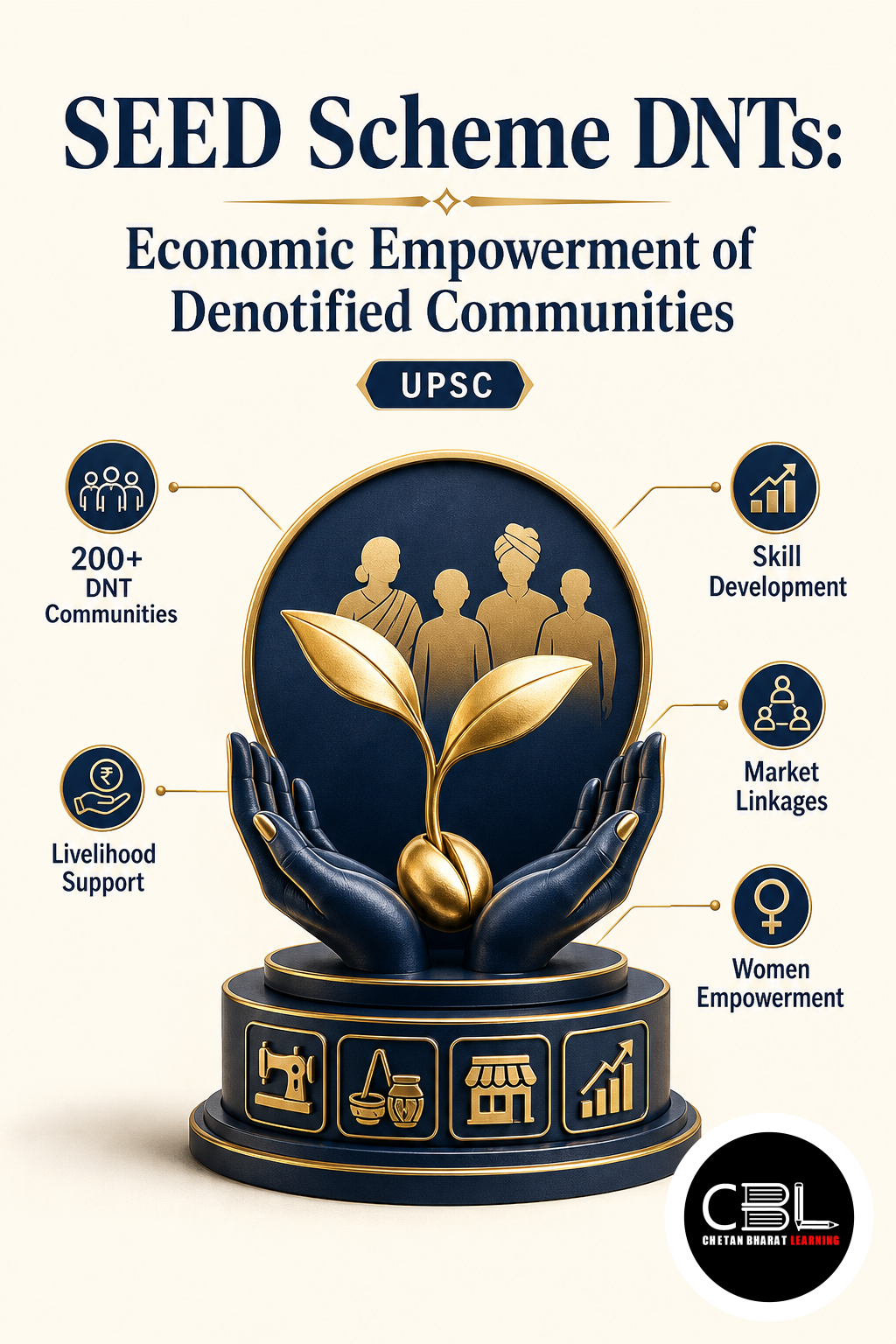
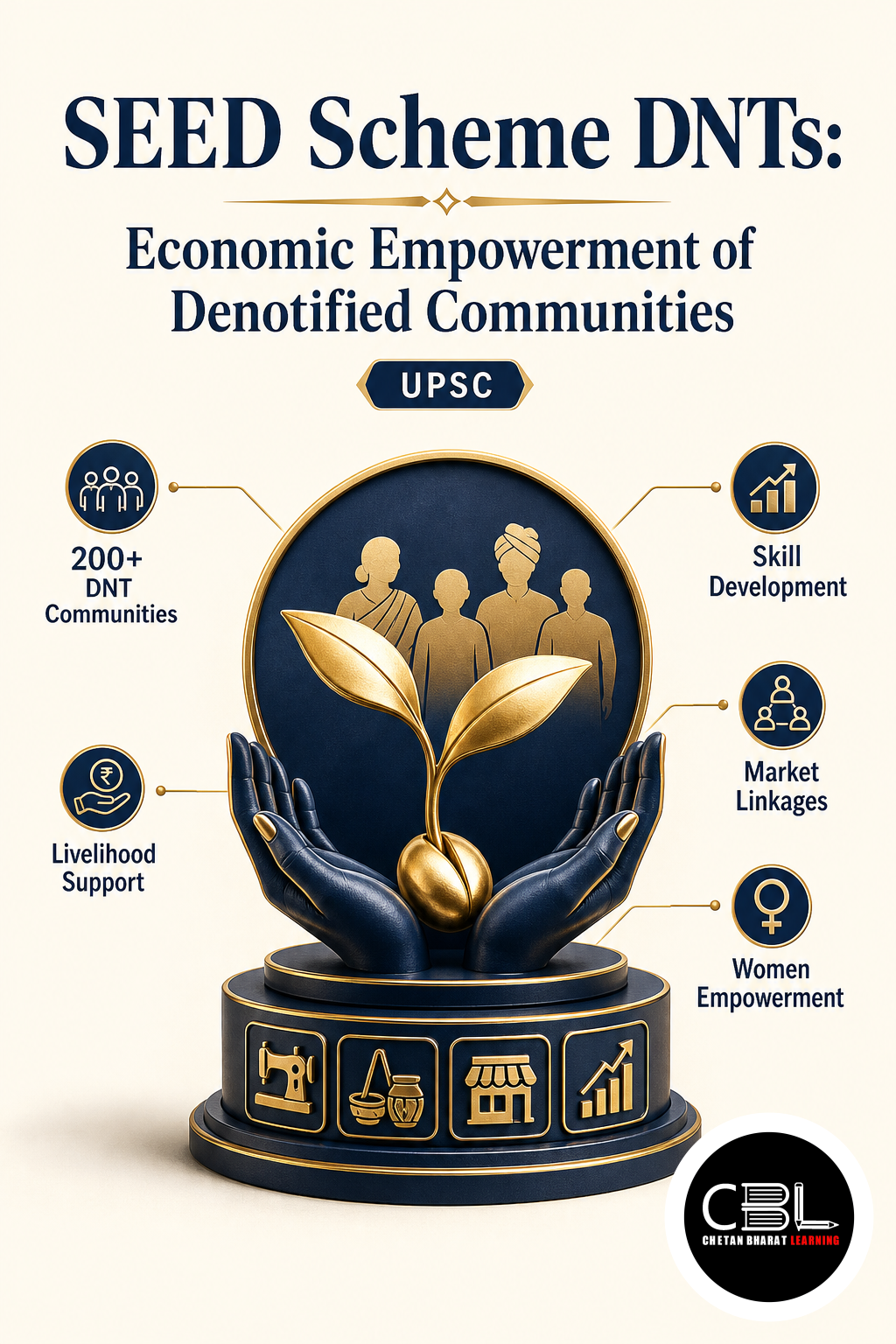
SEED Scheme DNTs is empowering De-notified, Nomadic, and Semi-Nomadic Communities (DNTs, NTs, and SNTs) through free coaching, health insurance, livelihood support, and housing assistance. The Scheme for Economic Empowerment of DNTs (SEED) was launched in 2022 by the Ministry of Social Justice and Empowerment. For more such social justice updates, explore the social justice archive.
Important For
| Exam | Paper/Subject |
|---|---|
| Prelims | Social Justice & Welfare |
| Mains | GS Paper 2 (Social Justice & Welfare) |
Quick Facts
| Launch Year | 2022 |
|---|---|
| Budget | ₹200 crore (5 years) |
| Health Cover | ₹5 lakh/family/year (PM-JAY) |
What is SEED Scheme DNTs?
SEED Scheme DNTs is a central sector scheme launched in 2022 by the Ministry of Social Justice and Empowerment to uplift De-notified, Nomadic, and Semi-Nomadic Communities. The scheme has four components: Education Support (free coaching for competitive exams and professional courses), Health Insurance (₹5 lakh per family per year under Ayushman Bharat PM-JAY), Livelihood (income-generation support through SHGs), and Housing Assistance (financial aid through convergence with PM Awas Yojana).
Denotified tribes are communities that were once notified as ‘criminal tribes’ under the British-era Criminal Tribes Act, 1871, and later denotified. Nomadic and semi-nomadic communities are characterised by their peripatetic lifestyle. The scheme aims to address the socio-economic marginalisation of these communities.
Why is SEED Scheme DNTs in News?
SEED Scheme DNTs is in the news as the government highlights its efforts to empower these communities. The scheme’s comprehensive approach—covering education, health, livelihood, and housing—has been noted. The budget of ₹200 crore for five years indicates the government’s commitment to addressing the historical marginalisation of DNTs.
The scheme complements other initiatives like the development of a national commission for DNTs and the inclusion of these communities in various welfare programmes. For more details, refer to the PIB release.
Key Features of SEED Scheme DNTs
SEED Scheme DNTs has several distinctive features:
- Education Support: Free coaching for UPSC, NEET, JEE, and banking exams.
- Health Insurance: ₹5 lakh cover per family per year under PM-JAY.
- Livelihood: Income-generation through self-help groups.
- Housing Assistance: Financial aid through PM Awas Yojana convergence.
- Central Sector Scheme: Fully funded by the central government.
Challenges in SEED Scheme DNTs
SEED Scheme DNTs faces several challenges:
- Identification: DNTs are not uniformly identified across states.
- Awareness: Many community members are unaware of the scheme.
- Coordination: Convergence with other schemes requires effective inter-departmental coordination.
- Social Stigma: Historical stigmatisation persists, affecting community participation.
- Geographical Spread: Communities are scattered, making outreach difficult.
Way Forward for SEED Scheme DNTs
To maximise the impact of SEED Scheme DNTs, the government should focus on awareness campaigns to reach the target communities. Strengthening the identification of DNTs through a national database can improve targeting. Regular monitoring and evaluation of the scheme’s components can ensure effectiveness.
Collaboration with civil society organisations and community-based groups can enhance outreach. Addressing social stigma through sensitisation programmes is essential. For international best practices, refer to the UNHRC.
Prelims Practice Corner
Q1. In which year was the SEED Scheme launched?
Options: (a) 2020, (b) 2021, (c) 2022, (d) 2023
Answer: (c) The SEED Scheme was launched in 2022.
Q2. What is the budget of the SEED Scheme?
Options: (a) ₹100 crore, (b) ₹150 crore, (c) ₹200 crore, (d) ₹250 crore
Answer: (c) The scheme has a ₹200 crore budget for five years.
Q3. Which ministry administers the SEED Scheme?
Options: (a) Ministry of Tribal Affairs, (b) Ministry of Social Justice and Empowerment, (c) Ministry of Rural Development, (d) Ministry of Finance
Answer: (b) The Ministry of Social Justice and Empowerment administers the scheme.
Q4. What health insurance cover is provided under SEED?
Options: (a) ₹2 lakh, (b) ₹3 lakh, (c) ₹5 lakh, (d) ₹10 lakh
Answer: (c) ₹5 lakh per family per year under PM-JAY.
Q5. What is the historical context of Denotified Tribes?
Options: (a) They were royal families, (b) They were notified as ‘criminal tribes’ under British law, (c) They were landowners, (d) They were traders
Answer: (b) Denotified tribes were once classified as ‘criminal tribes’ under British law.
Mains Practice Questions
Q1. Discuss the challenges faced by De-notified, Nomadic, and Semi-Nomadic Communities in India and the role of the SEED Scheme in their empowerment. (250 words, 15 marks)
Answer Structure:
- Intro: Introduce DNTs and the SEED Scheme.
- Body: Discuss the historical marginalisation of DNTs, their socio-economic challenges, and the scheme’s four components. Analyse the scheme’s potential and the challenges in implementation.
- Conclusion: Suggest measures for effective outreach and convergence.
Q2. What are Denotified and Nomadic Tribes, and why do they require special welfare measures? (150 words, 10 marks)
Answer Structure:
- Intro: Define Denotified and Nomadic Tribes.
- Body: Explain their historical marginalisation, social stigma, and economic deprivation. Special welfare measures are needed for their integration and upliftment.
- Conclusion: Conclude that targeted schemes like SEED are essential for their empowerment.
FAQs on SEED Scheme DNTs
What is the SEED Scheme?
It is a central sector scheme for the economic empowerment of Denotified, Nomadic, and Semi-Nomadic Communities.
What are the four components of SEED?
Education support, health insurance, livelihood support, and housing assistance.
What is the health insurance cover under SEED?
₹5 lakh per family per year under Ayushman Bharat PM-JAY.
Related Current Affairs
Preparing for UPSC, PCS or HCS?
Talk to a mentor at Chetan Bharat Learning, Chandigarh. Free guidance on choosing the right exam and building a study plan.
Chat on WhatsAppCall 97793 53345UPSC / IAS / PCS coaching in Chandigarh · Trusted by aspirants across Punjab & Haryana
Leave a Reply
You must be logged in to post a comment.