

UPSC Mapping
| Exam | Area |
|---|---|
| Prelims | International Relations & Security |
| Mains | GS Paper 2 (International Relations & Security) |
Article
What is India Japan Defence Cooperation?
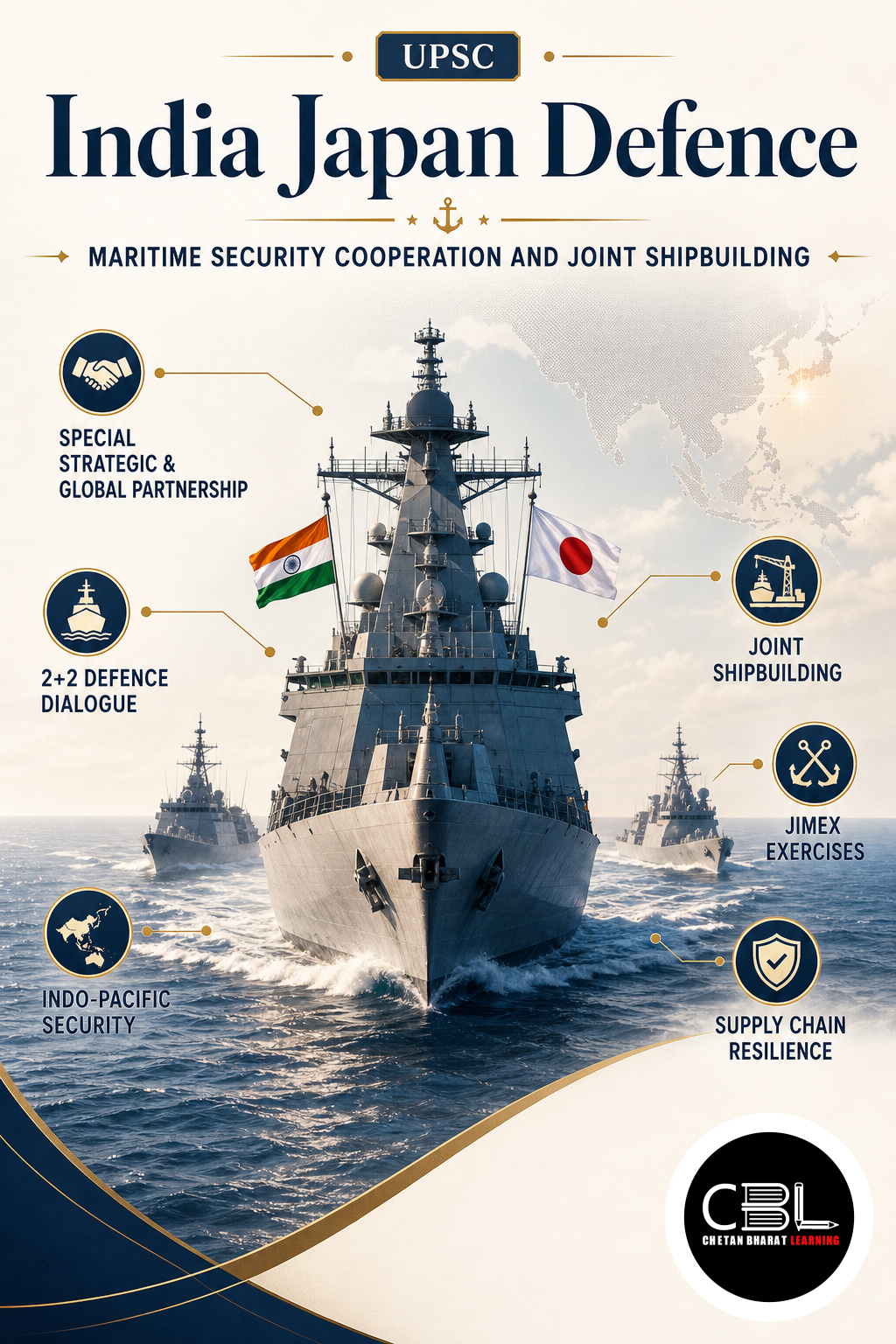
India Japan Defence cooperation encompasses a range of initiatives including joint shipbuilding, technology collaboration, and maritime security coordination. The signed MoA establishes a comprehensive framework for Maritime Domain Awareness, Search and Rescue, and Humanitarian Assistance and Disaster Relief. Key areas include co-development combining Japan’s technological expertise with India’s manufacturing capabilities under Make in India.
The UNICORN (Unified Complex Radio Antenna) project aims to fast-track the deployment of advanced antenna systems to enhance the stealth profile of Indian Navy warships. Research cooperation between DRDO and Japan’s ATLA through a dedicated Defence Industry Forum has been institutionalised. Japan is an East Asian island nation located at the junction of four tectonic plates, making it prone to earthquakes and tsunamis.
Why is India Japan Defence in News?
India Japan Defence is in the news following the high-level talks between Defence Minister Rajnath Singh and his Japanese counterpart Shinjiro Koizumi. The MoA on Maritime Security Cooperation was signed, and both ministers emphasised the importance of sharing assessments of the regional security environment and opposing unilateral actions that threaten freedom of navigation.
The two sides also discussed progress on the UNICORN project and institutionalising research cooperation. For more details, refer to the PIB release.
Key Features of India Japan Defence
- Maritime Security MoA: Comprehensive framework for operational cooperation.
- Joint Shipbuilding: Co-development using Japan’s technology and India’s manufacturing.
- UNICORN Project: Fast-tracking advanced radio antenna for Indian Navy stealth.
- Research Cooperation: DRDO-ATLA collaboration through a Defence Industry Forum.
- Geostrategic Location: Japan’s position near critical maritime chokepoints.
Challenges in India Japan Defence
- Technology Transfer: Ensuring effective transfer of sensitive technologies.
- Operational Integration: Aligning communication systems and procedures.
- China Factor: Balancing cooperation without provoking China.
- Industrial Capacity: India’s shipbuilding capacity must match Japan’s standards.
- Strategic Autonomy: Ensuring cooperation does not compromise India’s independent foreign policy.
Way Forward for India Japan Defence
To deepen India Japan Defence, both countries should focus on joint exercises and operational coordination, expanding the scope of HADR and SAR operations. The UNICORN project should be expedited to demonstrate tangible outcomes. Regular high-level dialogues and personnel exchanges can build trust and interoperability.
The defence industrial partnership should be deepened through co-development and co-production projects, leveraging Japan’s expertise in advanced technologies. The partnership should remain aligned with the vision of a free and open Indo-Pacific.
Prelims Practice Corner
Q1. What is the UNICORN project?
- (a) A satellite programme
- (b) A naval communications antenna project
- (c) A submarine project
- (d) A cyber defence initiative
Answer: (b) Unified Complex Radio Antenna project.
Q2. Which strait is near Japan?
- (a) Malacca Strait
- (b) Tsushima Strait
- (c) Hormuz Strait
- (d) Bab el-Mandeb
Answer: (b) Tsushima Strait.
Q3. What is the capital of Japan?
- (a) Osaka
- (b) Kyoto
- (c) Tokyo
- (d) Yokohama
Answer: (c) Tokyo.
Q4. Which Japanese island is disputed with Russia?
- (a) Senkaku
- (b) Dokdo
- (c) Kuril
- (d) Okinawa
Answer: (c) Kuril Islands.
Q5. What is the name of the India-Japan Air Force exercise?
- (a) Dharma Guardian
- (b) JAIMEX
- (c) Vier Guardian
- (d) Malabar
Answer: (c) Vier Guardian.
Mains Practice Questions
Q1. Discuss the strategic significance of the India-Japan defence partnership for the stability and security of the Indo-Pacific region. (250 words, 15 marks)
Answer Structure
- Intro: Introduce the MoA on Maritime Security and its objectives.
- Body: Discuss the strategic context, the role of China, and the importance of joint shipbuilding, UNICORN, and research cooperation. Analyse the benefits for both countries and the Indo-Pacific.
- Conclusion: Emphasise the need for continued engagement and operational coordination.
Q2. What is Maritime Domain Awareness (MDA) and why is it important for India’s security? (150 words, 10 marks)
Answer Structure
- Intro: Define MDA as the understanding of maritime activities.
- Body: Explain its importance for protecting sea lanes, energy security, anti-piracy, and fisheries. India’s location makes MDA critical.
- Conclusion: Conclude that MDA is essential for maritime security.
FAQs on India Japan Defence
- What is the India-Japan defence partnership?
- It is a strategic partnership for maritime security, joint shipbuilding, and technology cooperation in the Indo-Pacific.
- What is the UNICORN project?
- It is a Unified Complex Radio Antenna project to enhance the stealth profile of Indian Navy warships.
- What are the key areas of cooperation?
- Joint shipbuilding, research cooperation, maritime security, and humanitarian assistance.
Related Current Affairs
Preparing for UPSC, PCS or HCS?
Talk to a mentor at Chetan Bharat Learning, Chandigarh. Free guidance on choosing the right exam and building a study plan.
Chat on WhatsAppCall 97793 53345UPSC / IAS / PCS coaching in Chandigarh · Trusted by aspirants across Punjab & Haryana
Leave a Reply
You must be logged in to post a comment.