

UPSC Mapping
| Prelims | Mains |
|---|---|
| Economy & Energy | GS Paper 3 (Energy & Economy) |
Quick Facts
| Scheme Effective | 1 September 2026 |
|---|---|
| Current PNG Base | 1.74 crore |
Article
What is PNG Incentive Scheme?
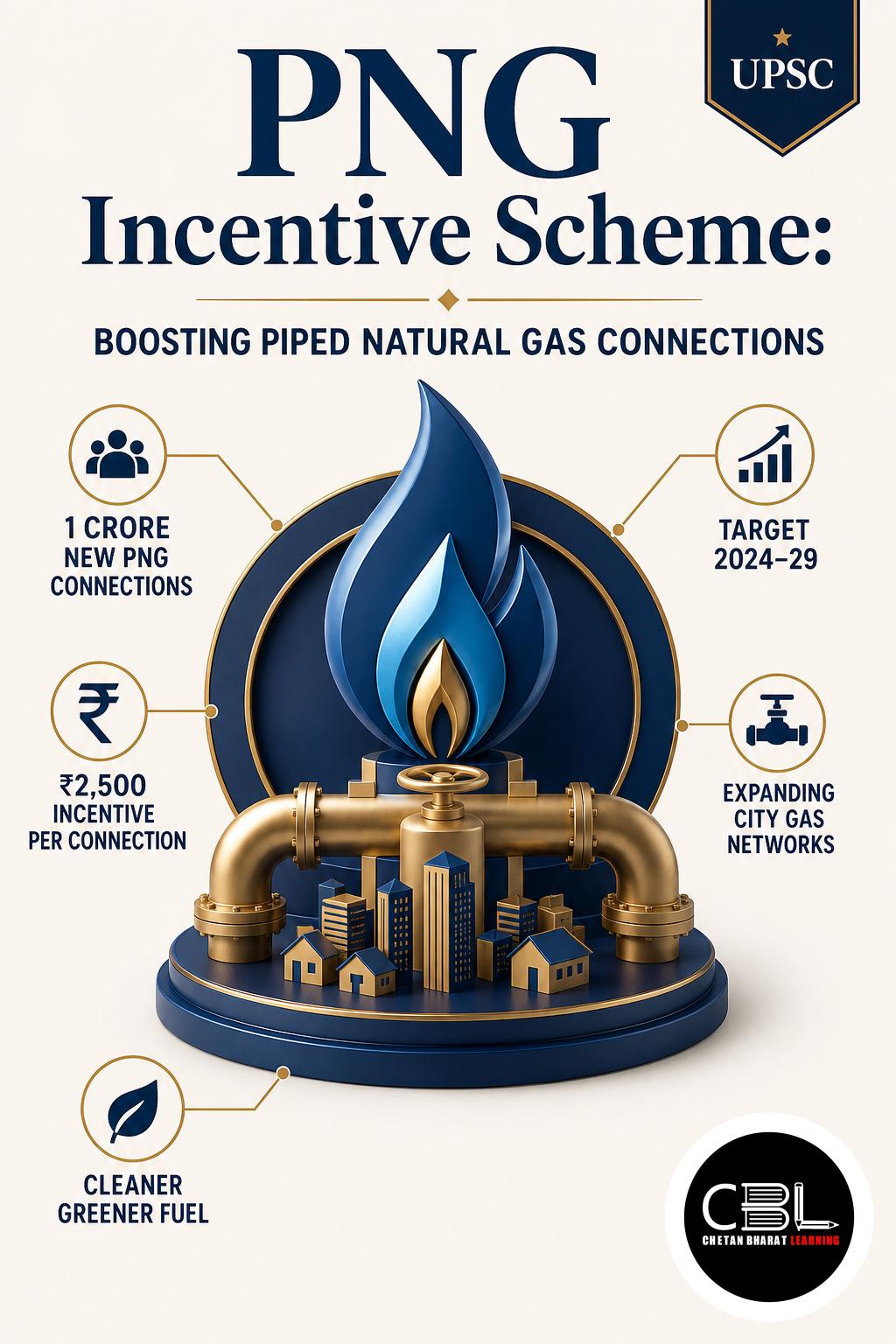
PNG Incentive Scheme is a government initiative to promote domestic piped natural gas (PNG) connections, taking effect on 1 September 2026, across two six-month tranches. Under the scheme, City Gas Distribution (CGD) entities will receive an additional 200 standard cubic meters of lower-priced Administered Price Mechanism (APM) gas for each eligible new billed connection. This allows companies to use cheaper domestic gas to replace costlier LNG purchased for their CNG transport arms, reducing the PNG household-connection payback period from 10 to about 3 years.
PNG consists of 85–95% methane and is supplied 24/7 via underground CGD pipelines, regulated by the Petroleum and Natural Gas Regulatory Board (PNGRB). Other initiatives include National PNG Drive 2.0, additional LPG allocation to reform-friendly states, and the Natural Gas & Petroleum Distribution Order, 2026, which standardises Right-of-Way charges.
Why is PNG Incentive Scheme in News?
PNG Incentive Scheme is in the news because it aims to significantly expand India’s PNG base and reduce reliance on imported LPG. The scheme is part of a broader push to promote natural gas as a cleaner and more economical household fuel. The government has also launched National PNG Drive 2.0 to replace LPG cylinders with piped gas nationwide.
The Natural Gas & Petroleum Distribution Order, 2026, standardises Right-of-Way charges and provides time-bound approvals for PNG infrastructure. The Pradhan Mantri Urja Ganga pipeline and North East Gas Grid extend the national gas grid into eastern and north-eastern India.
Key Features of PNG Incentive Scheme
- Additional APM Gas: 200 SCM of lower-priced gas per new billed connection.
- Reduced Payback Period: From 10 years to about 3 years for PNG connections.
- Two Tranches: Operates across two six-month periods from September 2026.
- Regulation: PNGRB regulates CGD entities; MoPNG oversees the sector.
- Infrastructure Push: Urja Ganga and North East Gas Grid expand the gas network.
Challenges in PNG Incentive Scheme
- Infrastructure: Expanding the CGD network to all regions requires significant investment.
- Consumer Adoption: Households may resist switching from LPG due to upfront connection costs.
- Regulatory Hurdles: Right-of-Way approvals and land acquisition can delay projects.
- Gas Availability: Ensuring adequate domestic gas supply to meet increased demand.
- Pricing: APM gas pricing must remain competitive to ensure scheme viability.
Way Forward for PNG Incentive Scheme
To maximise the impact of PNG Incentive Scheme, the government should streamline regulatory approvals and provide financial incentives for households to switch to PNG. Public awareness campaigns about the benefits of PNG—convenience, safety, and cost savings—can accelerate adoption.
Strengthening the gas pipeline network, especially in underserved regions, and ensuring affordable pricing are essential. The scheme’s success will contribute to India’s energy security and reduce the import bill.
Prelims Practice Questions
Q1. When does the PNG Incentive Scheme take effect?
- a. 1 January 2026
- b. 1 September 2026
- c. 1 April 2027
- d. 1 December 2026
Answer: (b) The scheme takes effect on 1 September 2026.
Q2. What incentive does the scheme provide to CGD entities?
- a. Tax exemption
- b. Additional APM gas
- c. Subsidy on pipelines
- d. Land grants
Answer: (b) Entities receive additional APM gas for each new connection.
Q3. What is the current PNG base in India?
- a. 1 crore
- b. 1.74 crore
- c. 2.5 crore
- d. 3 crore
Answer: (b) The current base is 1.74 crore connections.
Q4. Which body regulates CGD entities?
- a. RBI
- b. PNGRB
- c. SEBI
- d. CERC
Answer: (b) The Petroleum and Natural Gas Regulatory Board regulates CGD.
Q5. What is the composition of PNG?
- a. 70% methane
- b. 85-95% methane
- c. 50% methane
- d. 100% methane
Answer: (b) PNG consists of 85–95% methane.
FAQs on PNG Incentive Scheme
What is the PNG Incentive Scheme?
It is a government scheme to expand PNG connections by providing additional APM gas to CGD entities for each new billed connection.
What is PNG?
Piped Natural Gas is a clean fuel consisting of 85-95% methane, supplied through pipelines.
How does the scheme benefit consumers?
It reduces the payback period for PNG connections from 10 to about 3 years, making it more affordable.
Related Current Affairs
Preparing for UPSC, PCS or HCS?
Talk to a mentor at Chetan Bharat Learning, Chandigarh. Free guidance on choosing the right exam and building a study plan.
Chat on WhatsAppCall 97793 53345UPSC / IAS / PCS coaching in Chandigarh · Trusted by aspirants across Punjab & Haryana
Leave a Reply
You must be logged in to post a comment.