
UPSC Mapping
- Prelims: Governance & Media
- Mains: GS Paper 2 (Governance) & GS Paper 3 (Economy)
Article
Key Quick Facts
| Public Savings | $1 → $100+ |
|---|---|
| Press Freedom Impact | 1-2% GDP reduction |
| Disinformation Damage | $355-516 billion/year |
What is Independent Journalism?
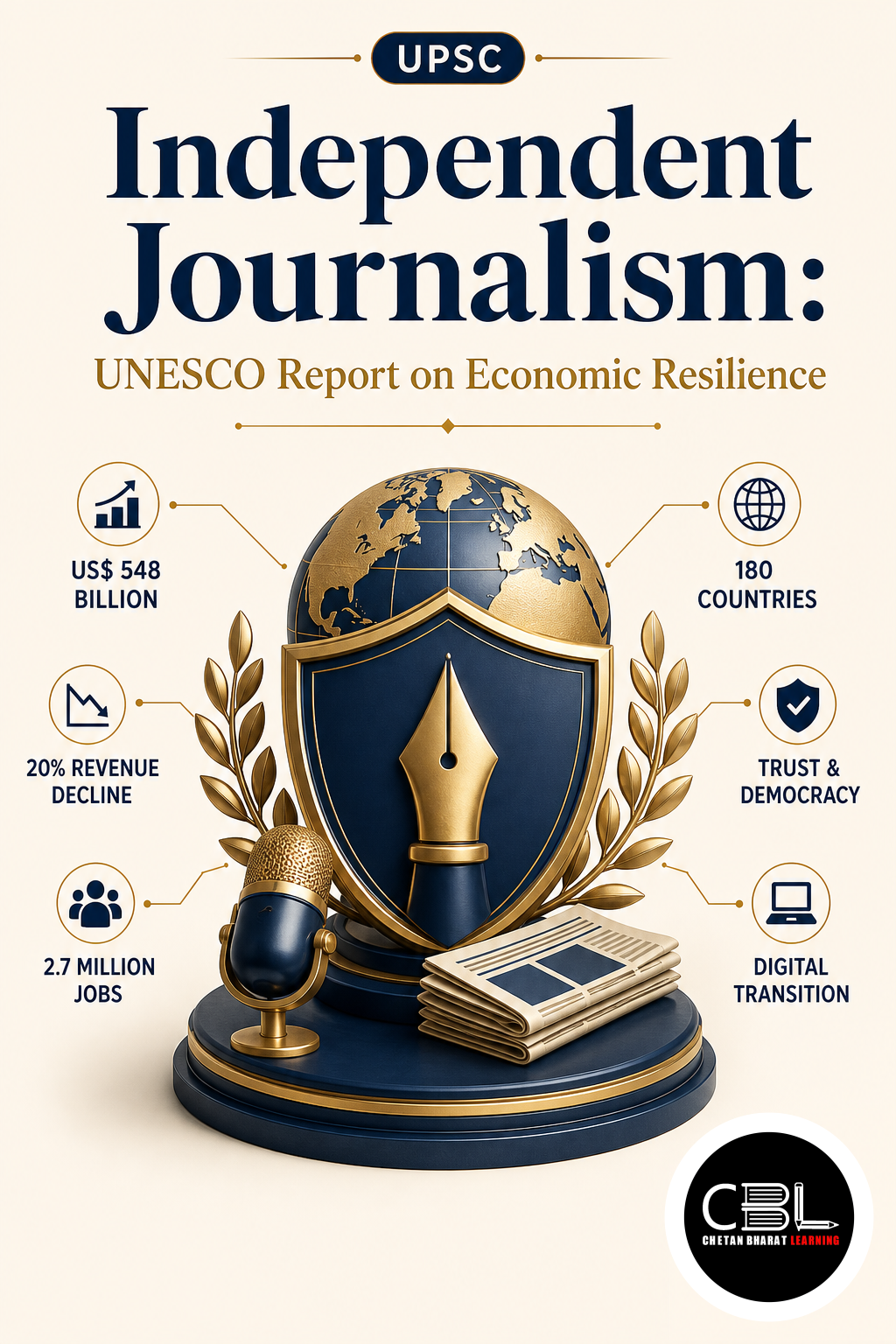
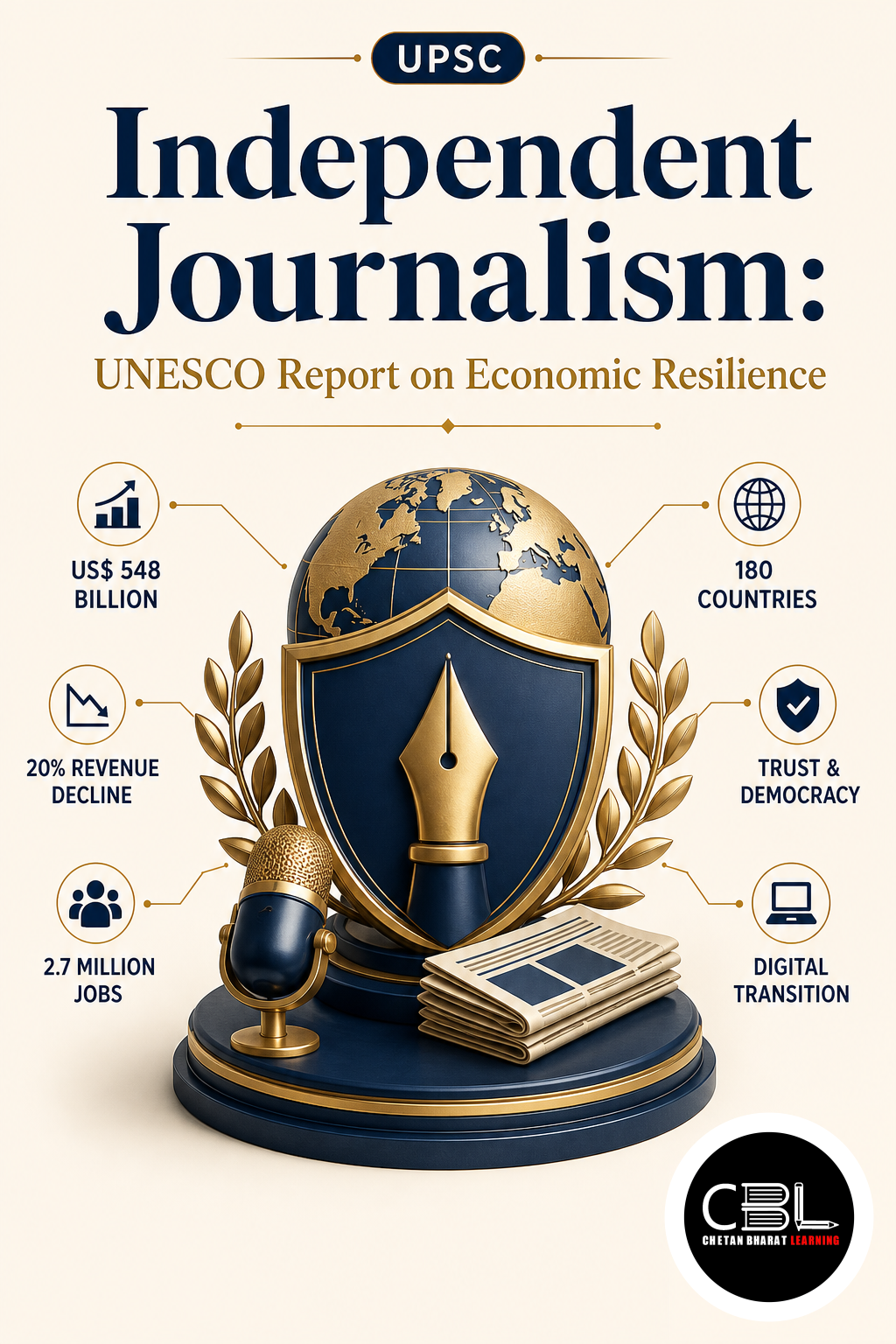
Independent Journalism refers to media that operates free from government, corporate, or political influence, providing accurate and impartial information to the public. UNESCO’s report highlights its role as a public good and a structural asset to national stability, noting that a decline in press freedom correlates with a 1% to 2% reduction in real GDP growth across 97 studied nations.
It also serves as a cost-effective defence against disinformation campaigns, which cause an estimated $355–516 billion in annual economic damage. During disasters, each additional news story published generates $500,000 in official emergency aid, while sustained access to free media reduces the likelihood of conflict and repression.
Why is Independent Journalism in News?
The 2026 World Press Freedom Index classifies only 1% of the global population as living in countries with ‘good’ press freedom. Digital platforms and generative AI now capture over 70% of digital advertising revenue, starving local news outlets of financial sustainability. UNESCO recommends allocating 0.1% of global GDP (about 15 days of global military spending) to sustainably fund healthy public media, guided by the Media Viability Manifesto. PIB release
Key Features of Independent Journalism
- Economic Value: Every $1 invested generates over $100 in public savings.
- GDP Impact: Press freedom decline correlates with 1-2% GDP reduction.
- Disinformation Shield: Reduces $355-516 billion in annual economic damage.
- Humanitarian Mobilisation: Each disaster story generates $500,000 in aid.
- Conflict Mitigation: Reduces likelihood of conflict and repression.
Challenges to Independent Journalism
- Democratic Decline: Only 1% of the global population lives in ‘good’ press freedom countries.
- Technological Disruption: Digital platforms and AI capture over 70% of digital ad revenue.
- Financial Contraction: Declining public and international funding reduces reliable information availability.
- Disinformation: False narratives undermine public trust.
- Legal Threats: SLAPPs and censorship laws stifle critical reporting.
Way Forward for Independent Journalism
Governments should allocate 0.1% of GDP to public media and independent journalism, implement the Media Viability Manifesto to coordinate international support, and provide targeted support for the Global South. Regulating digital platforms for fair revenue sharing, promoting media literacy, and ensuring journalist safety are also critical. UNESCO
Prelims Practice Corner
- Q1. What is the return on investment for investigative journalism as per UNESCO? (a) $1 → $10 (b) $1 → $50 (c) $1 → $100+ (d) $1 → $500
Answer: (c) Every $1 invested generates over $100 in public savings. - Q2. What percentage of the global population lives in countries with ‘good’ press freedom? (a) 1% (b) 5% (c) 10% (d) 25%
Answer: (a) Only 1% of the global population lives in ‘good’ press freedom countries. - Q3. How much does disinformation cost the global economy annually? (a) $100-200 billion (b) $355-516 billion (c) $1 trillion (d) $2 trillion
Answer: (b) Disinformation causes $355-516 billion in annual damage. - Q4. What percentage of digital ad revenue is captured by digital platforms and AI? (a) 40% (b) 50% (c) 60% (d) 70%
Answer: (d) They capture over 70% of digital ad revenue. - Q5. What is UNESCO’s funding recommendation? (a) 0.01% of GDP (b) 0.1% of GDP (c) 1% of GDP (d) 5% of GDP
Answer: (b) UNESCO recommends allocating 0.1% of global GDP.
Mains Practice Questions
- Q1. Discuss the economic and democratic significance of independent journalism, with reference to the UNESCO report on media viability. (250 words, 15 marks)
Answer Structure:- Intro: Introduce independent journalism as a public good.
- Body: Discuss economic value, democratic value, challenges, and suggest funding and regulatory reforms.
- Conclusion: Emphasise the need for sustainable media ecosystems.
- Q2. What are the key challenges facing independent journalism today, and how can they be addressed? (150 words, 10 marks)
Answer Structure:- Intro: Highlight the crisis of media viability.
- Body: Discuss challenges, suggest solutions: public funding, platform regulation, media literacy, legal protections.
- Conclusion: Conclude that independent journalism is essential for democracy.
FAQs on Independent Journalism
What is independent journalism?
It is journalism free from government, corporate, or political influence, serving the public interest.
Why is independent journalism economically important?
It reduces corruption, improves governance, and contributes to GDP growth.
What are the main threats to media viability?
Digital platforms capturing ad revenue, disinformation, financial contraction, and legal pressures.
Related Current Affairs
Preparing for UPSC, PCS or HCS?
Talk to a mentor at Chetan Bharat Learning, Chandigarh. Free guidance on choosing the right exam and building a study plan.
Chat on WhatsAppCall 97793 53345UPSC / IAS / PCS coaching in Chandigarh · Trusted by aspirants across Punjab & Haryana
Leave a Reply
You must be logged in to post a comment.