
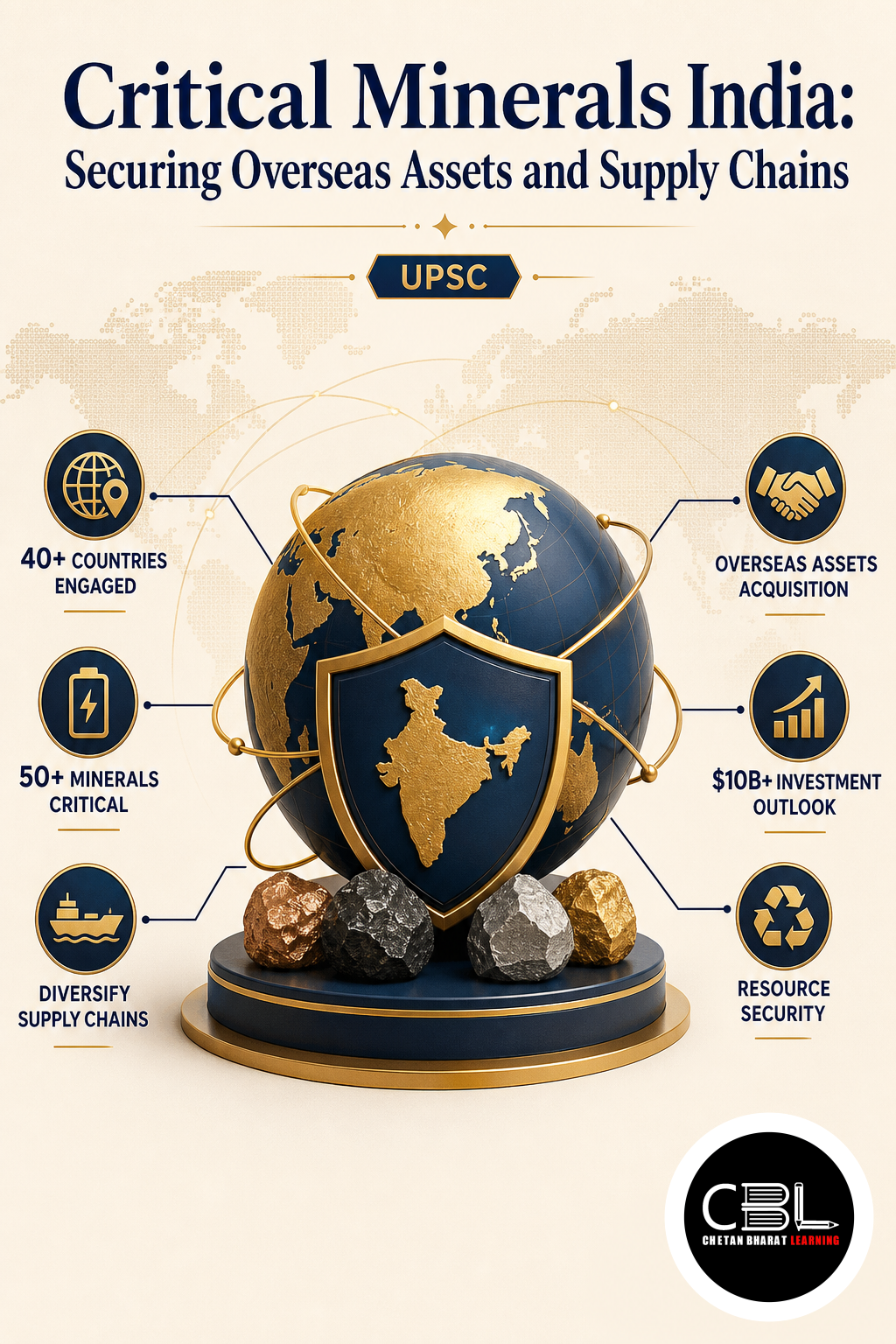

UPSC Mapping
| Prelims | Economy & Environment |
|---|---|
| Mains | GS Paper 3 (Economic Development & Security) |
Quick Facts
| Critical Minerals List | 30 minerals (2023) |
|---|---|
| KABIL Objective | Secure overseas strategic minerals |
| Lithium Triangle | Argentina, Bolivia, Chile |
What are Critical Minerals India?
Critical Minerals India are minerals that are strategically and economically important but face supply chain vulnerabilities. India identified a list of 30 critical minerals in 2023, including lithium, cobalt, rare earth elements, and graphite. These minerals are essential for clean-energy technologies (EV batteries, wind turbines), electronics, and defence.
India’s big problem is resource concentration—critical minerals are not evenly distributed globally. China dominates processing and refining, controlling significant portions of the supply chain. Mineral security requires control over the entire supply chain—exploration, mining, processing, refining, and manufacturing—not merely ownership of a mine.
Why is Critical Minerals India in News?
Critical Minerals India is in the news because India is struggling to secure overseas mineral assets through KABIL and other government-backed efforts. KABIL has acquired a lithium exploration interest in Catamarca, Argentina—part of the Lithium Triangle along with Bolivia and Chile.
However, India faces intense competition from China, the US, the EU, and Japan. Resource nationalism—governments imposing export restrictions, higher royalties, and local-content requirements—is rising. China’s dominance in rare-earth processing and magnet supply chains makes India’s dependence a strategic vulnerability.
Key Features of Critical Minerals India
- Criticality: Minerals are critical when they are strategically important, economically important, and supply-vulnerable.
- Resource Concentration: India lacks sufficient domestic reserves of many critical minerals.
- KABIL: A government-owned joint venture to acquire and develop strategic mineral assets abroad.
- Lithium Triangle: Argentina, Bolivia, and Chile hold significant shares of global lithium resources.
- National Critical Mineral Mission: Aims to strengthen domestic exploration, secure overseas assets, build processing capabilities, and promote recycling.
Challenges in Critical Minerals India
- China Dominance: China controls significant portions of critical mineral processing and rare-earth magnet supply chains.
- Resource Nationalism: Host countries may impose export restrictions, higher royalties, and local-content requirements.
- Competition: India competes with the US, EU, Japan, South Korea, and Australia for assets.
- High Capital Requirements: Mining projects require huge upfront investment, infrastructure, and long timelines.
- Supply Chain Vulnerability: India may acquire a mine but still depend on another country for processing and refining.
Way Forward for Critical Minerals India
To secure Critical Minerals India, the approach should be: explore, mine, process, recycle, and diversify—rather than simply import and consume. The National Critical Mineral Mission must strengthen domestic exploration through geological surveys and incentivise private sector participation.
Building processing and refining capabilities in India is essential to capture value and reduce dependence. Promoting recycling of critical minerals from end-of-life products (EV batteries, electronics) can create a circular economy. Diversifying overseas sources and engaging in multilateral agreements can reduce supply chain risks.
Prelims Practice Corner
Q1. How many critical minerals did India identify in 2023?
- (a) 10
- (b) 20
- (c) 30
- (d) 50
Answer: (c) India identified a list of 30 critical minerals.
Q2. What is the Lithium Triangle?
- (a) Three lithium mines in India
- (b) Argentina, Bolivia, Chile
- (c) Three lithium processing hubs
- (d) A lithium battery manufacturing zone
Answer: (b) The Lithium Triangle comprises Argentina, Bolivia, and Chile.
Q3. What is KABIL?
- (a) A mining company
- (b) Khanij Bidesh India Ltd., a government joint venture for overseas mineral acquisition
- (c) A research institute
- (d) A trade body
Answer: (b) KABIL is a government joint venture to secure strategic mineral assets abroad.
Q4. Which country dominates rare-earth processing and magnet supply chains?
- (a) USA
- (b) China
- (c) Australia
- (d) Japan
Answer: (b) China dominates rare-earth processing and magnet supply chains.
Q5. What is resource nationalism?
- (a) Nationalising all mines
- (b) Governments imposing export restrictions and higher royalties on minerals
- (c) Free trade in minerals
- (d) Privatising mining companies
Answer: (b) Resource nationalism refers to government measures to control mineral exports and increase revenue.
Mains Practice Questions
Q1. Discuss the strategic importance of critical minerals for India’s clean-energy transition and the challenges in securing their supply. (250 words, 15 marks)
Answer Structure:
- Intro: Introduce critical minerals and their importance for EVs, renewables, and electronics.
- Body: Discuss India’s vulnerability—resource concentration, import dependence, China’s dominance. Analyse KABIL’s efforts and challenges: competition, resource nationalism, supply chain gaps. Suggest a strategy: explore, mine, process, recycle, diversify.
- Conclusion: Emphasise the need for a comprehensive Critical Mineral Mission.
Q2. What is the role of KABIL in India’s critical mineral strategy, and what challenges does it face? (150 words, 10 marks)
Answer Structure:
- Intro: Define KABIL and its mandate.
- Body: Discuss KABIL’s role in acquiring overseas assets (lithium in Argentina). Analyse challenges: competition from China, resource nationalism, high capital requirements, and the need for processing capabilities.
- Conclusion: Conclude that KABIL is essential but must be part of a broader supply chain strategy.
FAQs on Critical Minerals India
What are critical minerals?
Minerals that are strategically and economically important but face supply chain vulnerabilities.
Why is India struggling to secure critical minerals?
Due to resource concentration, competition from China and others, resource nationalism, and the high capital requirements of mining projects.
What is the National Critical Mineral Mission?
It is a mission to strengthen domestic exploration, secure overseas assets, build processing capabilities, and reduce import dependence.
Related Current Affairs
Preparing for UPSC, PCS or HCS?
Talk to a mentor at Chetan Bharat Learning, Chandigarh. Free guidance on choosing the right exam and building a study plan.
Chat on WhatsAppCall 97793 53345UPSC / IAS / PCS coaching in Chandigarh · Trusted by aspirants across Punjab & Haryana
Leave a Reply
You must be logged in to post a comment.