

UPSC Mapping
Study Relevance
| Prelims | Mains |
|---|---|
| Economy & Energy | GS Paper 3 (Economic Development) |
Quick Facts
| Indicator | Value |
|---|---|
| US Share (2026) | 67% |
| Earlier US Share | ~10% |
| Shipping Time (US to India) | 25–35 days |
| Shipping Time (Gulf to India) | 5–10 days |
Article
What is LPG Dependence US?
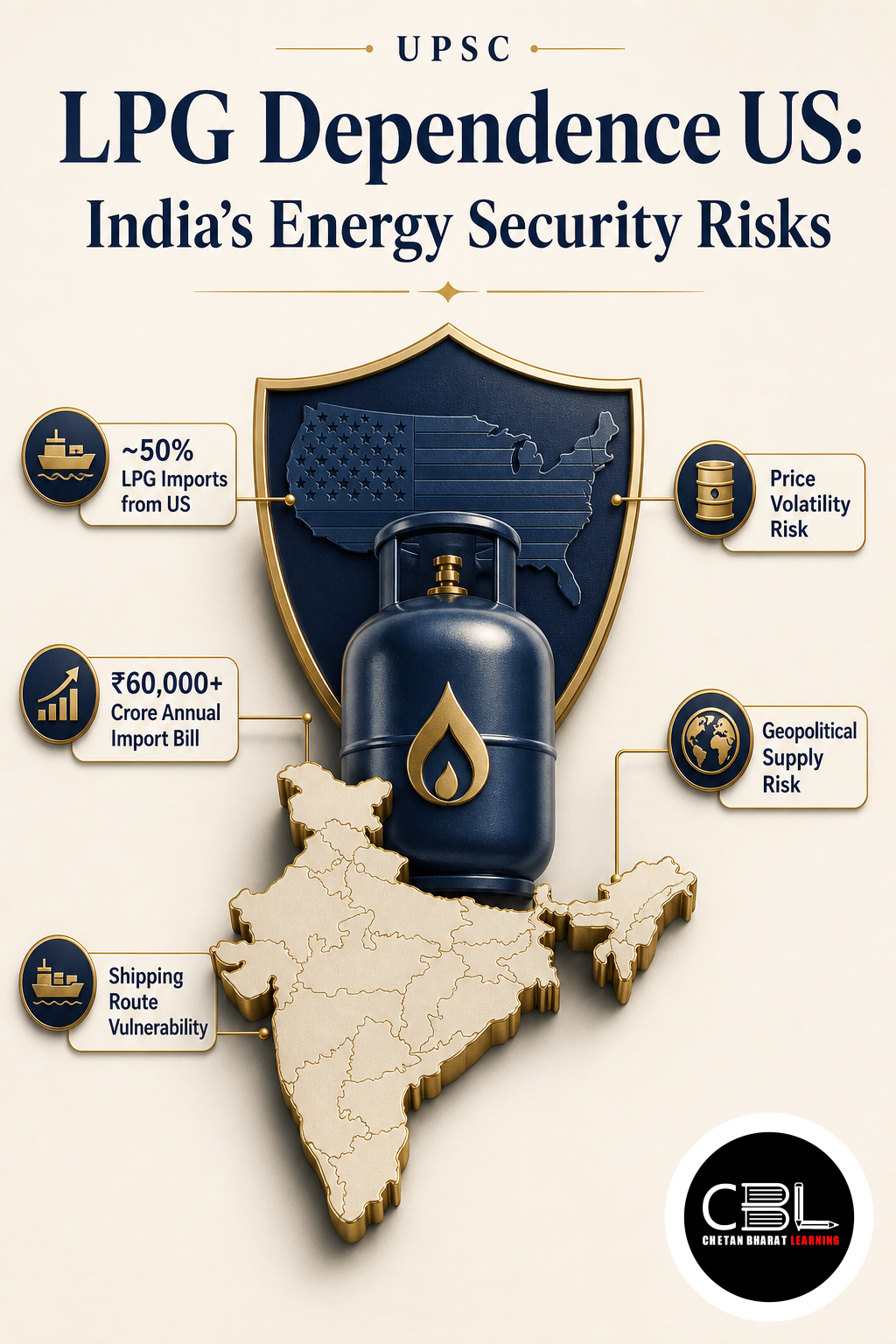
LPG Dependence US refers to India’s increasing reliance on the United States for its liquefied petroleum gas imports, which now constitute over two-thirds of total LPG imports. India is the world’s second-largest LPG importer, meeting about 60% of its consumption through imports, with nearly 90% traditionally passing through the Strait of Hormuz.
When the Strait faced severe disruptions in early 2026, West Asian supplies fell by almost 85% between February and June. To manage the crisis, India turned to the U.S. under a long-term deal for 2.2 million tonnes, and U.S. imports rose to 0.77 million metric tonnes in June alone, up 19.4% from May. This strategic pivot, while solving an immediate shortage, has created a new set of vulnerabilities.
Why is LPG Dependence US in News?
The LPG Dependence US is in the spotlight because the Minister of Petroleum and Natural Gas publicly disclosed the dramatic increase in U.S. share, sparking debates on energy security. The shift was a crisis response to Hormuz disruptions, but experts warn that over-reliance on a single distant supplier carries geopolitical and economic risks.
Additionally, the government has informed Parliament that accumulated under-recoveries of oil marketing companies crossed ₹59,000 crore as of July 31, 2026, partly due to the higher costs of U.S. imports and a weaker rupee. For official data, refer to the PIB release on the energy situation.
Key Features of India’s LPG Dependence US
- High Concentration: The U.S. now supplies 67% of India’s LPG imports, a massive concentration compared to the earlier diversified West Asian sourcing.
- Long-Term Contracts: State-run refiners signed a deal for 2.2 million tonnes for 2026, ensuring supply but locking in volume commitments.
- Cost Dynamics: Although U.S. LPG (Mont Belvieu) can be cheaper at source, longer shipping routes (25–35 days vs 5–10 days from Gulf) often offset the advantage.
- Geopolitical Buffer: The U.S. supply bypasses the Strait of Hormuz, reducing exposure to chokepoint risks, but introduces exposure to U.S. trade policies.
- Political Fuel: LPG is a politically sensitive commodity; shortages can trigger social unrest, so the government prioritises availability over cost.
Challenges of LPG Dependence US
- Currency and Inflation Risks: A strong dollar, driven by U.S. inflation and high interest rates, increases the rupee cost of each imported cargo, straining the fiscal deficit.
- Geopolitical Leverage: The U.S. has a history of using sanctions and trade restrictions as foreign policy tools, potentially affecting energy supplies to India.
- Freight and Transit Costs: Longer shipping distances make freight costs more volatile, and any disruption on the U.S. route could cripple supplies.
- Under-recoveries: Oil marketing companies face mounting losses if domestic LPG prices are kept low despite rising global prices and a weaker rupee.
- Limited Domestic Production: Domestic LPG production meets only about 65% of consumption (4.3 million tonnes vs 6.5 million tonnes in Q1 FY27), leaving a persistent import gap. For more insights on such economic vulnerabilities, explore the Indian economy section.
Way Forward for LPG Dependence US
To mitigate the risks of excessive LPG Dependence US, India must pursue a multi-pronged diversification strategy. Experts suggest exploring supplies from Australia, which lies in the Indo-Pacific and offers shorter routes than the U.S., though its export volumes remain small. Argentina, Nigeria, and Angola could also provide strategic flexibility, though none can replace Gulf volumes at scale.
Strengthening domestic production is equally critical; refineries have already ramped up daily LPG output from 34,000 to 55,000 tonnes during the crisis. Additionally, improving forex hedging tools for OMCs and building larger strategic reserves can cushion against price shocks. True energy security lies not in swapping one dependency for another, but in building resilient, diversified supply chains. For more on strategic reserves, refer to the NITI Aayog.
Prelims Practice Corner
Q1. What is the current share of the United States in India’s LPG imports as of 2026?
- (a) 10%
- (b) 35%
- (c) 67%
- (d) 85%
Answer: (c) India’s LPG imports from the US have risen to 67%.
Q2. What was the primary reason for India’s shift to US LPG imports?
- (a) Lower cost of US LPG
- (b) Disruptions in the Strait of Hormuz
- (c) US sanctions on India
- (d) Increased domestic production
Answer: (b) Disruptions in the Strait of Hormuz reduced West Asian supplies, prompting a shift to US imports.
Q3. Approximately how many days does it take for an LPG shipment from the US to reach India?
- (a) 5–10 days
- (b) 15–20 days
- (c) 25–35 days
- (d) 40–50 days
Answer: (c) US shipments take 25–35 days, compared to 5–10 days from the Gulf.
Q4. As of July 2026, what was the total accumulated under-recovery of public sector oil marketing companies?
- (a) ₹20,000 crore
- (b) ₹40,000 crore
- (c) ₹59,000 crore
- (d) ₹80,000 crore
Answer: (c) The under-recoveries crossed ₹59,000 crore as of July 31, 2026.
Q5. Which country is suggested as a potential alternative LPG supplier with shorter shipping routes than the US?
- (a) Russia
- (b) Australia
- (c) Brazil
- (d) Qatar
Answer: (b) Australia offers advantages in shipping distance and is outside the Hormuz chokepoint.
Mains Practice Questions
Q1. Analyse the strategic and economic implications of India’s growing dependence on the United States for LPG imports. (250 words, 15 marks)
Answer Structure:
- Intro: Briefly mention the rise in US LPG share and its context (Hormuz crisis).
- Body: Discuss strategic risks: US foreign policy leverage, sanctions. Economic risks: dollar strength, freight costs, under-recoveries. Also note the benefit of bypassing Hormuz.
- Conclusion: Suggest a balanced approach of diversification and domestic production enhancement.
Q2. What is the concept of energy security, and how does India’s recent LPG sourcing shift affect it? (150 words, 10 marks)
Answer Structure:
- Intro: Define energy security as reliable, affordable, and sustainable energy supply.
- Body: Explain how the shift to US imports improved reliability (avoiding Hormuz) but reduced affordability due to longer routes and currency risks. Also mention sustainability concerns.
- Conclusion: Conclude that a diversified mix is essential for long-term energy security.
FAQs on LPG Dependence US
Why has India’s LPG dependence on the US increased?
The increase is a direct result of disruptions in the Strait of Hormuz, which sharply reduced traditional West Asian supplies, forcing India to secure alternative American imports.
What percentage of India’s LPG now comes from the US?
As of 2026, the US supplies 67% of India’s LPG imports, compared with roughly 10% earlier.
How can India reduce its LPG dependence on the US?
India can diversify suppliers by sourcing from Australia, Argentina, and Nigeria, increase domestic production, and build strategic reserves while improving forex risk management.
Related Current Affairs
Preparing for UPSC, PCS or HCS?
Talk to a mentor at Chetan Bharat Learning, Chandigarh. Free guidance on choosing the right exam and building a study plan.
Chat on WhatsAppCall 97793 53345UPSC / IAS / PCS coaching in Chandigarh · Trusted by aspirants across Punjab & Haryana
Leave a Reply
You must be logged in to post a comment.