
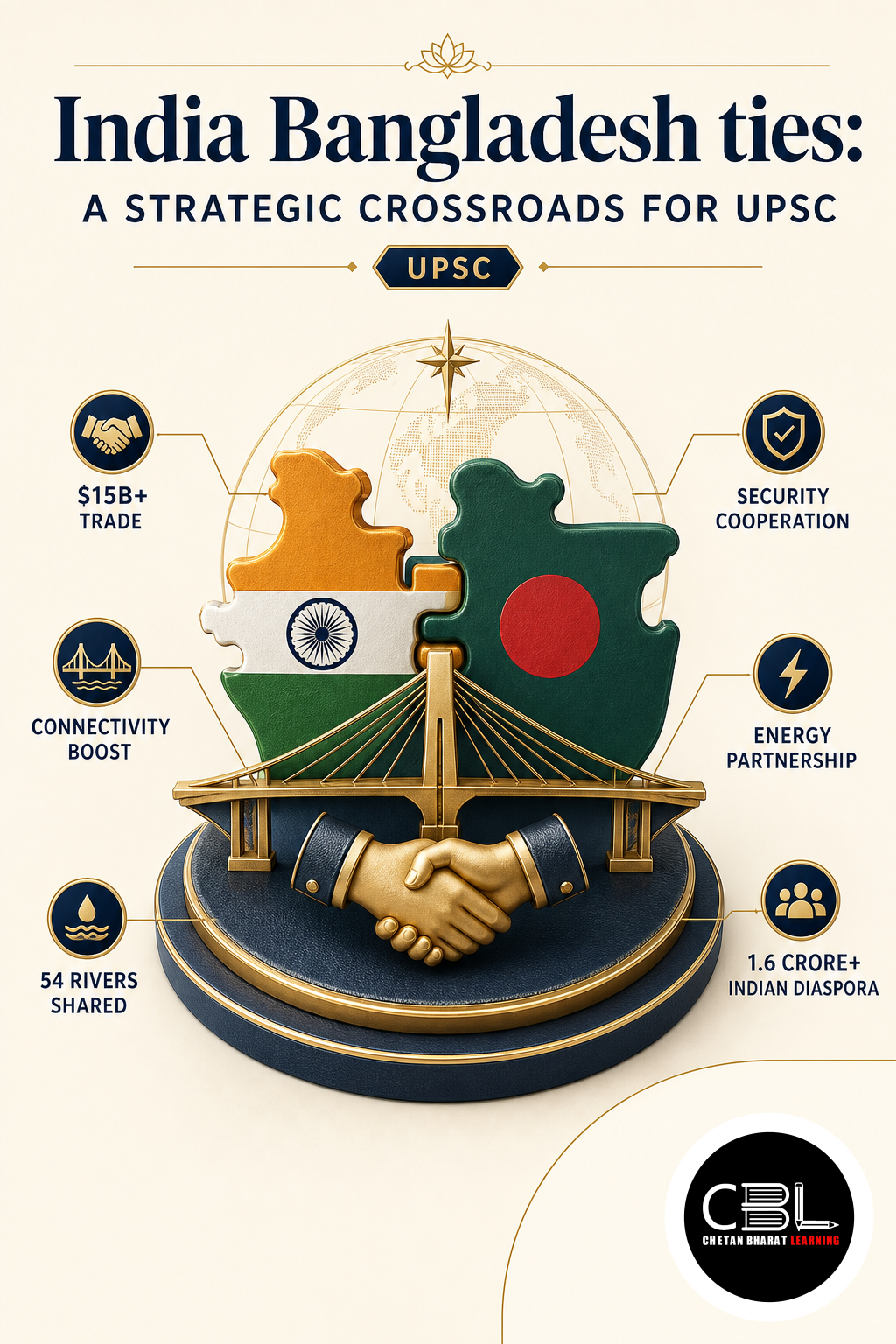

UPSC Mapping
- Prelims – International Relations: India’s Neighbourhood
- Mains – GS Paper II: India and its Neighbourhood
Quick Facts
| Neighbour | Bangladesh |
|---|---|
| Strategic Region | Bay of Bengal |
| Key Issue | Connectivity and Water |
| Indian Region | Northeast India |
What are India Bangladesh ties?
India Bangladesh ties refer to the broad bilateral relationship between India and Bangladesh across diplomacy, trade, connectivity, energy, border management, water resources, security and people-to-people relations. The relationship is shaped by geography because Bangladesh borders India’s West Bengal, Assam, Meghalaya, Tripura and Mizoram, while the two countries share a long land and riverine frontier.
The relationship also has a strong historical and cultural foundation. India’s role in Bangladesh’s Liberation War, shared linguistic and cultural links in parts of eastern South Asia and extensive economic interaction provide a base for cooperation. At the same time, high interdependence does not automatically eliminate friction, especially where national interests differ over water, migration, border management and trade.
Bangladesh is also important to India’s Act East Policy. Connectivity through Bangladesh can offer the Indian Northeast access to ports, waterways, roads and railways while reducing dependence on the narrow Siliguri Corridor for some forms of regional movement. Earlier bilateral agreements have recognised the potential of using Bangladeshi ports and multimodal routes for connectivity with India’s Northeast.
Why are India Bangladesh ties in News?
India Bangladesh ties are receiving renewed attention after Indian High Commissioner Dinesh Trivedi held talks with Bangladesh Prime Minister Tarique Rahman in Dhaka and subsequently met Prime Minister Narendra Modi in New Delhi. The sequence indicates that diplomatic communication remains active as both governments navigate a relationship that has experienced considerable strain in recent years.
The present phase follows a political transition in Bangladesh. Prime Minister Modi congratulated Tarique Rahman after his electoral victory in February 2026 and reaffirmed India’s commitment to the peace, progress and prosperity of both countries. This provides an institutional basis for engagement even when specific bilateral questions remain sensitive.
The relationship matters because Bangladesh sits at the intersection of India’s Northeast, Bay of Bengal and eastern neighbourhood. It is relevant to regional connectivity, border security, trade routes, energy cooperation and India’s wider Indo-Pacific interests.
Key Features
- Northeast connectivity: Bangladesh can provide India with alternative road, rail, inland-waterway and port routes linking the Northeast with the rest of the country and the Bay of Bengal.
- Trade and economy: Bilateral commerce creates economic interdependence, while improved logistics and border infrastructure can support regional value chains.
- Transboundary rivers: Shared river systems make water governance a permanent diplomatic issue, with the Ganges and Teesta occupying particular importance.
- Border management: India and Bangladesh must manage illegal crossings, smuggling, trafficking and other cross-border activities while protecting border communities and livelihoods.
- Energy cooperation: Electricity trade and grid connectivity have created another channel for practical cooperation and regional integration.
Challenges
- Water-sharing disputes: The Teesta remains a difficult issue because river management involves both international diplomacy and domestic political interests within India.
- Border sensitivities: Illegal crossings, trafficking, smuggling and incidents involving border personnel can affect public perceptions and diplomatic trust.
- Trade imbalance concerns: Differences in market access and trade composition can generate perceptions of unequal economic benefit.
- Political transitions: Changes in Bangladesh’s domestic political environment can alter perceptions of India and affect the pace of bilateral engagement.
- Migration and public perceptions: Irregular migration and related political narratives can complicate an otherwise cooperative bilateral relationship.
Way Forward
India should treat India Bangladesh ties as a long-term institutional partnership rather than a relationship dependent on political personalities. Regular diplomatic consultations, stronger working-level mechanisms and issue-specific dialogue can help separate areas of cooperation from areas of disagreement.
Water diplomacy should receive sustained attention. India and Bangladesh can strengthen joint river-basin management through reliable hydrological data exchange, flood forecasting, pollution control, navigation cooperation and dialogue on equitable water utilisation.
Connectivity should remain a major pillar. Roads, railways, inland waterways and port facilities can improve the economic integration of Bangladesh and India’s Northeast. Such projects should be accompanied by efficient customs procedures, border infrastructure and digital systems so that physical connectivity translates into commercial connectivity.
Energy cooperation can also be expanded through reliable cross-border electricity trade and grid coordination. Earlier bilateral cooperation has already supported power-grid connectivity, demonstrating how practical economic interests can create durable diplomatic incentives.
At the regional level, India should strengthen Bangladesh’s role in BIMSTEC and Bay of Bengal cooperation. A stable Bangladesh is valuable not only bilaterally but also for India’s wider eastern maritime strategy, connectivity with Southeast Asia and integration of the Northeast.
Prelims Practice Corner
- Which of the following Indian States share a land boundary with Bangladesh?
- (a) Assam, Meghalaya, Tripura, Mizoram and West Bengal
- (b) Assam, Manipur, Tripura, Mizoram and West Bengal
- (c) West Bengal, Bihar, Assam and Tripura
- (d) Meghalaya, Nagaland, Tripura and Mizoram
Answer: (a) West Bengal, Assam, Meghalaya, Tripura and Mizoram.
- The Teesta River is associated with which of the following?
- (a) India and Nepal only
- (b) India and Bangladesh
- (c) India and Bhutan only
- (d) Bangladesh and Myanmar
Answer: (b) The Teesta is a transboundary river flowing from India into Bangladesh.
- Which policy framework gives Bangladesh particular importance for India’s Northeast connectivity?
- (a) Act East Policy
- (b) Look West Policy
- (c) Central Asia Connect Policy
- (d) SAGAR doctrine alone
Answer: (a) Act East Policy.
- Chattogram and Mongla ports are significant in India-Bangladesh relations mainly because they can:
- (a) Provide military bases to India
- (b) Support movement of goods to and from India’s Northeast
- (c) Replace all Indian ports
- (d) Resolve the Teesta dispute
Answer: (b) Potential for regional connectivity and movement of goods.
- Which of the following best explains why transboundary rivers are important in India-Bangladesh relations?
- (a) They concern only navigation
- (b) They involve upstream-downstream interests, water security and ecological management
- (c) They have no impact on diplomacy
- (d) They are governed exclusively by international organisations
Answer: (b) Shared rivers create interconnected interests in water allocation, flood management, ecology and development.
Mains Practice Questions
- Examine the strategic importance of Bangladesh for India’s Northeast and Act East Policy. (10 marks)
Answer structure: Intro – Bangladesh’s geography and the Bay of Bengal; Body – multimodal connectivity, ports, inland waterways, trade, energy, Act East linkages; Conclusion – cooperative connectivity as a foundation for a stronger eastern neighbourhood.
- India-Bangladesh ties combine deep interdependence with persistent areas of friction. Discuss. (15 marks)
Answer structure: Intro – geography, history, economics and security; Body – trade, connectivity, energy, border cooperation, cultural links vs Teesta, migration, border incidents, trade concerns, political perceptions; Conclusion – institutionalised dialogue, cooperative water governance, resilient connectivity and pragmatic neighbourhood diplomacy.
FAQs on India Bangladesh ties
- Why is Bangladesh strategically important for India?
- Because of its location between India’s mainland, Northeast and the Bay of Bengal. It supports India’s interests in connectivity, trade, energy, border security and the Act East Policy.
- Why is the Teesta River important in India-Bangladesh relations?
- The Teesta is a transboundary river whose water management affects both India and Bangladesh. Its sharing involves downstream water requirements in Bangladesh and upstream/domestic federal considerations in India.
- How can Bangladesh strengthen India’s Northeast connectivity?
- By providing routes through roads, railways, inland waterways and ports that connect the Northeast with wider Indian and Bay of Bengal markets, complementing existing routes and supporting regional economic integration.
UPSC static linkage: Neighbourhood First; Act East Policy; BIMSTEC; Bay of Bengal cooperation; transboundary water governance; Teesta; Ganges Water Sharing Treaty; border management; BBIN; Northeast connectivity.
Source basis: Official PIB releases, The Indian Express, Ministry of External Affairs, CBL editorial and SEO guidelines.
Related Current Affairs
Preparing for UPSC, PCS or HCS?
Talk to a mentor at Chetan Bharat Learning, Chandigarh. Free guidance on choosing the right exam and building a study plan.
Chat on WhatsAppCall 97793 53345UPSC / IAS / PCS coaching in Chandigarh · Trusted by aspirants across Punjab & Haryana
Leave a Reply
You must be logged in to post a comment.