

UPSC Mapping
| Prelims | Mains |
|---|---|
| Tropical Cyclones, Typhoons, Coriolis Force | GS Paper I – Physical Geography & GS Paper III – Disaster Management |
What are Tropical Cyclones?
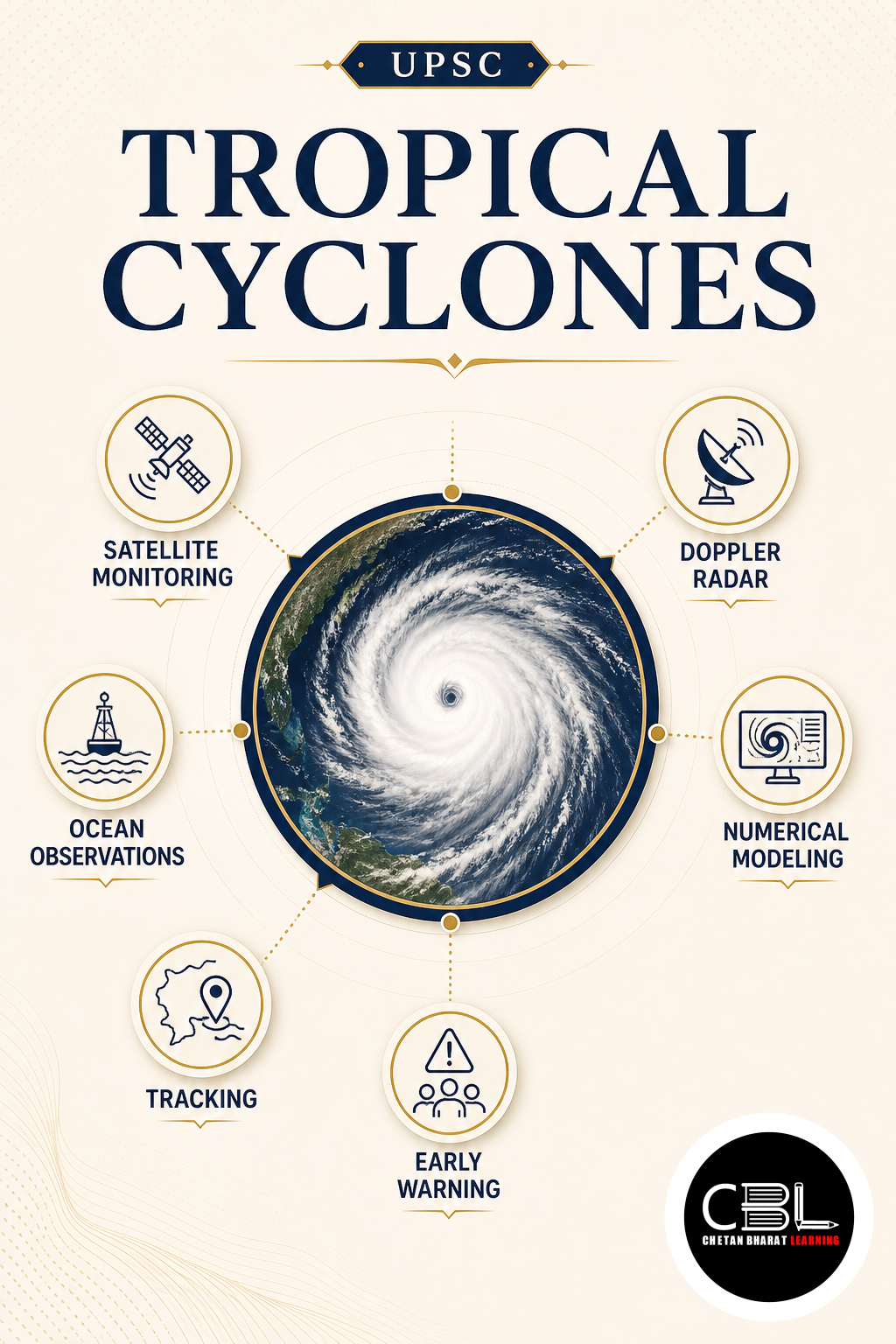
Tropical Cyclones are intense low-pressure systems that develop over warm tropical oceans. Their development requires warm sea-surface temperatures, abundant moisture, rising air and sufficient Coriolis force.
Warm ocean water supplies the energy that supports storm development, while condensation releases latent heat into the atmosphere. This process strengthens rising air and helps maintain the storm’s circulation under suitable atmospheric conditions.
These systems receive different names across ocean basins: hurricanes, typhoons or cyclones depending on the region. Typhoon Dolphin formed over the western Pacific Ocean.
Why are Tropical Cyclones in News?
Scientists are studying sharks equipped with sensors to improve hurricane forecasting. Tagged sharks function as mobile ocean sensors, collecting information such as water temperature, salinity and depth. Such observations complement conventional weather and ocean-monitoring systems.
Typhoon Dolphin affected eastern China, leading to evacuations and transport disruptions. The event demonstrates the importance of accurate forecasts and timely warnings in reducing human and economic consequences.
Key Features
- Cyclone formation: Warm ocean water provides heat and moisture for cyclone development.
- Latent heat: Released during condensation, sustaining the storm system.
- Coriolis force: Earth’s rotation enables organised cyclonic circulation away from the Equator.
- Ocean sensing: Tagged sharks as mobile sensors aiding forecasting research.
- Early warning: Improved prediction supports evacuation, preparedness and response measures.
A cyclone is a natural hazard; it becomes a disaster when exposure, vulnerability and insufficient coping capacity result in significant losses. Disaster impacts depend on population distribution, infrastructure quality, warning systems and preparedness.
Challenges
- Rapid intensification: Warm ocean conditions can lead to sudden changes in strength.
- Coastal vulnerability: Densely populated coasts face greater exposure to winds and flooding.
- Forecast uncertainty: Requires continuous atmospheric and oceanic observations.
- Disaster exposure: Severity influenced by population density, infrastructure and preparedness.
- Preparedness gaps: Forecasts must translate into effective community action.
Integrating innovative biological sensors into forecasting systems requires reliable data collection, scientific validation and integration with established networks. Disaster risk reduction also demands resilient infrastructure, public communication, evacuation planning and institutional coordination.
Way Forward
Combining marine-animal tracking with conventional weather monitoring can strengthen cyclone forecasting. Comprehensive ocean observations improve understanding of storm development and behaviour.
Early warning systems link scientific information with risk reduction. Forecasts have value when they reach vulnerable communities in time, supported by evacuation plans, resilient infrastructure and coordinated response.
In India, connect this topic with tropical climatology, coastal vulnerability, disaster management and climate resilience. Official information is available through the India Meteorological Department (https://mausam.imd.gov.in).
An integrated UPSC approach combines physical geography with human vulnerability, covering cyclone formation science, ocean observations and disaster risk reduction principles.
Prelims Practice Corner
Q1. Tropical cyclones derive much of their energy from:
(a) Ocean tides (b) Latent heat released during condensation (c) Earth’s magnetic field (d) Cold ocean currents
Answer: (b) Latent heat released during condensation.
Q2. Why do tropical cyclones generally not form at the Equator?
(a) Ocean water is always cold (b) Coriolis force is negligible (c) Atmospheric pressure is always high (d) Moisture is absent
Answer: (b) Coriolis force is negligible.
Q3. Typhoon Dolphin developed over which ocean basin?
(a) Atlantic Ocean (b) Indian Ocean (c) Western Pacific Ocean (d) Southern Ocean
Answer: (c) Western Pacific Ocean.
Q4. In the reported research, tagged sharks are primarily used as:
(a) Satellite launch platforms (b) Mobile ocean sensors (c) Artificial reefs (d) Coastal barriers
Answer: (b) Mobile ocean sensors.
Q5. A natural hazard becomes a disaster primarily when:
(a) It occurs over an ocean (b) It affects vulnerable populations and causes significant losses (c) It lasts for one day (d) It forms outside the tropics
Answer: (b) It affects vulnerable populations and causes significant losses.
Mains Practice Questions
Q1. Explain the factors responsible for the formation and intensification of tropical cyclones. (10 Marks)
Answer Structure
- Introduction: Define tropical cyclones as intense low-pressure systems over warm tropical oceans.
- Body: Discuss warm sea-surface temperatures, moisture, latent heat, rising air, Coriolis force and atmospheric conditions; include vulnerability and preparedness.
- Conclusion: Highlight how scientific forecasting and preparedness reduce cyclone-related losses.
Q2. Discuss the role of innovative ocean observations in improving tropical cyclone forecasting and disaster risk reduction. (15 Marks)
Answer Structure
- Introduction: Importance of continuous ocean observations for cyclone prediction.
- Body: Describe tagged sharks as mobile sensors, temperature and salinity data, conventional monitoring, early warning, evacuation and risk reduction.
- Conclusion: Integrating innovative and established systems enhances climate and disaster resilience.
FAQs on Tropical Cyclones
Why are sharks being used for cyclone research?
Tagged sharks function as mobile ocean sensors, collecting water temperature, salinity and depth observations.
What conditions are required for tropical cyclone formation?
Warm sea-surface temperatures, abundant moisture, rising air and sufficient Coriolis force. Latent heat sustains development.
Why do tropical cyclones not form at the Equator?
The Coriolis force is negligible at the Equator, preventing organised cyclonic circulation.
What was Typhoon Dolphin?
A tropical cyclone that formed over the western Pacific Ocean and affected eastern China, causing evacuations and transport disruptions.
What is the difference between a cyclone and a disaster?
A cyclone is a natural hazard; it becomes a disaster when exposure and vulnerability cause significant losses.
How can better ocean observations improve forecasting?
Additional data on marine conditions influence cyclone development and intensity; tagged sharks offer innovative observations.
Why are early warning systems important?
Timely warnings allow preparation, evacuation and coordinated emergency response, reducing cyclone impacts.
Why is this topic important for UPSC?
It links physical geography, tropical climatology, ocean science and disaster management, relevant to GS Paper I and III and Prelims.
Related Current Affairs
Preparing for UPSC, PCS or HCS?
Talk to a mentor at Chetan Bharat Learning, Chandigarh. Free guidance on choosing the right exam and building a study plan.
Chat on WhatsAppCall 97793 53345UPSC / IAS / PCS coaching in Chandigarh · Trusted by aspirants across Punjab & Haryana
Leave a Reply
You must be logged in to post a comment.