
UPSC Syllabus Mapping
| GS Paper | GS-I & GS-III |
|---|---|
| Subject | Geography and Environment — Climatology, Air Pollution, Climate Change, Monsoon and Atmospheric Processes |
What are Atmospheric Aerosols?
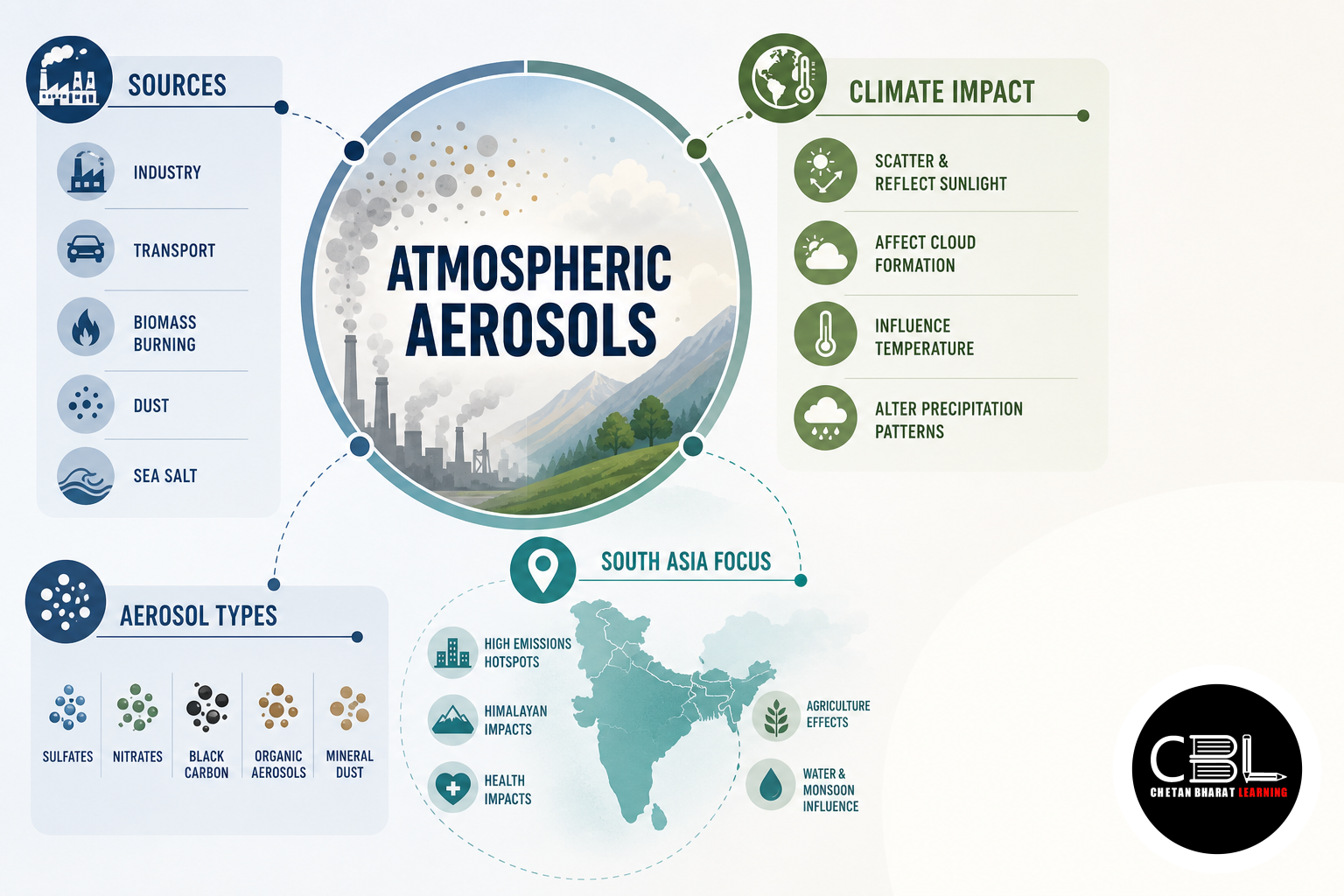
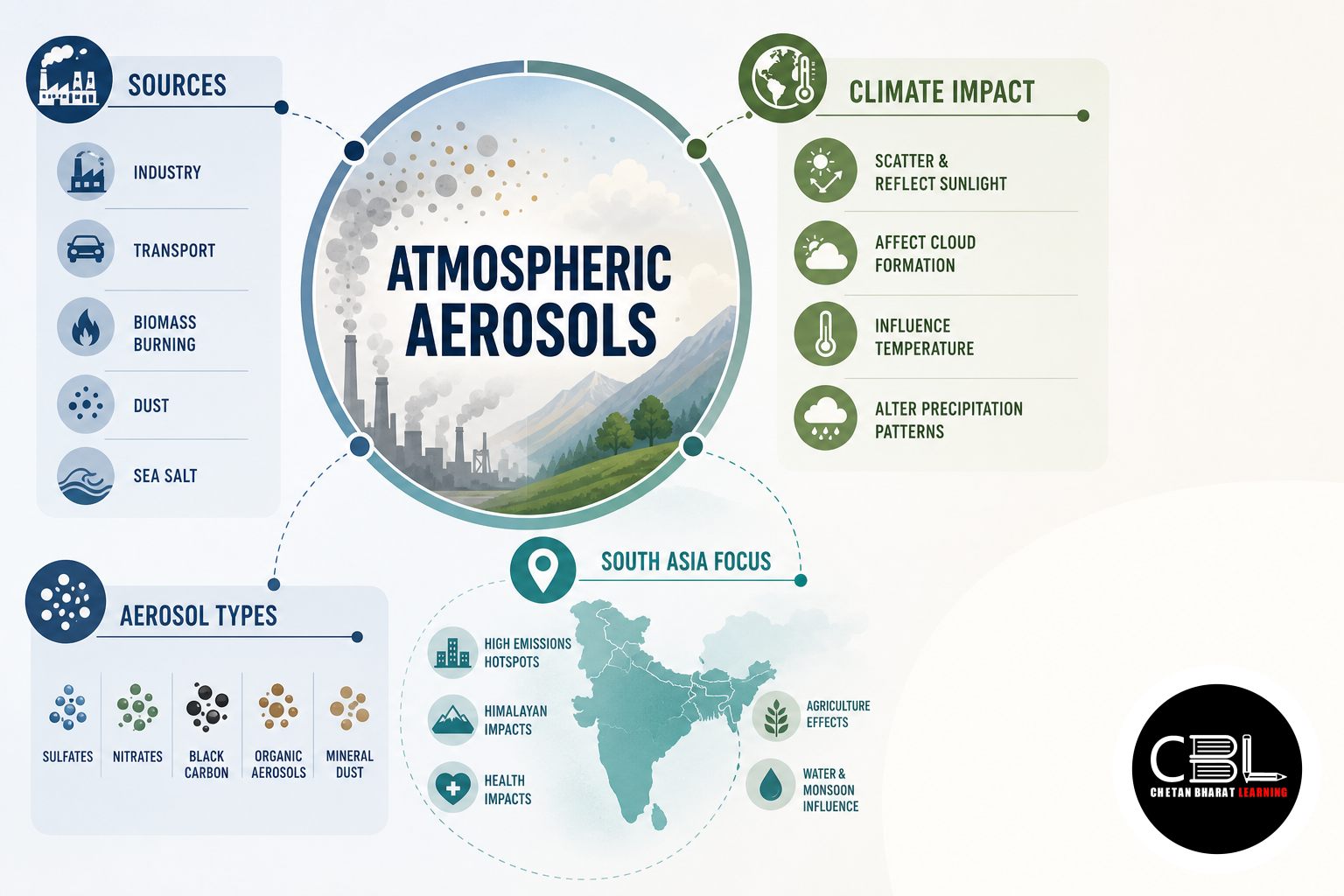
Aerosols are suspensions of extremely small solid particles or liquid droplets in the atmosphere. Their dimensions vary widely, from nanometres to micrometres. Some are visible when present in sufficient concentrations as dust, smoke or haze, while individual particles can be too small to be seen by the unaided eye. They can remain airborne from short durations near their sources to much longer periods depending on their size, altitude and atmospheric conditions.
Sources can be natural or anthropogenic. Deserts release mineral dust, oceans generate sea-salt particles, volcanoes inject ash and gases, and wildfires produce smoke. Human activities add particles and aerosol-forming gases through vehicles, industries, power generation, construction and biomass or fossil-fuel combustion. Because different particles interact differently with solar radiation and clouds, aerosols can exert either cooling or warming influences on the climate system.
Why are Atmospheric Aerosols in News?
Recent research has examined the climatic effects of different aerosol mixtures across major world regions and highlighted South Asia as particularly affected by dust-pollution combinations. Scientists classified observed aerosol conditions into categories including pure dust, dust-dominated mixtures, pollution-dominated mixtures and particles ranging from very weakly absorbing to strongly absorbing.
The study highlighted strongly absorbing particles—often associated with substantial black-carbon content—as producing particularly strong atmospheric warming. By contrast, very weakly absorbing particles primarily scatter incoming radiation and generate much less atmospheric heating. Understanding aerosol composition is essential for regional climate assessment rather than treating all particulate pollution as climatically identical.
Key Features of Atmospheric Aerosols
A useful UPSC distinction is between primary and secondary aerosols. Primary particles enter the atmosphere directly—examples include mineral dust, sea spray, smoke and volcanic ash. Secondary particles form within the atmosphere when precursor gases undergo physical or chemical transformations.
- Scattering: Particles scatter incoming solar radiation, sending part of it back to space, generally exerting a cooling influence.
- Absorption: Dark particles such as black carbon absorb solar radiation and heat the surrounding atmosphere.
- Cloud interaction: Aerosols act as cloud condensation nuclei, influencing droplet formation and precipitation.
- Regional diversity: Mineral dust is key over deserts, while urban regions contain complex pollution mixtures.
- Biomass burning: Forest fires release light-absorbing carbonaceous particles.
- Shorter lifetime: Many aerosols persist far less time than long-lived greenhouse gases, creating uneven climatic effects.
Aerosols influence Earth’s energy budget through direct (scattering/absorption) and indirect (cloud modification) pathways. Absorbing particles can alter atmospheric temperature profiles, affecting stability and circulation.
Challenges Related to Aerosol Pollution
South Asia’s complex mix of natural and anthropogenic sources—mineral dust, urban/industrial emissions, agricultural burning and household combustion—changes over space and time, complicating climatic impact assessments.
Aerosol effects on the South Asian monsoon are critical: by shifting solar energy distribution between surface and atmosphere, particles can alter temperature gradients, circulation and rainfall. The net response depends on aerosol type, altitude, season and interactions with land and ocean.
Reducing particulate pollution is essential for public health, but some particles (e.g., sulfates) have masked greenhouse-gas warming, whereas black carbon warms the atmosphere. Integrated policies must couple air-quality improvements with greenhouse-gas mitigation.
Way Forward for Aerosol Research and Policy
India needs sustained observations of aerosol composition, vertical distribution and optical properties via ground stations, aircraft and satellites. Improved data can refine weather and climate models and distinguish local from transboundary pollution.
Reducing black carbon and combustion pollutants delivers co-benefits: cleaner household energy, better industrial controls, cleaner transport and managed biomass burning address both health and climate objectives. Regional cooperation is vital given pollutant transport across borders.
Climate policy should integrate aerosol management with greenhouse-gas mitigation. The Intergovernmental Panel on Climate Change assesses aerosol radiative effects; better understanding of dust-pollution interactions is particularly valuable for South Asia given high exposure, heavy aerosol loading and monsoon dependence.
Prelims Practice Corner
-
Consider the following as sources of primary aerosols:
1. Sea spray
2. Mineral dust
3. Volcanic ash
4. Smoke particles
Which of the above can directly enter the atmosphere as particles?Answer: (d) 1, 2, 3 and 4.
-
Secondary aerosols are distinguished from primary aerosols because they:
(a) Exist only above oceans
(b) Form in the atmosphere from precursor substances
(c) Cannot interact with sunlight
(d) Are always naturally producedAnswer: (b) Secondary particles form through atmospheric transformations of precursor substances.
-
Black carbon generally contributes to atmospheric heating because it:
(a) Absorbs solar radiation
(b) Eliminates all cloud droplets
(c) Reflects all radiation back to space
(d) Produces oxygen through photolysisAnswer: (a) Absorbs solar radiation.
-
Aerosols can influence climate through:
1. Scattering solar radiation
2. Absorbing radiation
3. Modifying cloud properties
Select the correct answer:Answer: (d) 1, 2 and 3.
-
Which of the following are natural sources of atmospheric particles?
1. Dust storms
2. Sea spray
3. Volcanic eruptions
4. Forest fires
Select the correct answer:Answer: (d) 1, 2, 3 and 4.
Mains Practice Questions
-
Aerosols can produce both warming and cooling effects on the climate system. Explain the mechanisms involved. (10 marks)
Outline: Definition → primary and secondary particles → scattering and cooling → absorption and atmospheric heating → black carbon → cloud interactions → regional variation → climate complexity.
-
The interaction of natural dust and anthropogenic pollution makes South Asia particularly important for aerosol-climate research. Discuss. (15 marks)
Outline: Dust transport → urban-industrial pollution → biomass burning → mixed aerosol composition → black carbon → radiation balance → monsoon implications → health effects → monitoring → regional cooperation and integrated climate policy.
FAQs on Atmospheric Aerosols
What are the major natural sources of aerosols?
Natural sources include desert and mineral dust, sea spray, volcanic emissions and smoke from naturally occurring vegetation fires.
Do all aerosols cool the atmosphere?
No. Many particles scatter sunlight and can exert a cooling influence, while strongly absorbing particles such as black carbon absorb radiation and heat the atmosphere. Their overall climatic effect depends on composition, altitude, clouds and other conditions.
How do scientists observe aerosols?
Scientists combine ground-based instruments, aircraft measurements and satellite observations. Space-based lidar missions and sensors provide information on aerosol distribution and vertical structure, helping researchers study their interactions with clouds and climate.
Related Current Affairs
Preparing for UPSC, PCS or HCS?
Talk to a mentor at Chetan Bharat Learning, Chandigarh. Free guidance on choosing the right exam and building a study plan.
Chat on WhatsAppCall 97793 53345UPSC / IAS / PCS coaching in Chandigarh · Trusted by aspirants across Punjab & Haryana
Leave a Reply
You must be logged in to post a comment.