
UPSC Syllabus Mapping
GS Paper: GS-II
Subject: International Relations
Topic: India-Pakistan Relations, Transboundary Water Governance
Article
Why in News?
India has reiterated its decision to keep the Indus Waters Treaty in abeyance and has served notices to Pakistan seeking modification or renegotiation of the Treaty. The issue has become significant in the backdrop of security concerns, climate change, and the need for modern river basin management.
Understanding the Indus Waters Treaty
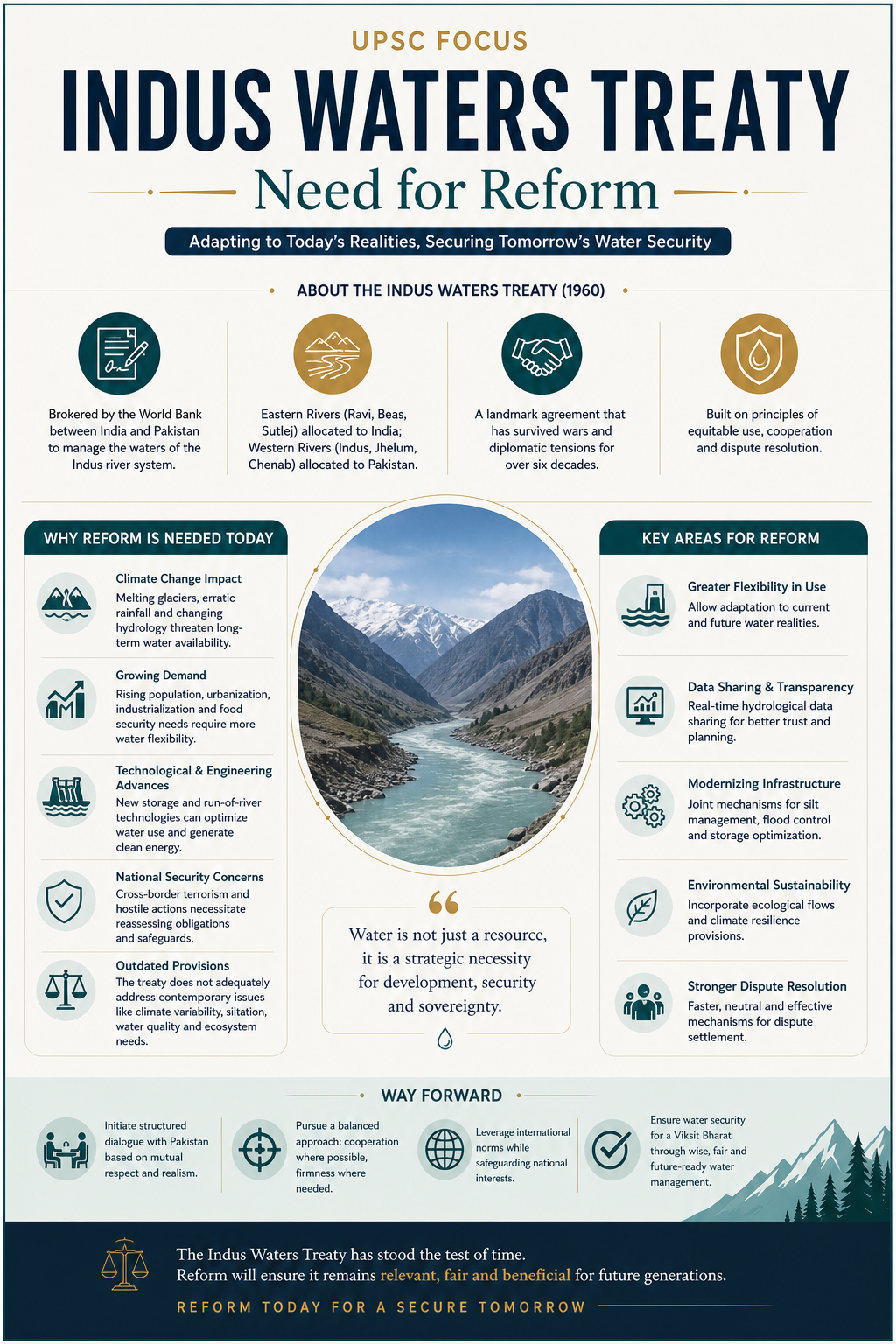
The Indus Waters Treaty (IWT) was signed on 19 September 1960 in Karachi by Prime Minister Jawaharlal Nehru and Pakistan President Ayub Khan, with the World Bank acting as a facilitator. The Treaty allocates the waters of the six rivers of the Indus Basin between India and Pakistan.
River Allocation
| Eastern Rivers (India) | Western Rivers (Pakistan) |
|---|---|
| Ravi | Indus |
| Beas | Jhelum |
| Sutlej | Chenab |
Key Features of the Treaty
- Allocates exclusive use of Eastern Rivers to India.
- Pakistan receives unrestricted use of Western Rivers, subject to India’s limited rights.
- Established the Permanent Indus Commission (PIC) for implementation.
- Provides mechanisms for dispute resolution involving Neutral Experts and Courts of Arbitration.
- Article VII allows cooperation on engineering and drainage works.
- Article XII permits modification through mutual agreement.
Need for Reform
- Climate change has altered river flows and glacier melt patterns.
- Population growth has significantly increased water demand.
- The Treaty lacks provisions on environmental flows.
- No framework exists for water quality management.
- Modern basin-wide integrated water management principles are absent.
- Technological advances in hydrology and water monitoring are not reflected.
- The Treaty predates concerns related to ecosystem conservation and climate resilience.
India’s Position
India argues that renegotiation is permitted under Article XII and has officially sought modification. According to India’s position, the changing security environment, evolving water management practices and climate-related challenges justify revisiting the six-decade-old agreement.
Permanent Indus Commission (PIC)
- Permanent bilateral body established under the Treaty.
- Facilitates exchange of hydrological data.
- Conducts inspections and resolves technical issues.
- Functions primarily as an implementation mechanism rather than a basin management authority.
Comparison with Modern River Treaties
| Aspect | Indus Waters Treaty | Modern Agreements (e.g. Mekong) |
|---|---|---|
| Climate Change | Not addressed | Integrated into management |
| Environmental Flows | Absent | Included |
| Water Quality | Absent | Included |
| Adaptive Governance | Limited | Flexible institutions |
Static Linkages for UPSC
- Indus River System: Indus, Jhelum, Chenab, Ravi, Beas and Sutlej.
- Origin of Indus: Tibetan Plateau near Lake Manasarovar.
- World Bank’s facilitative role.
- India-Bangladesh Ganga Water Treaty (1996).
- Transboundary Water Governance.
- Integrated River Basin Management.
Significance for India
- Strategic importance in India-Pakistan relations.
- Supports irrigation and hydropower projects in Jammu & Kashmir and Ladakh.
- Highlights the relationship between water security and national security.
- Important for climate adaptation and sustainable development.
Challenges
- Balancing treaty obligations with national security concerns.
- Political sensitivities between India and Pakistan.
- Upstream developments involving China.
- Increasing climate variability in the Himalayan region.
Way Forward
- Promote evidence-based negotiations.
- Strengthen basin-wide scientific cooperation.
- Incorporate climate resilience and environmental safeguards.
- Enhance hydrological data sharing.
- Modernise institutional mechanisms for adaptive river governance.
Prelims Practice Corner
- 1. The Indus Waters Treaty was signed in:
(a) 1956 (b) 1960 (c) 1965 (d) 1971
Answer: (b) - 2. Which institution facilitated the Indus Waters Treaty?
(a) United Nations (b) Asian Development Bank (c) World Bank (d) IMF
Answer: (c) - 3. Which river joins the Indus directly among the following?
(a) Chenab (b) Ravi (c) Beas (d) Sutlej
Answer: (a) - 4. Article XII of the Treaty relates to:
(a) Arbitration (b) Modification of the Treaty (c) Water Allocation (d) Hydropower Projects
Answer: (b) - 5. Which of the following is not adequately covered under the existing Treaty?
(a) Environmental flows (b) Climate change (c) Water quality (d) All of the above
Answer: (d)
Mains Practice Questions
Question 1 (10 Marks)
Discuss why the Indus Waters Treaty requires updating in the context of climate change and evolving water governance.
Answer Framework: Introduction → Features of IWT → Emerging Challenges → Need for Reform → Way Forward.
Question 2 (15 Marks)
Examine the strategic significance of the Indus Waters Treaty in India-Pakistan relations. Should the Treaty evolve towards integrated river basin management?
FAQs
- Why is the Indus Waters Treaty considered unique?
It has survived multiple wars and prolonged political tensions while continuing to regulate water sharing between India and Pakistan. - Why does India seek modification of the Treaty?
India argues that changing security conditions, climate change, technological advances and modern water governance require updating the Treaty through provisions already available under Article XII. - Why is this topic important for UPSC?
It integrates International Relations, Geography, Environment, Disaster Management, Water Security and India’s neighbourhood policy, making it relevant for both Prelims and GS-II Mains.
Related Current Affairs
Preparing for UPSC, PCS or HCS?
Talk to a mentor at Chetan Bharat Learning, Chandigarh. Free guidance on choosing the right exam and building a study plan.
Chat on WhatsAppCall 97793 53345UPSC / IAS / PCS coaching in Chandigarh · Trusted by aspirants across Punjab & Haryana
Leave a Reply
You must be logged in to post a comment.