
UPSC Syllabus Mapping
GS Paper: GS-II
Subject: Governance & Social Justice
Syllabus Pointers: Census, vulnerable sections, public policy, welfare targeting, data governance. Prepare with our comprehensive UPSC Current Affairs Hub.
Key Updates on Caste Census
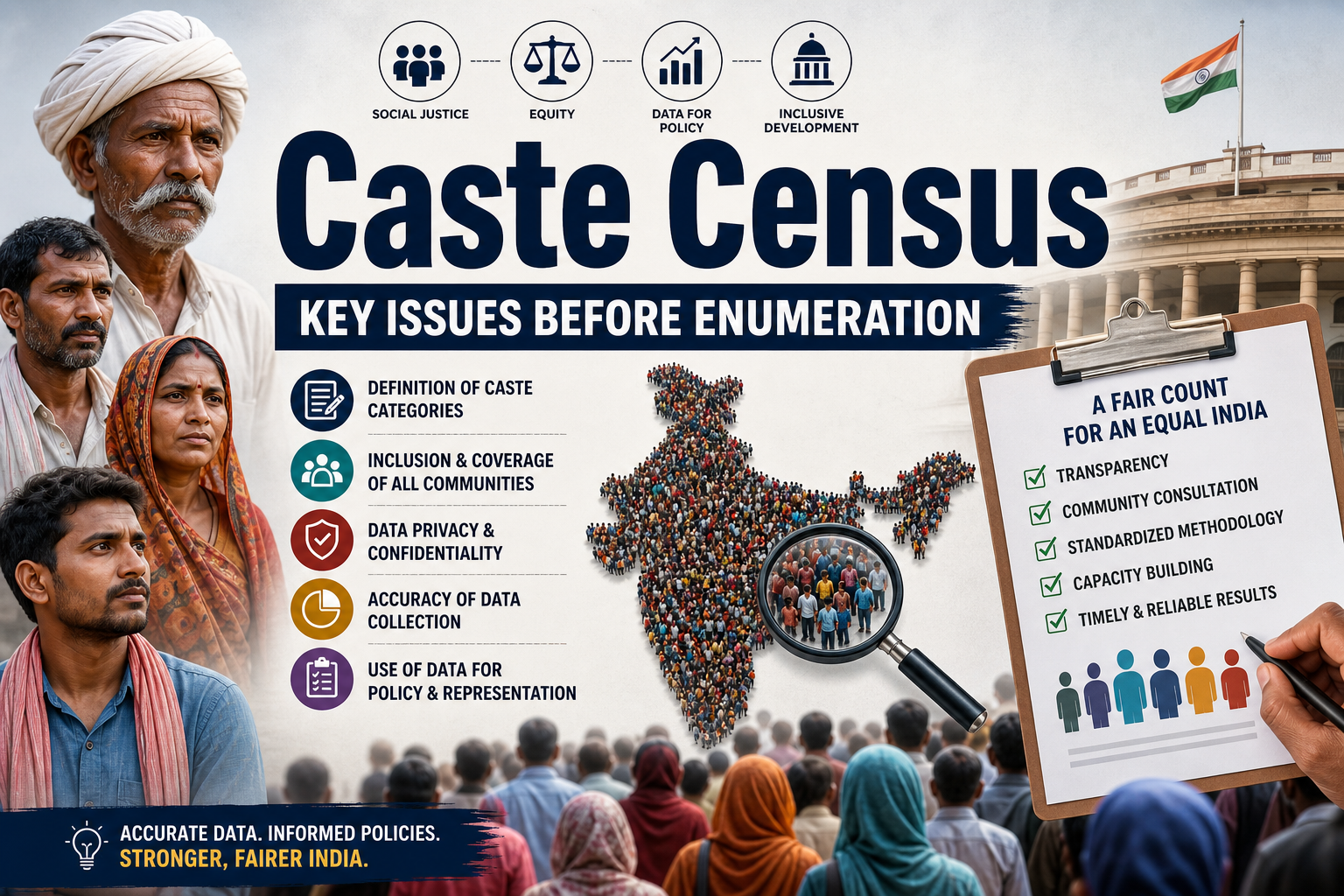
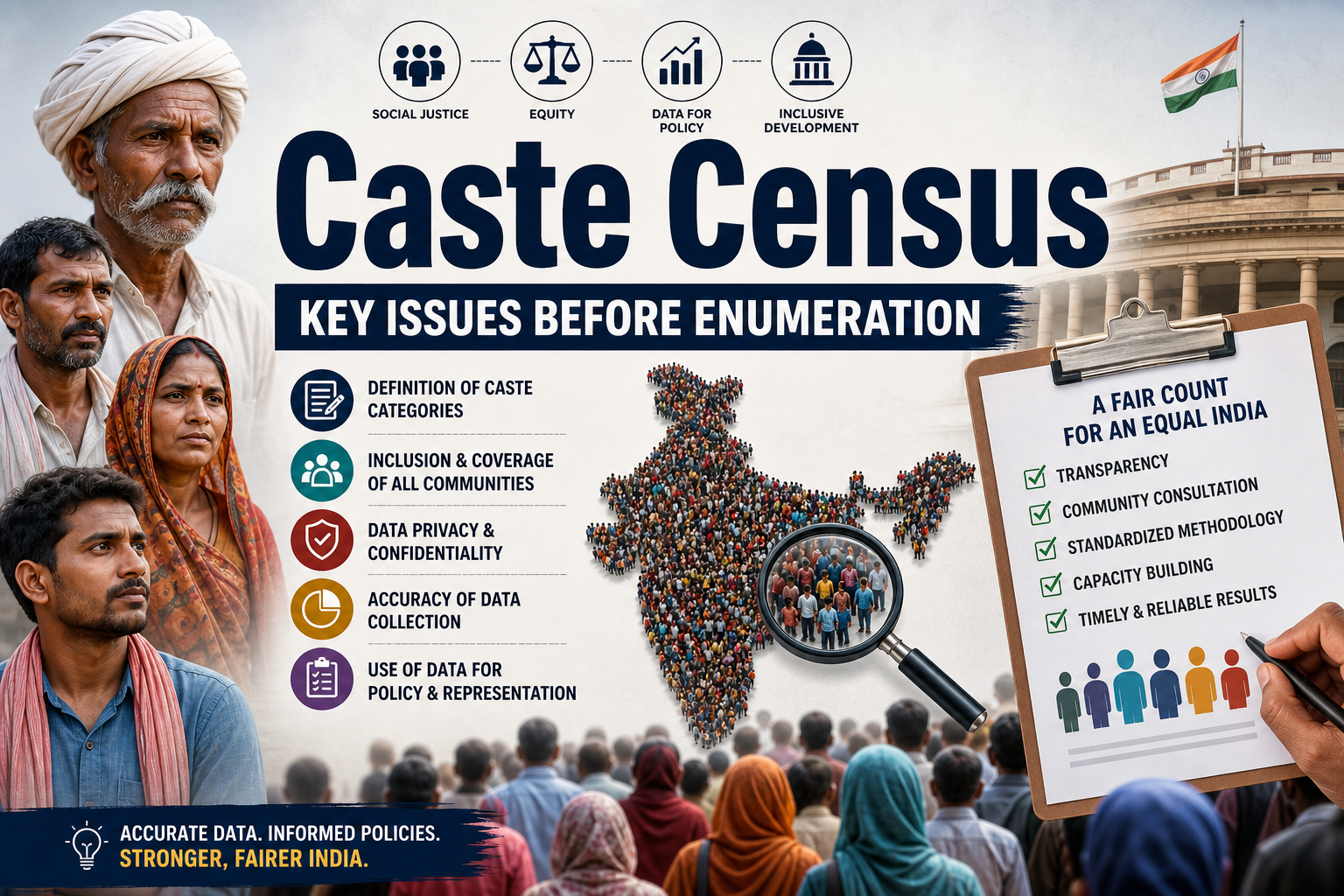
Recent updates regarding Caste Census indicate that the Government is examining different methods for collecting caste data during the upcoming population Census. According to the news report, officials are considering either self-declaration through an open response or a structured list of recognised castes while attempting to avoid the data-quality issues witnessed during the 2011 Socio-Economic and Caste Census (SECC).
Key Dimensions of Caste Census
- The proposed exercise would be conducted alongside the population Census.
- Policymakers are weighing two broad approaches: free-text entry versus a predefined dropdown list of recognised castes.
- Open responses risk spelling variations and duplicates; a standardised list simplifies processing but may raise classification concerns.
Background and Significance
India’s last comprehensive caste census was conducted in 1931, while the 2011 SECC collected caste information separately but faced serious data-quality and standardisation challenges. Reliable caste data can influence welfare delivery, reservation policy, socio-economic planning and evidence-based governance. The Census is conducted under the Census Act, 1948, and supervised by the Office of the Registrar General and Census Commissioner of India.
Challenges
- Administrative: Standardising caste names across states and languages.
- Political: Data may shape debates on reservation and social justice.
- Technical: Digital classification, verification and database mapping require robust systems.
Way Forward
The methodology should prioritise accuracy, transparency and ease of implementation. Standardised digital validation, expert consultation and clear classification protocols can improve reliability. Public confidence will depend on transparent procedures and responsible use of the data.
Prelims Practice Corner
| Question | Options | Answer |
|---|---|---|
| 1. The Census of India is conducted under which legislation? |
|
(a) |
| 2. Which statement regarding the 2011 SECC is correct? |
|
(a) |
Mains Practice Question
Discuss the significance of caste enumeration in India’s Census. Examine the administrative, legal and socio-political challenges involved and suggest measures for ensuring credible data collection. (150 words, 10 Marks)
FAQs
- What is a caste census? It refers to collection of caste-related information during Census operations.
- Why is it important? It supports evidence-based policymaking, welfare planning and social justice assessments.
- What are the main concerns? Data accuracy, standardisation, verification, privacy and political implications.
Related Current Affairs
Preparing for UPSC, PCS or HCS?
Talk to a mentor at Chetan Bharat Learning, Chandigarh. Free guidance on choosing the right exam and building a study plan.
Chat on WhatsAppCall 97793 53345UPSC / IAS / PCS coaching in Chandigarh · Trusted by aspirants across Punjab & Haryana
Leave a Reply
You must be logged in to post a comment.