
Important for:
UPSC, Haryana HCS, Punjab PCS
Prelims: PIL, Judicial Activism, Supreme Court
Mains: GS Paper 2 — Judiciary, Public Interest Litigation, Constitutional Governance
Why in News?
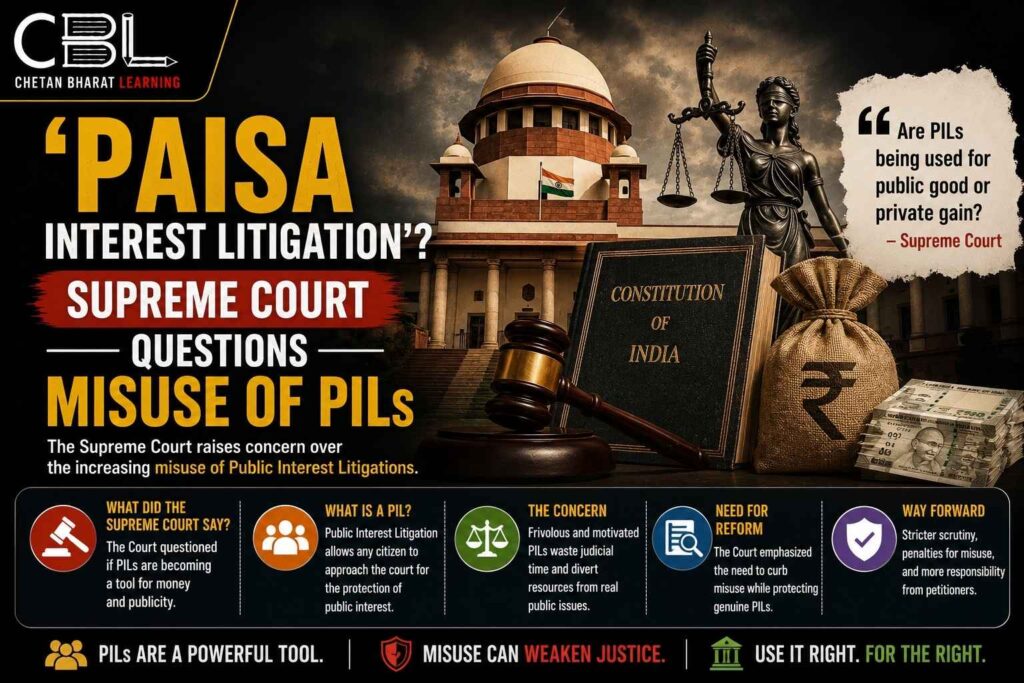
A Supreme Court judge observed that Public Interest Litigation (PIL) is increasingly being misused as “private interest litigation”, “publicity interest litigation”, and even “paisa interest litigation”.
The remarks came during hearings related to the Sabarimala review petitions.
What is PIL?
➤ Public Interest Litigation (PIL) allows:
✔ Any citizen or group
✔ To approach courts
✔ For protection of public interest and fundamental rights
Why Was PIL Introduced?
PIL emerged in India to:
- Improve access to justice
- Help weaker sections of society
- Address human rights violations
- Promote social justice
Key Constitutional Basis
PIL is mainly filed under:
- Article 32 → Supreme Court
- Article 226 → High Courts
What Did the Court Say?
The court observed that some PILs are now being used for:
1. Publicity
To gain media attention
2. Political Motives
To target opponents or institutions
3. Private Interests
Cases filed for personal benefit instead of public welfare
4. Financial or Hidden Agendas
Hence the term:
→ “Paisa Interest Litigation”
Context: Sabarimala Case
The discussion happened during review petitions linked to:
→ Entry of women into Sabarimala Temple.
The court questioned whether some petitioners had genuine public interest.
Why PILs Are Important
Despite misuse concerns, PILs remain crucial for:
✔ Environmental protection
✔ Prison reforms
✔ Human rights protection
✔ Welfare of marginalized communities
✔ Government accountability
Concerns Over PIL Misuse
1. Judicial Burden
Frivolous petitions waste court time
2. Political Weaponisation
Used to settle political scores
3. Media Trials
Publicity-driven litigation affects institutions
4. Delay in Genuine Cases
Important cases may get delayed
Key Insight for UPSC
➤ PIL is a powerful democratic tool, but courts increasingly stress:
✔ Genuine public interest
✔ Responsible litigation
✔ Judicial discipline
PRELIMS PRACTICE QUESTIONS
Q1. PIL stands for:
A. Public Investigation Law
B. Public Interest Litigation
C. Personal Interest Law
D. Public Institutional Litigation
⇢ Answer: B
Q2. Article 32 is associated with:
A. Election Commission
B. Fundamental Rights enforcement
C. Panchayati Raj
D. Finance Commission
⇢ Answer: B
Q3. PILs were mainly introduced to:
A. Increase taxes
B. Promote access to justice
C. Reduce elections
D. Control media
⇢ Answer: B
Q4. Article 226 relates to:
A. Parliament powers
B. High Court writ jurisdiction
C. Emergency provisions
D. President’s powers
⇢ Answer: B
Q5. One concern regarding PIL misuse is:
A. Judicial burden
B. Faster justice
C. Better governance
D. Reduced litigation
⇢ Answer: A
CBL Mains Practice Question
“Public Interest Litigation strengthened judicial activism in India, but its misuse raises concerns about judicial efficiency and accountability.” Discuss.
FAQs
1. What is PIL?
A legal mechanism allowing citizens to approach courts in public interest.
2. Which Articles are linked to PIL?
Articles 32 and 226.
3. Why did the SC criticise some PILs?
Because some are allegedly filed for publicity or private agendas.
4. Why are PILs important?
They improve access to justice and protect rights.
5. Which GS paper covers this topic?
GS Paper 2.
Related Current Affairs
Preparing for UPSC, PCS or HCS?
Talk to a mentor at Chetan Bharat Learning, Chandigarh. Free guidance on choosing the right exam and building a study plan.
Chat on WhatsAppCall 97793 53345UPSC / IAS / PCS coaching in Chandigarh · Trusted by aspirants across Punjab & Haryana
Leave a Reply
You must be logged in to post a comment.