
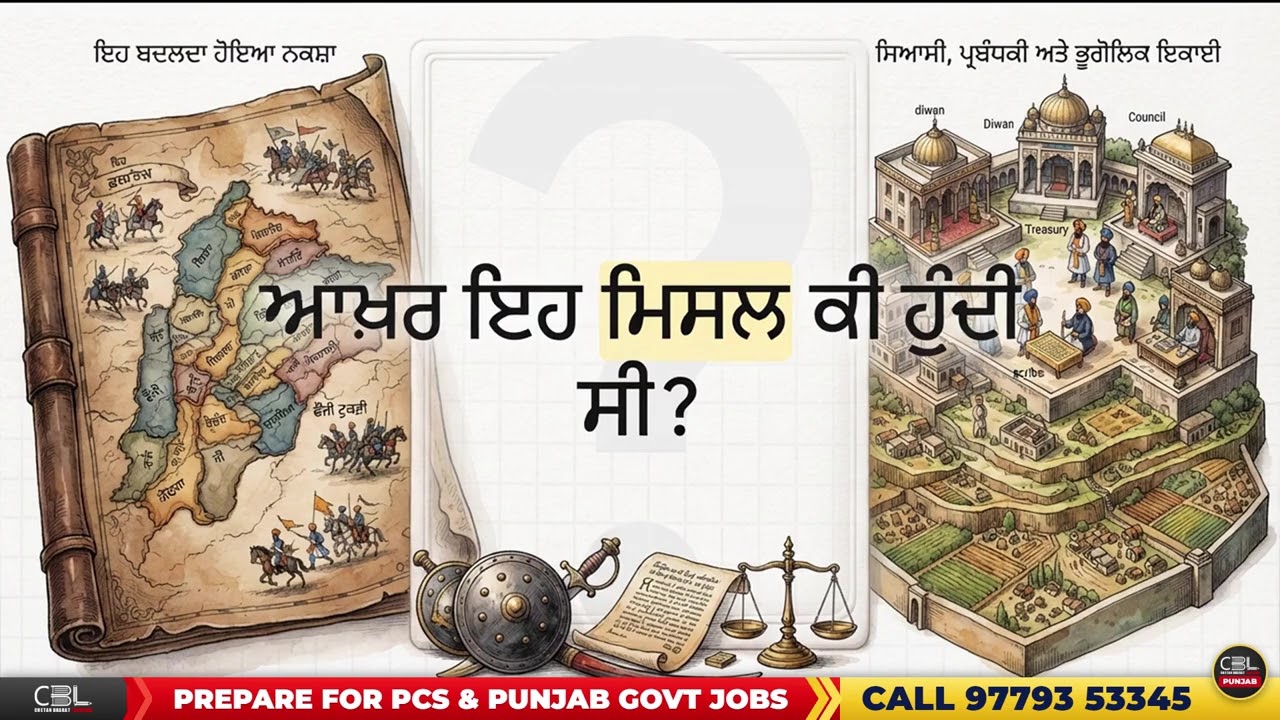
The Sikh misls and the Dal Khalsa are important topics in Punjab history for Punjab PCS and other state exams. This lesson traces the organisation of Sikh forces after Banda Singh Bahadur’s martyrdom and the rise of Ranjit Singh.
Quick answer: The Sikh misls were military, political and territorial units led by their own sardars. The Dal Khalsa was formed at Amritsar in 1748 to organise Sikh forces, while the Sarbat Khalsa and its collective decisions, called Gurmatas, helped the misls act together on shared concerns.
Nawab Kapur Singh and the Dal Khalsa
After Banda Singh Bahadur’s martyrdom in 1716, Sikhs faced a difficult period. Some moved towards forests and hills, while independent jathas continued to resist Mughal rule. The lesson explains that organising these scattered groups became important for their collective survival and political presence.
In 1733, following an offer of agreement from the Mughal authorities, Kapur Singh received the title of Nawab. He organised Sikh forces into the Buddha Dal and Taruna Dal. The experienced Buddha Dal helped care for religious places, guide the community and plan strategy; it was not a non-combatant group. The Taruna Dal consisted of younger fighters who carried out mobile military operations.
At a Vaisakhi gathering in Amritsar in 1748, the Dal Khalsa was established under Nawab Kapur Singh’s leadership, with Jassa Singh Ahluwalia taking command. The lesson describes the smaller jathas being combined into 11 major military units. It presents the Phulkian misl as having developed separately from the main Dal Khalsa structure, bringing the commonly recognised total to 12 misls.
Twelve Sikh misls and their leaders
A misl was more than a military group: over time, it became a political, administrative and territorial unit. Each had a leading sardar, territory and an independent force. The misls could cooperate or clash over territory, but they shared a Sikh collective identity.
Use these associations from the lesson for revision. Jassa Singh Ahluwalia and Jassa Singh Ramgarhia were two different leaders.
| Misl | Leader or association in the lesson |
|---|---|
| Ahluwalia | Jassa Singh Ahluwalia; Kapurthala |
| Bhangi | Hari Singh Dhillon; Lahore and Amritsar |
| Ramgarhia | Jassa Singh Ramgarhia; Batala |
| Sukerchakia | Charat Singh; Gujranwala |
| Kanhaiya | Jai Singh and, later, Sada Kaur; Gurdaspur |
| Nakai | Hira Singh Nakai; south of Lahore |
| Nishanwalia | Dasandha Singh; Ambala |
| Shaheed | Baba Deep Singh; Damdama Sahib |
| Dallewalia | Tara Singh Gheba; parts of Doaba |
| Karor Singhia | Baghel Singh; military action in Delhi in 1783 |
| Singhpuria | Nawab Kapur Singh; also called Faizullapuria |
| Phulkian | Baba Ala Singh; associated with Patiala and Nabha |
Sarbat Khalsa, Gurmata and Ranjit Singh
The Sarbat Khalsa was a collective gathering of the Sikh community, often held at Amritsar on Vaisakhi or Diwali. A shared resolution passed at the gathering was called a Gurmata. These institutions helped the independent misls coordinate political and military action.
The lesson then follows the Sukerchakia misl from Charat Singh to his son Maha Singh and later Ranjit Singh. Ranjit Singh took Lahore in 1799 and became Maharaja in 1801. His rise marked a movement from the misl system towards a centralised Sikh empire.
Inside the video
- 0:03 – Punjab before the misls
- 0:52 – Nawab Kapur Singh and the two dals
- 1:59 – Formation of the Dal Khalsa
- 2:33 – The twelve misls and their organisation
- 3:39 – Misl leaders and regions
- 5:53 – Sarbat Khalsa and Gurmata
- 6:58 – Ranjit Singh takes Lahore and becomes Maharaja
Prelims Practice Corner
Frequently Asked Questions
What was a Sikh misl?
A misl was a military, political and territorial unit led by a sardar. Each had its own area and force, while sharing a collective Sikh identity with the other misls.
Who commanded the Dal Khalsa when it was formed?
Jassa Singh Ahluwalia took command of the Dal Khalsa. It was established under Nawab Kapur Singh’s leadership at Amritsar in 1748.
When did Ranjit Singh become Maharaja?
Ranjit Singh became Maharaja in 1801. He had taken Lahore in 1799.
Related Current Affairs
Preparing for UPSC, PCS or HCS?
Talk to a mentor at Chetan Bharat Learning, Chandigarh. Free guidance on choosing the right exam and building a study plan.
Chat on WhatsAppCall 97793 53345UPSC / IAS / PCS coaching in Chandigarh · Trusted by aspirants across Punjab & Haryana





Leave a Reply
You must be logged in to post a comment.