
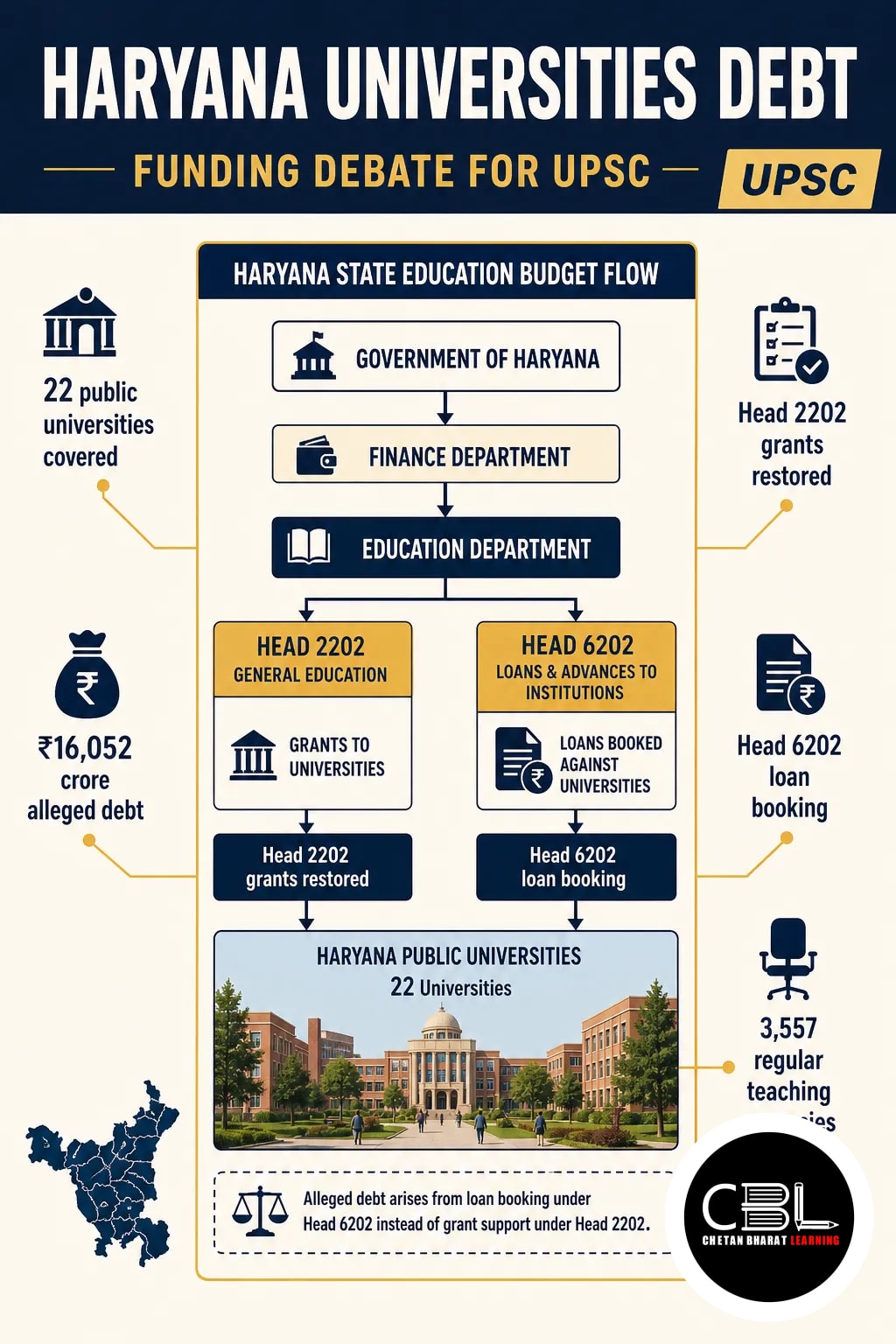

Haryana universities debt has become a public policy issue after an opposition leader alleged that state funding was being recorded as loans. The dispute raises questions about affordability, staffing and public-service governance.
Quick answer: Former Haryana minister Sampat Singh alleges that 22 public universities accumulated ₹16,052 crore in debt over four years because grants were converted into perpetual loans. He also cites 3,557 vacant teaching posts. The Haryana universities debt debate concerns how funding is classified and whether public institutions can remain affordable.
What is the university funding dispute?
The dispute concerns whether Haryana is financing public universities through grants or recording assistance as loans. Sampat Singh, national patron of the Indian National Lok Dal, alleges that the latter approach created ₹16,052 crore in liabilities across 22 universities.
A grant-in-aid supports an institution without ordinarily requiring repayment. A loan, by contrast, creates a liability under its terms. Thus, the classification affects how universities account for assistance and assess future obligations.
Singh describes the funding as perpetual loans and says officials indicated that recovery was not intended. However, the source does not establish the contractual terms or independently verify the liabilities. The accounting label alone cannot establish when repayment is due or whether recovery will occur.
Why are Haryana universities debt claims in the news?
Singh has called for restoring grants and waiving the alleged liabilities. He says the government initially replaced grants with loans through an order on 29 April 2022, but withdrew it a month later after protests.
However, he alleges that universities received grants for only two quarters of 2022-23. He says subsequent funding continued under other heads, including non-recurring expenditure, while assistance was booked as loans. His allegations and figures are not presented in the source as independently verified government findings.
| Indicator | Figure or claim attributed to Singh |
|---|---|
| Public universities covered | 22 |
| Alleged debt over four years | ₹16,052 crore |
| Sanctioned regular teaching posts | 6,290 |
| Filled regular teaching posts | 2,733 |
| Vacant regular teaching posts | 3,557, or nearly 56.5% |
How do the budget heads differ?
The disputed heads distinguish education expenditure from loans for education and related fields. Singh alleges that university assistance moved from Head 2202 to Head 6202.
| Budget head | Relevance to the allegation |
|---|---|
| 2202 | Education head under which Singh demands restoration of grants-in-aid. |
| 6202 | Loans for Education, Sports, Art and Culture; Singh alleges assistance was booked here. |
For meaningful scrutiny, legislators would need the actual budget entries, university accounts and loan documents. In particular, repayment conditions, interest provisions and any waiver must be checked rather than inferred from the head alone.
What are the implications for public higher education?
The alleged shift raises questions about affordability, institutional finances and teaching capacity. Its actual effects, however, require university-level evidence.
- Access and equity: If universities raise fees to meet costs, students from lower-income and middle-class households could face greater pressure. Singh specifically warns about affordable public education.
- Teaching capacity: Vacancies can increase reliance on temporary arrangements and strain departments. However, the figures alone do not establish that the funding classification caused every vacancy.
- Institutional autonomy: Unclear liabilities can complicate long-term planning. Therefore, universities need clarity about their obligations before committing resources.
- Public accountability: Singh warns of commercialisation, closure or privatisation. These are his concerns about possible outcomes, not established decisions.
Singh also says Sports University, Rai, and Sanskrit University in Kaithal have only five to seven regular teaching staff members each. According to him, other teachers there work part-time or under different arrangements.
Can universities mobilise alternative resources?
Universities can seek supplementary funds, but such sources may not provide predictable support for core expenses. Singh says institutions were asked to use alumni contributions, Corporate Social Responsibility (CSR) funds, patents and surplus land.
For example, alumni donations may fluctuate, while patent revenue depends on successful commercialisation. Similarly, commercial use of land needs transparent safeguards and must not compromise academic needs. Hence, alternative funding should be assessed against its reliability, conditions and effect on public access.
What should a policy response prioritise?
A credible response should first establish the facts and then address funding and staffing together. Singh demands full grants under Head 2202, a halt to loan conversion, waiver of existing liabilities and funds for recruitment.
- Publish the accounts: Release university-wise funding entries and loan terms. Thus, the public can distinguish recorded liabilities from amounts actually recoverable.
- Protect core provision: Set out predictable support for teaching and operational expenses. Also, assess how financing choices affect student fees.
- Review vacancies: Identify recruitment needs and the status of sanctioned posts. Singh cites an 17 August directive under which newly created posts vacant for four years after Finance Department approval are deemed abolished.
- Set safeguards: Disclose conditions attached to external funds and land use. Consequently, universities can pursue resources while protecting academic priorities.
Overall, the Haryana universities debt issue illustrates a wider governance question: financial classification must be transparent, while public institutions need dependable resources and accountability for outcomes.
Source: The Hindu National, 28 November 2026
- Haryana good governance awards: Apply by 25 November (14 Nov 2026)
Haryana HCS candidates should connect the reported university funding dispute with state budgeting and education governance. Punjab PCS candidates can similarly use it to examine how funding design and teaching vacancies affect public services.
Prelims Practice Corner
Mains Practice Questions
Frequently Asked Questions
How much debt do Haryana universities allegedly face?
₹16,052 crore, according to Sampat Singh. He alleges that 22 public universities accumulated this liability over four years.
Which budget head is at the centre of the loan allegation?
Head 6202, which covers loans for education, sports, art and culture. Singh alleges that university assistance was booked there instead of under Head 2202.
How many regular teaching posts were reported vacant?
Singh cited 3,557 vacancies among 6,290 sanctioned posts. Thus, nearly 56.5% of those posts were vacant according to his figures.
Has the source established that the alleged loans will be recovered?
No, because the source does not establish the loan terms or recovery schedule. Singh says officials indicated that the perpetual loans were not intended to be recovered.
Related Current Affairs
Preparing for UPSC, PCS or HCS?
Talk to a mentor at Chetan Bharat Learning, Chandigarh. Free guidance on choosing the right exam and building a study plan.
Chat on WhatsAppCall 97793 53345UPSC / IAS / PCS coaching in Chandigarh · Trusted by aspirants across Punjab & Haryana






Leave a Reply
You must be logged in to post a comment.