
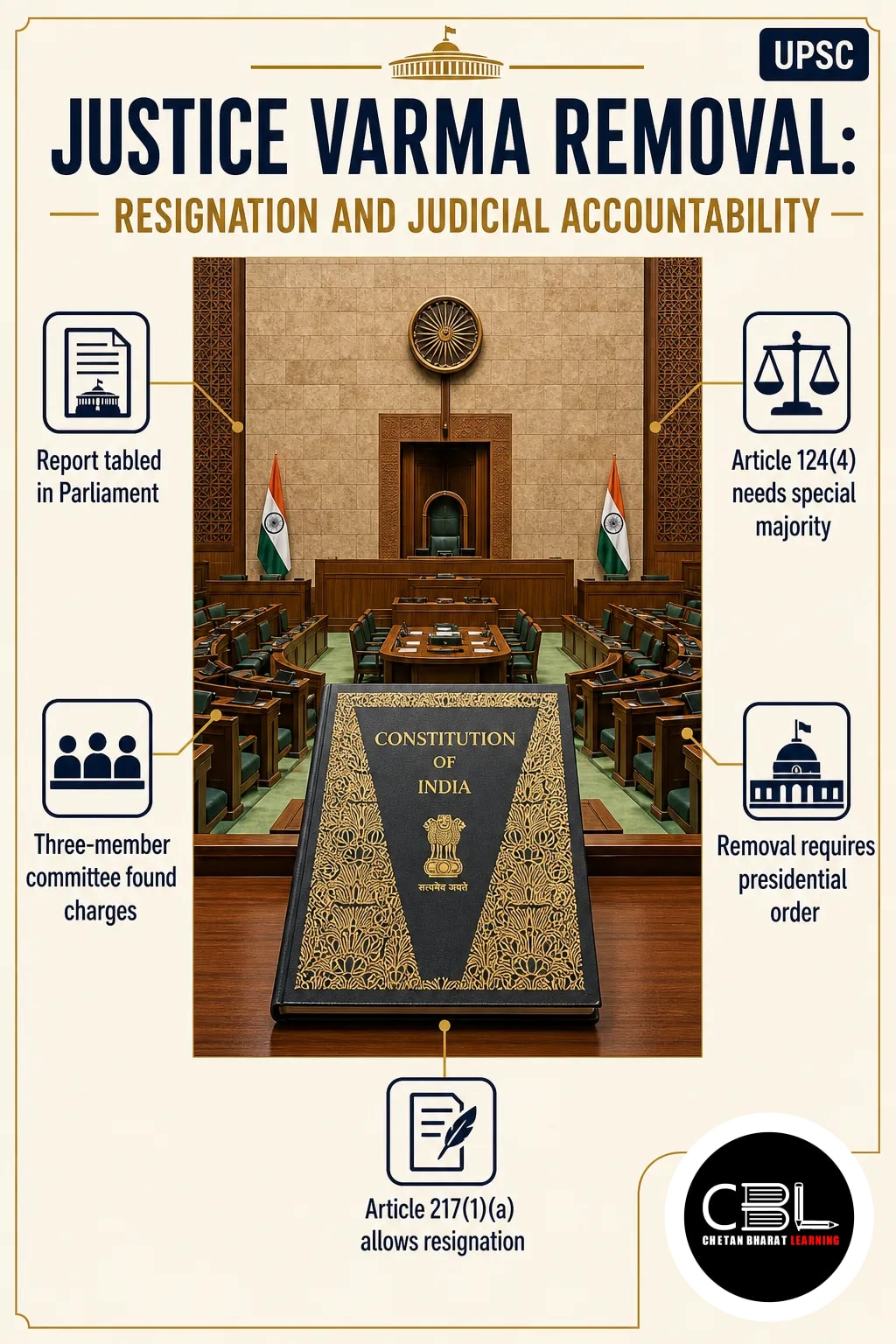
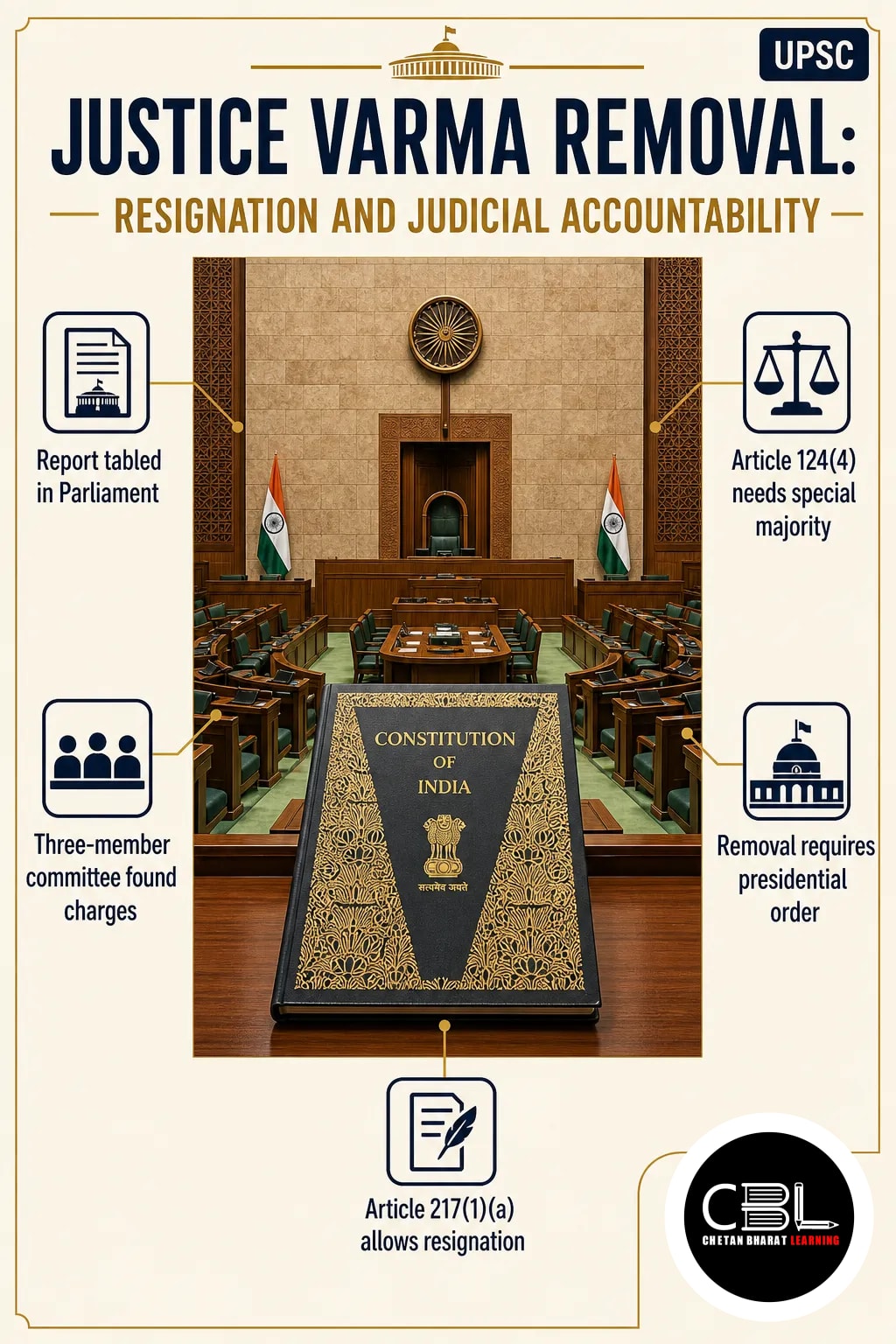
Justice Varma removal proceedings have raised a constitutional question about resignation and judicial accountability. The case is significant for polity and governance because it tests the relationship between an inquiry and removal from office.
Quick answer: In a letter circulated to Members of Parliament on 19 November 2026, Justice Yashwant Varma argued that his resignation made the Justice Varma removal proceedings infructuous. A three-member inquiry committee had earlier found all three charges against him proved. He denied the allegations and said resignation did not amount to an admission.
What has Justice Varma argued?
Justice Varma argues that proceedings aimed at removing him cannot continue after his resignation from judicial office. In his view, an attempt to remove him now would lack a constitutional foundation.
He made the argument in a letter dated 10 September to Lok Sabha Secretary General Utpal Kumar Singh. The letter responded to the inquiry committee appointed by Lok Sabha Speaker Om Birla; it reached Members of Parliament on 19 November 2026.
Varma also maintained that he was innocent, including of the suggestion that he possessed ill-gotten funds. Moreover, he said his resignation should not be treated as an admission of the allegations or the committee’s findings. His position is an argument about the proceedings, not a reported court ruling.
What did the inquiry committee find?
The three-member committee found all three charges against Varma proved, according to its report tabled in Parliament on 12 August 2026.
- Cash at the residence: The first charge concerned his failure to explain the presence, source or ownership of cash found at his official residence.
- Evidence preservation: The second concerned failure to secure and preserve material evidence, followed by the unexplained disappearance of the currency.
- Explanations: The third concerned explanations the committee considered evasive and unsatisfactory during its inquiry.
The findings and Varma’s denial must therefore be presented separately. The source does not establish a final parliamentary decision on whether the proceedings can continue. For the earlier stage, see CBL’s account of the parliamentary inquiry and removal process.
Which constitutional and legal provisions apply?
The Constitution provides for removal on grounds of proved misbehaviour or incapacity, while the Judges (Inquiry) Act, 1968 regulates the investigation and proof of those grounds.
| Provision | What it provides |
|---|---|
| Article 217(1)(a) | A High Court judge may resign by writing to the President. |
| Article 217(1)(b) | A High Court judge may be removed by the President in the manner provided for a Supreme Court judge. |
| Article 124(4) | Removal requires a presidential order after an address by each House, supported by the prescribed special majority in the same session. |
| Articles 124(5) and 218 | Article 124(5) enables Parliament to regulate the process; Article 218 applies specified Supreme Court removal provisions to High Courts. |
| Judges (Inquiry) Act, 1968 | The Act lays down the procedure for investigating and proving misbehaviour or incapacity. |
The special majority means a majority of the total membership of each House and at least two-thirds of members present and voting. Both Houses must support the address in the same session; the President then issues the removal order.
The inquiry committee’s finding is therefore distinct from the parliamentary address and presidential order. A finding that charges are proved does not itself constitute removal. For exam purposes, distinguish these stages rather than treating an inquiry report as the final constitutional act.
Why does resignation raise a difficult question?
Resignation raises the question because the constitutional remedy under discussion removes a judge from an office the person no longer holds.
Varma’s position focuses on that purpose: if no office remains to be vacated, he says the removal proceedings cannot survive. However, the inquiry report already exists, and the case also raises questions about how institutions address its findings.
These are related but separate issues. Removal from office, assessment of alleged conduct and any other legally available process need not be treated as identical. The source does not say that resignation automatically settles every possible consequence, nor does it establish that any other proceeding has begun.
Consequently, an answer should identify the unresolved question without declaring either side’s interpretation settled law. It should also distinguish the committee’s assessment from Varma’s denial and avoid assuming guilt merely from resignation.
What are the implications for judicial accountability?
The case highlights the need to protect judicial independence while ensuring credible scrutiny of alleged misconduct.
- Independence: A demanding removal threshold protects judges against arbitrary political pressure; however, it also makes removal deliberately difficult.
- Accountability: A formal inquiry can examine serious allegations, but its findings must be distinguished from the separate constitutional steps for removal.
- Fair procedure: The person concerned must have an opportunity to answer charges; moreover, a denial deserves accurate presentation alongside adverse findings.
- Institutional clarity: Uncertainty about resignation can affect public understanding of an inquiry’s purpose and possible outcomes.
For Parliament and the judiciary, the broader challenge is to maintain confidence without weakening either independence or procedural fairness. The Justice Varma removal issue illustrates why institutional accountability requires more than a simple choice between resignation and removal.
What should a way forward address?
A way forward should clarify the legal consequences of resignation while preserving fair inquiry and constitutional safeguards.
First, institutions should explain which questions concern removal from office and which concern the status of an inquiry’s findings. Second, any action must rest on an applicable legal process, not an assumption that an adverse report automatically establishes every consequence.
Finally, reasoned institutional communication can reduce confusion without prejudging disputed facts. For the examination, link such clarity to separation of powers, judicial independence and public confidence in constitutional institutions.
Source: The Hindu, 20 November 2026
Asked in UPSC: Previous Year Questions
- UPSC CSE Prelims 2019 (GS Paper I): Which statements about the Speaker’s power to reject a judge’s removal motion and the legal framework for removal are correct?
UPSC tests the distinction between constitutional provisions and the statutory removal procedure.
Punjab PCS and Haryana HCS General Studies may test the constitutional safeguards for High Court judges. Therefore, revise Articles 217 and 218 alongside the parliamentary removal procedure.
Prelims Practice Corner
Mains Practice Questions
Frequently Asked Questions
What did Justice Varma say about removal after resignation?
He argued that the removal proceedings became infructuous after his resignation. However, the source does not report a final decision on that argument.
How many charges did the inquiry committee find proved?
The committee found all three charges proved. Its report was tabled in Parliament on 12 August 2026.
Who removes a High Court judge in India?
The President removes a High Court judge through the constitutionally prescribed process. First, each House must support an address with the required special majority in the same session.
Related Current Affairs
Preparing for UPSC, PCS or HCS?
Talk to a mentor at Chetan Bharat Learning, Chandigarh. Free guidance on choosing the right exam and building a study plan.
Chat on WhatsAppCall 97793 53345UPSC / IAS / PCS coaching in Chandigarh · Trusted by aspirants across Punjab & Haryana









Leave a Reply
You must be logged in to post a comment.