
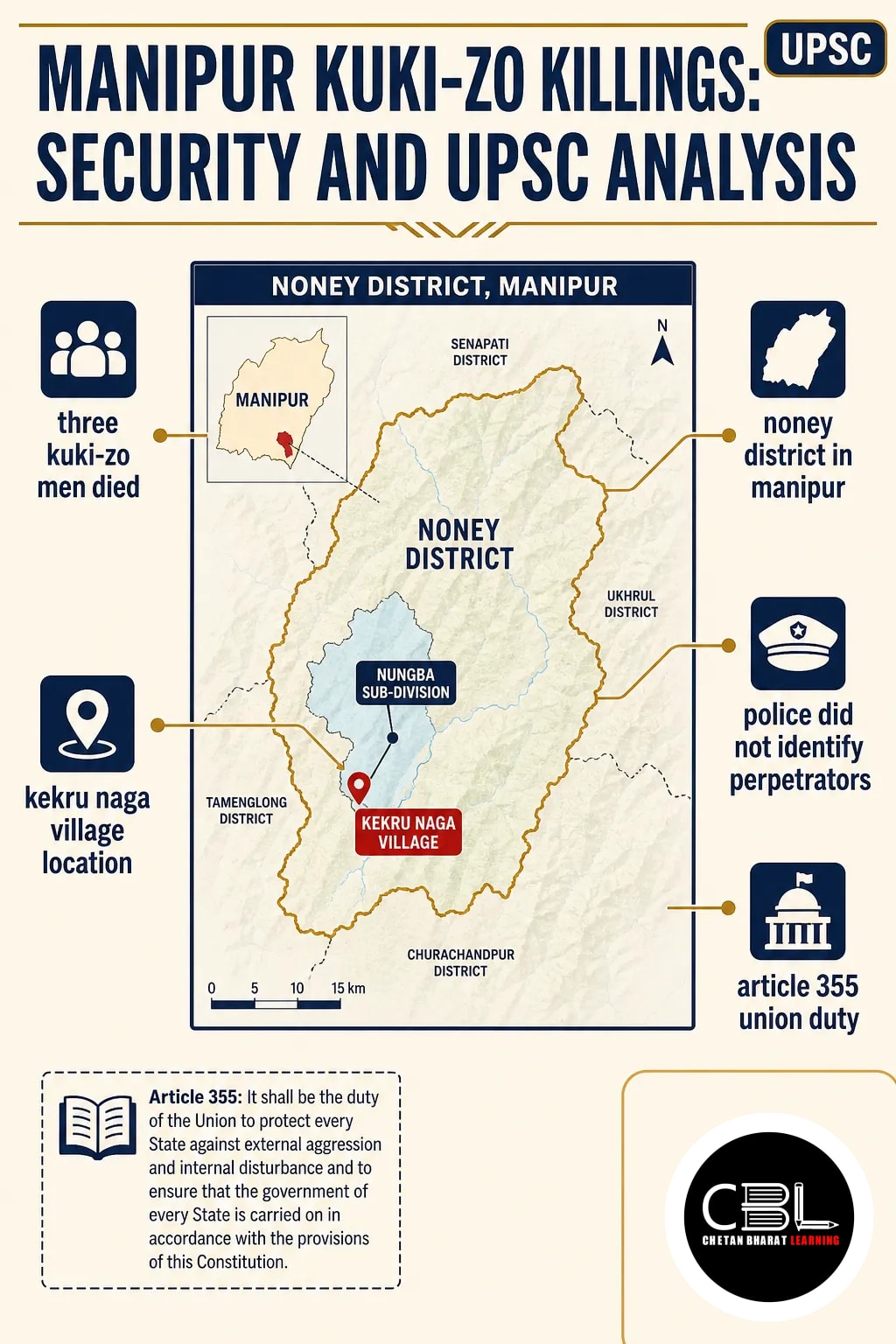
Manipur Kuki-Zo killings have brought attention to civilian safety and accountability after three men died in Noney district. The incident is relevant to national security and governance.
Quick answer: Three Kuki-Zo men died on Saturday after an exchange of fire with unidentified armed persons at Kekru Naga village in Manipur’s Noney district. Police heightened security but did not identify the perpetrators or specify the cause. Meanwhile, Kuki Inpi Manipur accused two groups and demanded action to protect vulnerable communities.
Where did the incident occur?
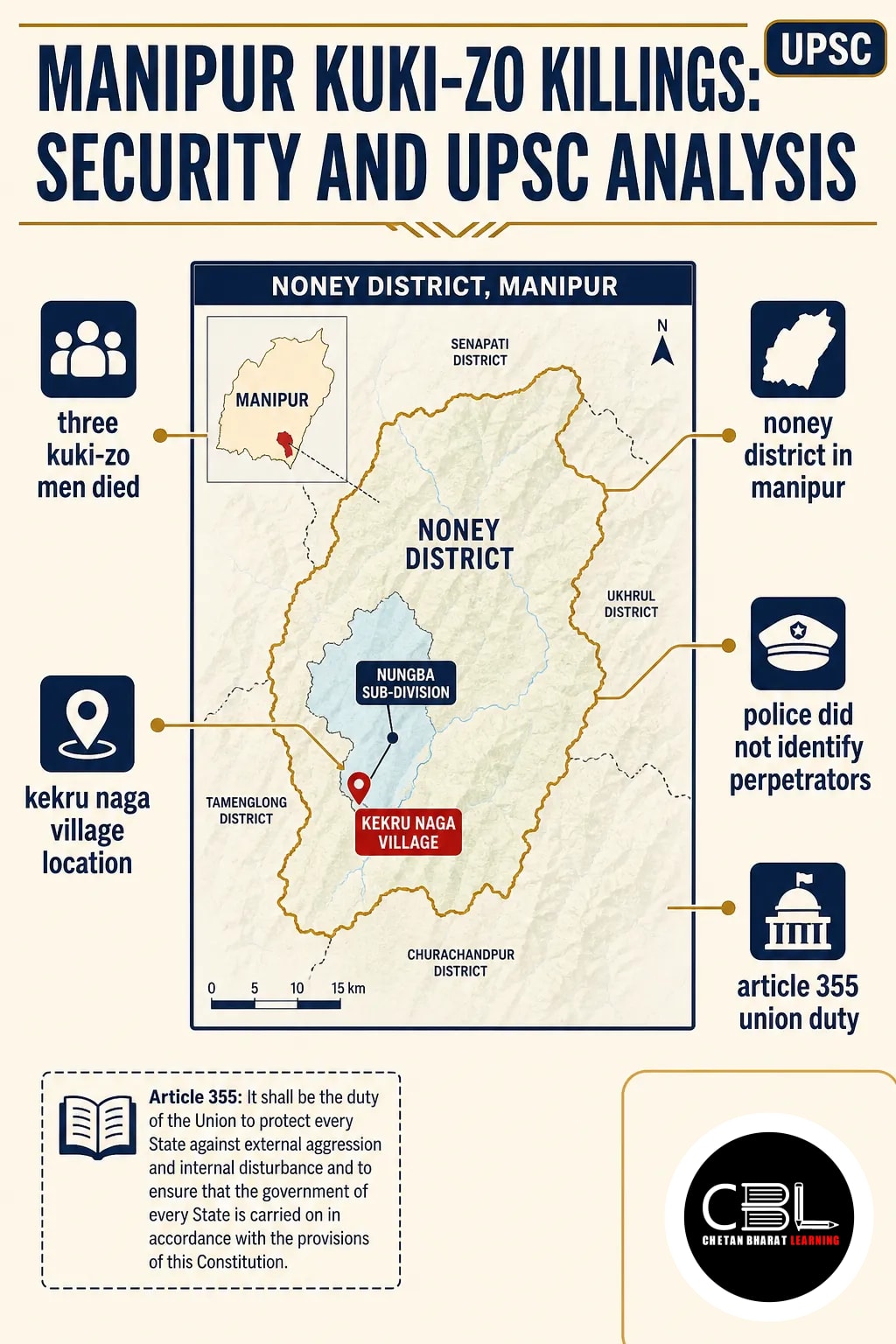
The incident occurred at Kekru Naga village in the Nungba sub-division of Manipur’s Noney district. The location matters for identifying the administrative area concerned, not for assigning responsibility for the firing.
| Fact | Detail |
|---|---|
| State | Manipur |
| District | Noney |
| Sub-division | Nungba |
| Village | Kekru Naga |
What is known about the Manipur Kuki-Zo killings?
Three Kuki-Zo men died following an exchange of fire with unidentified armed persons on Saturday. Police subsequently heightened security, but they did not publicly identify the perpetrators or specify a cause.
The Indian Express also cited unconfirmed reports about the timing and duration of the firing. These accounts said it began around 10 am and lasted several hours, following 48 hours of intermittent attacks in and around the village. However, they should not be treated as established police findings.
For wider context, see CBL’s coverage of violence involving Meitei and Kuki communities. The present incident should nevertheless be assessed on its own verified evidence.
What did Kuki Inpi Manipur allege?
Kuki Inpi Manipur (KIM), an apex body representing Kuki tribes, said the men were village volunteers and condemned their deaths. It accused the National Socialist Council of Nagalim (Isak-Muivah), or NSCN-IM, and the Zeliangrong United Front (K), or ZUF(K), of the killings.
However, police have not publicly identified those responsible. The organisation’s allegation and its description of the victims must therefore remain attributed to KIM rather than presented as independent findings.
KIM also accused authorities of failing to provide adequate security to vulnerable Kuki-Zo communities. In addition, it sought justice, accountability and immediate intervention to prevent further violence.
Why does the incident matter for governance?
The deaths raise questions about civilian protection, evidence-based policing and public confidence in institutions. These are analytical issues for examination; they do not establish the cause of this particular incident.
- Immediate security: Heightened security can deter further attacks, but authorities must also assess risks in nearby areas.
- Accountability: An impartial investigation can establish the sequence of events, identify those responsible and test competing claims.
- Trust: Timely communication about verified findings can reduce uncertainty; however, officials should avoid prejudging responsibility.
- Access to justice: Families need accessible complaint and legal processes, while witnesses need confidence that they can share information safely.
The Manipur Kuki-Zo killings also illustrate the distinction between an immediate security response and a durable peace process. For related context, read about the Manipur Suspension of Operations rally; the source does not establish a connection between that event and the Noney incident.
What constitutional principles guide the response?
The Constitution places protection of life, equality and lawful administration at the centre of the response. Moreover, the distribution of responsibilities makes coordination between governments relevant.
| Provision | Relevance |
|---|---|
| Article 14 | Guarantees equality before the law and equal protection of laws. |
| Article 21 | Protects life and personal liberty except according to procedure established by law. |
| Seventh Schedule: State List | Includes public order and police among state subjects, subject to constitutional qualifications. |
| Article 355 | Places a duty on the Union to protect states against external aggression and internal disturbance. |
These provisions provide an analytical framework; they do not by themselves determine whether any authority breached a duty in this case. Separately, the debate on security powers and rights offers context, but the source does not establish that a special law governed this incident.
What should a response prioritise?
A response should combine immediate protection with investigation and sustained dialogue. First, authorities can assess local security needs and maintain communication with affected residents without treating community identity as evidence of guilt.
Second, investigators should preserve evidence, record witness accounts and share verified updates without compromising due process. In addition, coordination between state and Union authorities can support security where necessary, while keeping responsibilities clear.
Finally, engagement with community representatives can help identify safety concerns and build confidence. However, dialogue cannot substitute for an impartial investigation into the Manipur Kuki-Zo killings or for equal protection under law.
Source: The Indian Express, 1 November 2026
State PCS General Studies can test Manipur’s district geography and the constitutional distribution of policing responsibilities. In addition, Mains answers can examine impartial investigation and public trust as state governance issues.
Prelims Practice Corner
Mains Practice Questions
Frequently Asked Questions
Where did the three Kuki-Zo men die?
They died after an exchange of fire at Kekru Naga village in Manipur. The village is in Nungba sub-division of Noney district.
Have police identified the perpetrators?
No, police have not publicly identified the perpetrators. However, Kuki Inpi Manipur accused two groups, an allegation that must be distinguished from police findings.
What did Kuki Inpi Manipur demand?
It demanded justice, accountability and immediate intervention to prevent further violence. In addition, it called on the government to ensure civilian safety in affected areas.
Related Current Affairs
Preparing for UPSC, PCS or HCS?
Talk to a mentor at Chetan Bharat Learning, Chandigarh. Free guidance on choosing the right exam and building a study plan.
Chat on WhatsAppCall 97793 53345UPSC / IAS / PCS coaching in Chandigarh · Trusted by aspirants across Punjab & Haryana

 Ananya RanaIAS · AIR 60
 Aditya SharmaIAS · AIR 70
 Ria Kaur SethiIPS · AIR 89
 Aman AloonIRS · AIR 295
 Sumer Singh VirkIRS · AIR 335
 Shivani PanchalIAS

Leave a Reply
You must be logged in to post a comment.