
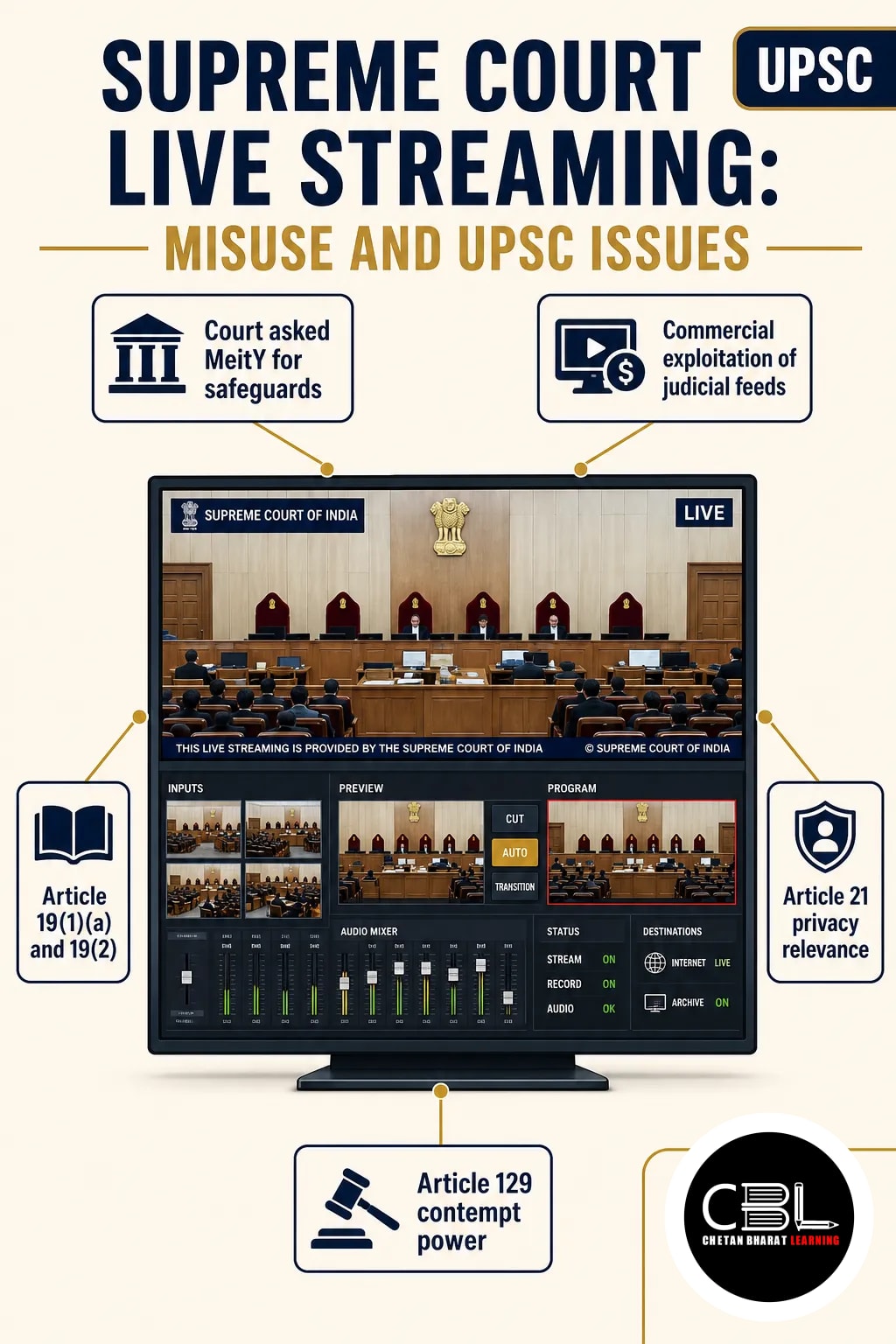

Supreme Court live streaming has come under scrutiny after the Court sought measures against misuse of judicial feeds. The issue connects open justice with digital governance; explore more polity current affairs.
Quick answer: On 30 October 2026, the Supreme Court asked the Ministry of Electronics and Information Technology to formulate measures against commercial exploitation of judicial feeds. Suggestions from High Courts and stakeholders had reached the ministry. The Court is also considering concerns about altered clips, misleading captions and unauthorised circulation.
What did the Court direct?
The Court asked the Ministry of Electronics and Information Technology (MeitY) to formulate measures against commercial exploitation of live-streamed proceedings. The proposed policy regime would also incorporate action against non-compliance with court directions.
Earlier orders had barred unauthorised use and circulation of live-streamed proceedings on social media and digital platforms. However, the source does not describe a final policy or a blanket prohibition on reporting court proceedings.
Solicitor General Tushar Mehta said suggestions from High Courts and other stakeholders had been forwarded to MeitY. He also sought consideration after the Deepavali vacation and asked the Court to consider removing material uploaded in breach of restrictions.
Why is misuse of judicial feeds a concern?
Unauthorised extraction and alteration can turn a public hearing into a misleading digital product. In particular, a short clip may omit the context of a judge’s question, a lawyer’s argument or the final order.
The Court is examining circulation and commercial use of clips, including those with misleading captions or representations. As a result, viewers may confuse an edited fragment with an authoritative account of proceedings.
Advocate Prashant Bhushan proposed verifiable digital signatures or watermarks on official clips. He also suggested making proceedings available on the Supreme Court website in authenticated, watermarked form. These are proposals, not measures the source says the Court has adopted.
Authenticity concerns extend beyond court video; CBL’s coverage of deepfake scams and digital verification provides a related technology context.
Which constitutional principles are relevant?
The issue requires a balance between open justice, free expression and privacy. The following provisions provide an analytical framework; they do not themselves prescribe a complete live-streaming policy.
| Article | Relevance |
|---|---|
| Article 19(1)(a) | Protects freedom of speech and expression, relevant to discussion and reporting of judicial proceedings. |
| Article 19(2) | Allows reasonable restrictions on specified grounds, including contempt of court. |
| Article 21 | Protects life and personal liberty; the Supreme Court has recognised privacy under this provision. |
| Article 129 | Makes the Supreme Court a court of record with power to punish for its contempt. |
Open hearings enable public scrutiny of judicial work. Nevertheless, digital circulation can amplify exposure of participants, making privacy safeguards relevant. For a broader policy context, see the discussion of the digital data protection challenge.
What are the implications for open justice?
Supreme Court live streaming can widen access to hearings, but access alone does not guarantee accurate understanding. A viewer may benefit from watching proceedings without travelling to court; however, a detached excerpt can obscure their legal context.
- Judicial accountability: Public access allows citizens to observe hearings directly; therefore, reliable archives can support informed scrutiny.
- Integrity of proceedings: Misleading edits can distort arguments and judicial observations; consequently, an official reference copy matters.
- Rights of participants: Wider circulation can intensify privacy risks; hence, sensitive proceedings need particular care.
- Public communication: Legitimate reporting and criticism remain important; therefore, restrictions should distinguish them from prohibited misuse.
A judge’s question during argument does not necessarily express the Court’s final conclusion. Accordingly, readers should consult the full proceedings and the final order before treating a clip as a statement of law.
What challenges should a policy address?
A workable policy must identify misuse without unnecessarily limiting access or lawful commentary. The Court’s direction starts that policy process; it does not settle its operational details.
- Defining prohibited conduct: Commercial exploitation, unauthorised circulation and misleading modification raise distinct problems; therefore, rules need clear categories.
- Enforcement at scale: Copies can spread across platforms; consequently, identifying and addressing breach requires coordination.
- Verification limits: A watermark may help identify an official source; however, it cannot alone establish that every caption is accurate.
- Removal safeguards: Overbroad takedowns could affect legitimate discussion; therefore, reasons and a review mechanism deserve consideration.
What would a balanced way forward look like?
A balanced framework would protect authentic access while targeting conduct that violates court directions. MeitY can use the submissions already received to develop options for the Court’s consideration.
First, official authenticated recordings could give viewers and platforms a reference against which to check clips. Second, clear terms could explain permitted access, restrictions and procedures for dealing with violations. These are policy options, not decisions announced in the source.
Furthermore, a response process could provide reasons, allow correction of errors and protect legitimate reporting. Courts and platforms should also consider privacy when deciding how sensitive material is made available.
Finally, public guidance should distinguish a hearing from a final judgment. Thus, Supreme Court live streaming can remain a tool for transparency without treating every circulating clip as authoritative.
Source: The Hindu, 30 October 2026
Asked in UPSC: Previous Year Questions
- UPSC CSE Prelims 2024 (GS Paper I): Under which Article of the Constitution has the Supreme Court placed the right to privacy?
UPSC tests the constitutional basis of privacy; therefore, connect Article 21 with risks from digital circulation.
State PCS General Studies can test the balance between open courts, privacy and digital governance. Candidates should also distinguish the Supreme Court’s direction to MeitY from the suggestions received from High Courts.
Prelims Practice Corner
Mains Practice Questions
Frequently Asked Questions
What did the Supreme Court ask MeitY to do?
It asked MeitY to formulate measures against commercial exploitation of live-streamed proceedings. The ministry had also received suggestions from High Courts and other stakeholders.
Did the Court announce a final policy on judicial feeds?
No, the source describes a policy under consideration, not a final policy. The Solicitor General said the ministry would consider the suggestions and respond.
Who suggested watermarks for official court clips?
Advocate Prashant Bhushan suggested verifiable watermarks or digital signatures. He also proposed authenticated, watermarked proceedings on the Supreme Court website.
Why is privacy relevant to court live streaming?
Privacy matters because digital circulation can amplify exposure of people involved in proceedings. Therefore, access policies should consider safeguards for sensitive material.
Related Current Affairs
Preparing for UPSC, PCS or HCS?
Talk to a mentor at Chetan Bharat Learning, Chandigarh. Free guidance on choosing the right exam and building a study plan.
Chat on WhatsAppCall 97793 53345UPSC / IAS / PCS coaching in Chandigarh · Trusted by aspirants across Punjab & Haryana

 Ananya RanaIAS · AIR 60
 Aditya SharmaIAS · AIR 70
 Ria Kaur SethiIPS · AIR 89
 Aman AloonIRS · AIR 295
 Sumer Singh VirkIRS · AIR 335
 Shivani PanchalIAS

Leave a Reply
You must be logged in to post a comment.