
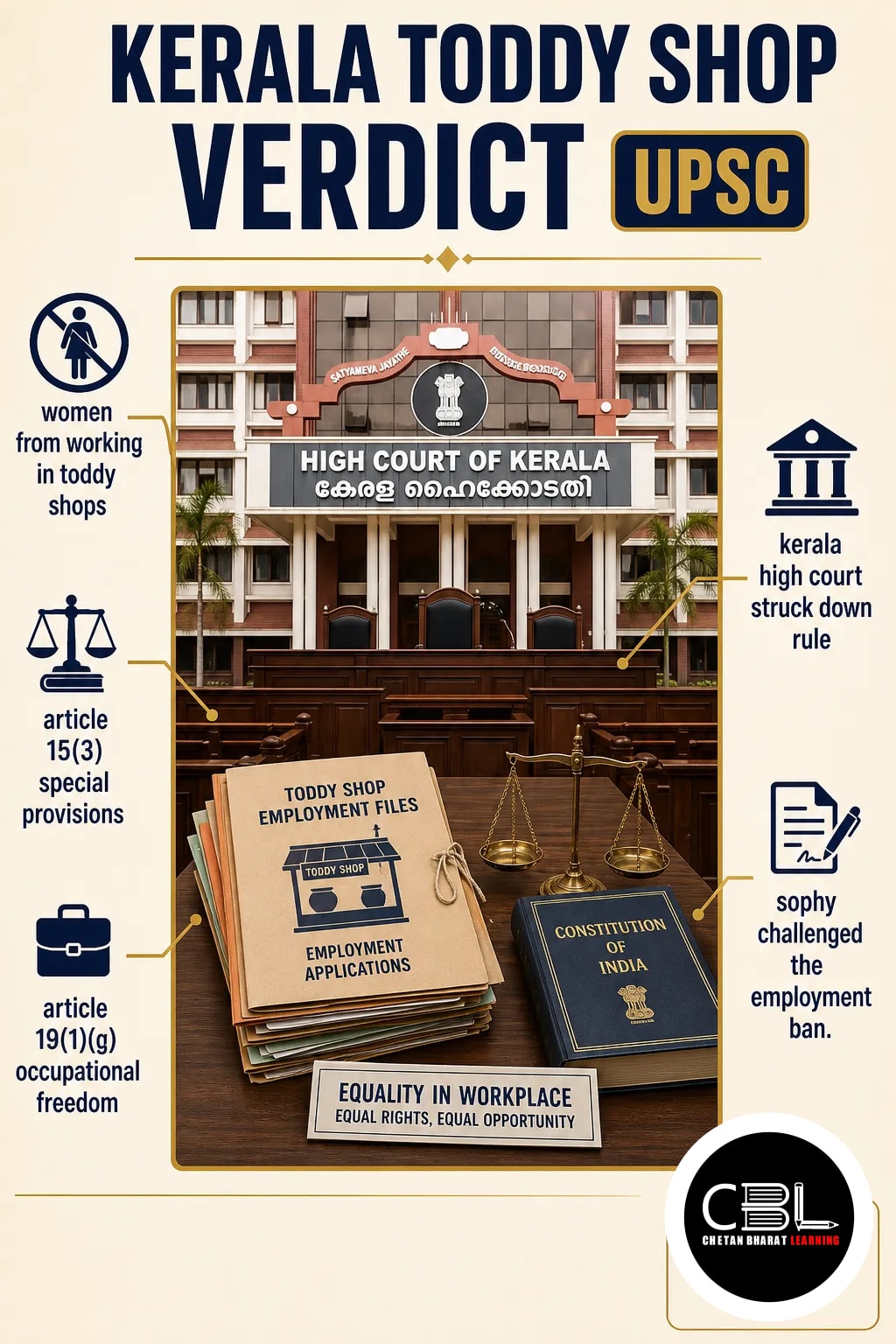
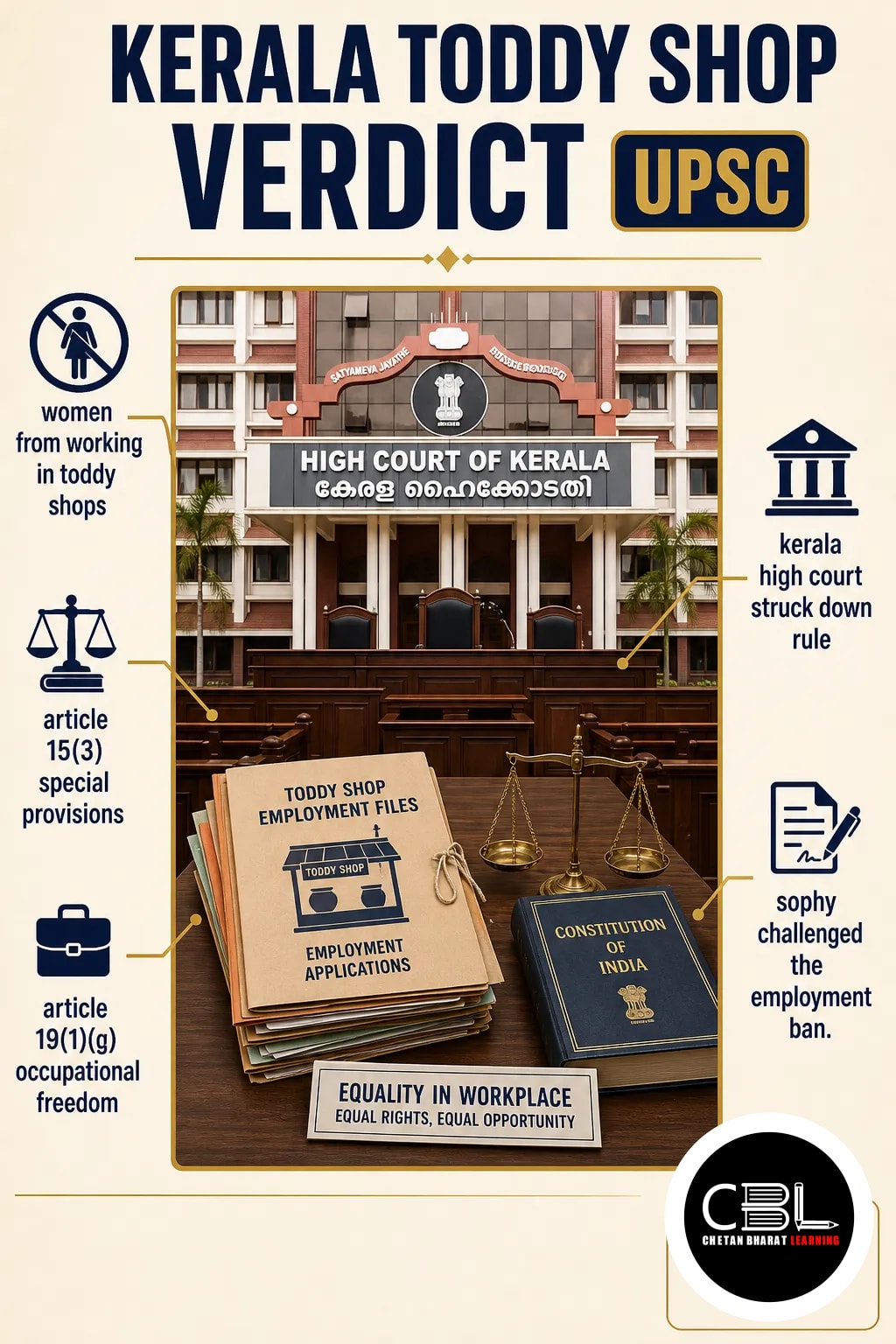
The Kerala toddy shop verdict has removed a rule barring women from employment in the shops. The ruling connects workplace safety with constitutional rights and equality.
Quick answer: In the Kerala toddy shop verdict, the High Court struck down a provision of the Kerala Abkari Shops Disposal Rules, 2002, that barred women from working in toddy shops. Justice P. Gopinath held that the ban violated fundamental rights. Thrissur native Sophy had challenged the denial of employment.
What did the Kerala High Court hold?
The court struck down the provision prohibiting women from working in toddy shops in any capacity. It held that the restriction violated rights to equality, non-discrimination, trade and life.
Justice P. Gopinath reiterated a Supreme Court observation on workplace protection. The State must help secure women against harassment; however, it cannot achieve that objective by barring them from their chosen industry.
Thus, the Kerala toddy shop verdict distinguishes protecting workers from excluding them from work. The source does not identify the precise date of the decision or the number of the struck-down rule.
Why did Sophy challenge the rule?
Sophy, a Thrissur native, approached the High Court after she was denied employment because of the restriction. The 2002 rules prohibited the employment of women in any capacity in a toddy shop.
She argued that the rules had initially restricted employment in foreign liquor shops too. However, she said the High Court had struck down that portion, as well as a similar restriction in the Foreign Liquor Rules, 1953. These earlier rulings are presented here as her submissions, not as additional findings in the present case.
What did the State argue?
The State defended the restriction as a safeguard against workplace exploitation. It argued that toddy shops were often located in remote places and that the rule protected women’s safety and well-being.
In addition, the State cited a Supreme Court order recognising that occupational requirements and social circumstances can warrant different treatment. The High Court nevertheless rejected the blanket prohibition at issue.
Which constitutional provisions are relevant?
The Constitution protects equality, non-discrimination, occupational freedom and life, while allowing certain protective measures and restrictions. The table provides the constitutional framework for analysis; the source does not specify which numbered provisions the judgment discussed.
| Provision | What it says |
|---|---|
| Article 14 | Guarantees equality before law and equal protection of laws. |
| Article 15(1) | Prohibits State discrimination against citizens on specified grounds, including sex. |
| Article 15(3) | Permits the State to make special provisions for women and children. |
| Articles 19(1)(g) and 19(6) | Protect occupational freedom for citizens, subject to constitutionally permitted restrictions and other provisions under Article 19(6). |
| Article 21 | Protects life and personal liberty except according to procedure established by law. |
Exam distinction: Article 15(3) allows special provisions; it does not make every sex-based restriction automatically valid. Moreover, occupational freedom is not absolute, and liquor is a regulated sector. The issue here was the exclusion of women from employment, not a general challenge to liquor regulation.
What are the implications for gender equality at work?
The ruling places equal access to employment alongside the obligation to address workplace risks. Its immediate effect concerns the challenged restriction in Kerala, rather than every employment rule across India.
- Access and choice: Removing a blanket ban allows women to seek work without that rule blocking entry solely on the basis of sex.
- Substantive safety: Moreover, equal access has practical value only if workers can report harassment and work in safe conditions.
- Regulatory design: Therefore, governments should examine whether a measure addresses a specific risk without unnecessarily excluding a group.
- Related sectors: Similarly, the debate over women working in mining raises questions about access and occupational safety.
The judgment does not establish that every workplace offers equal opportunities or adequate protection. Instead, it removes the identified legal barrier and leaves the practical task of securing safe work.
What concerns remain, and what is the way forward?
The main challenge is to make employment accessible without disregarding the safety risks cited by the State. Remote locations can make access to assistance and complaint mechanisms more difficult; however, exclusion transfers the cost of that concern to women seeking work.
First, authorities can review sex-based employment restrictions against their stated purpose and actual operation. Second, employers and regulators should ensure accessible complaints channels, prompt response and protection against retaliation. In addition, inspections and awareness measures can help workers understand available safeguards.
Finally, workplace protection should include all workers, while recognising risks that women may face. The broader discussion of social security arrangements for workers also illustrates why legal access and effective implementation both matter.
Source: The Hindu, 30 October 2026
Asked in UPSC: Previous Year Questions
- UPSC CSE Mains 2021 (GS Paper II): Analyse the distinguishing features of the notion of Right to Equality in the Constitutions of the USA and India.
UPSC tests equality as a constitutional principle; therefore, connect its provisions with their application.
State PCS General Studies can test the Kerala ruling alongside Articles 14, 15 and 21. In addition, candidates should examine how state employment regulations balance equal opportunity with workplace safety.
Prelims Practice Corner
Mains Practice Questions
Frequently Asked Questions
Can women work in Kerala toddy shops after the verdict?
Yes, because the High Court struck down the provision that barred their employment in any capacity. However, the judgment does not remove other applicable workplace regulations.
Who challenged the Kerala toddy shop employment ban?
Sophy, a native of Thrissur, challenged it after being denied employment. The denial followed from a provision in the 2002 Abkari Shops Disposal Rules.
Why is Article 15(3) relevant to this debate?
Article 15(3) permits special provisions for women and children. However, that permission does not automatically validate every restriction placed on women.
Related Current Affairs
Preparing for UPSC, PCS or HCS?
Talk to a mentor at Chetan Bharat Learning, Chandigarh. Free guidance on choosing the right exam and building a study plan.
Chat on WhatsAppCall 97793 53345UPSC / IAS / PCS coaching in Chandigarh · Trusted by aspirants across Punjab & Haryana
Leave a Reply
You must be logged in to post a comment.