
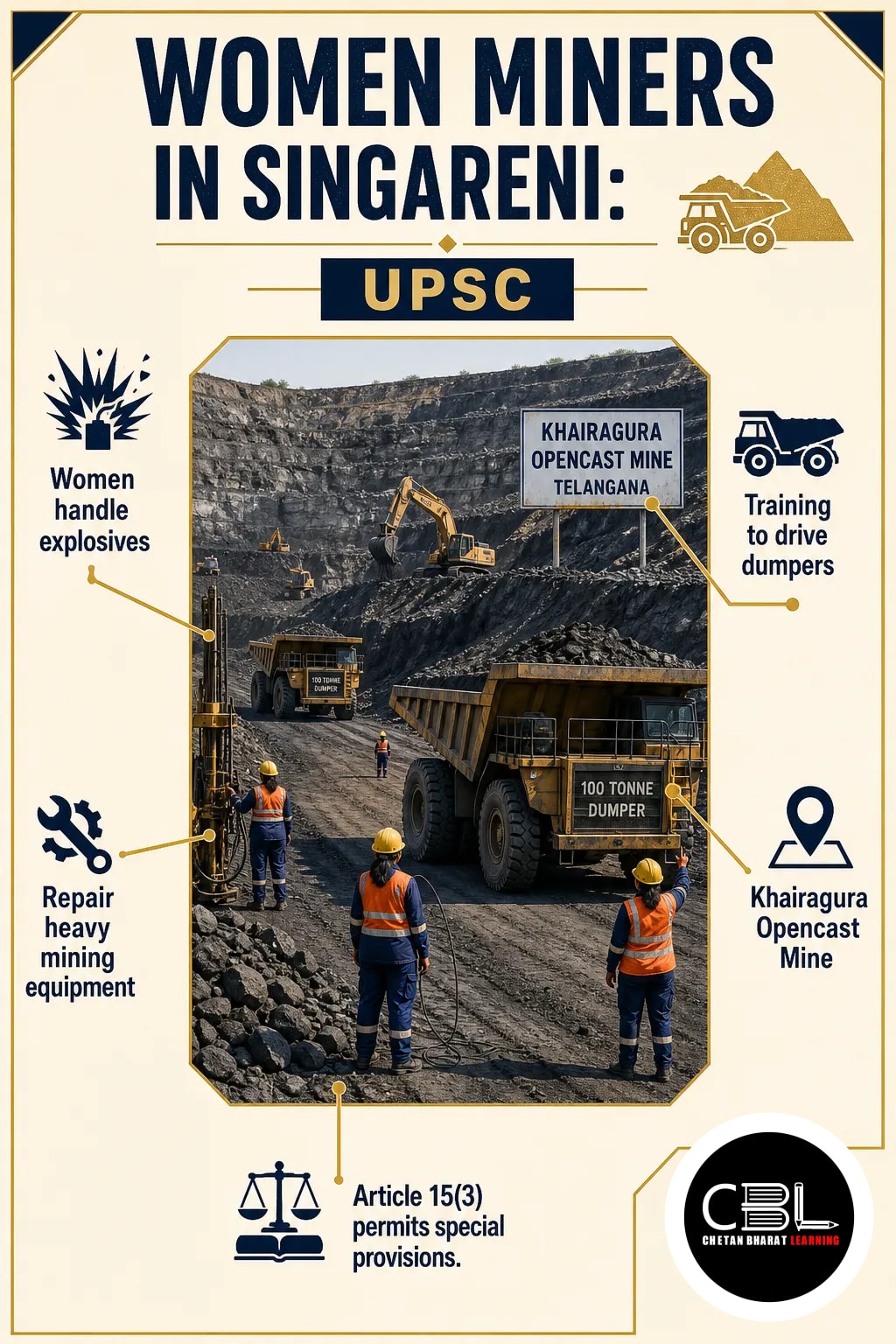
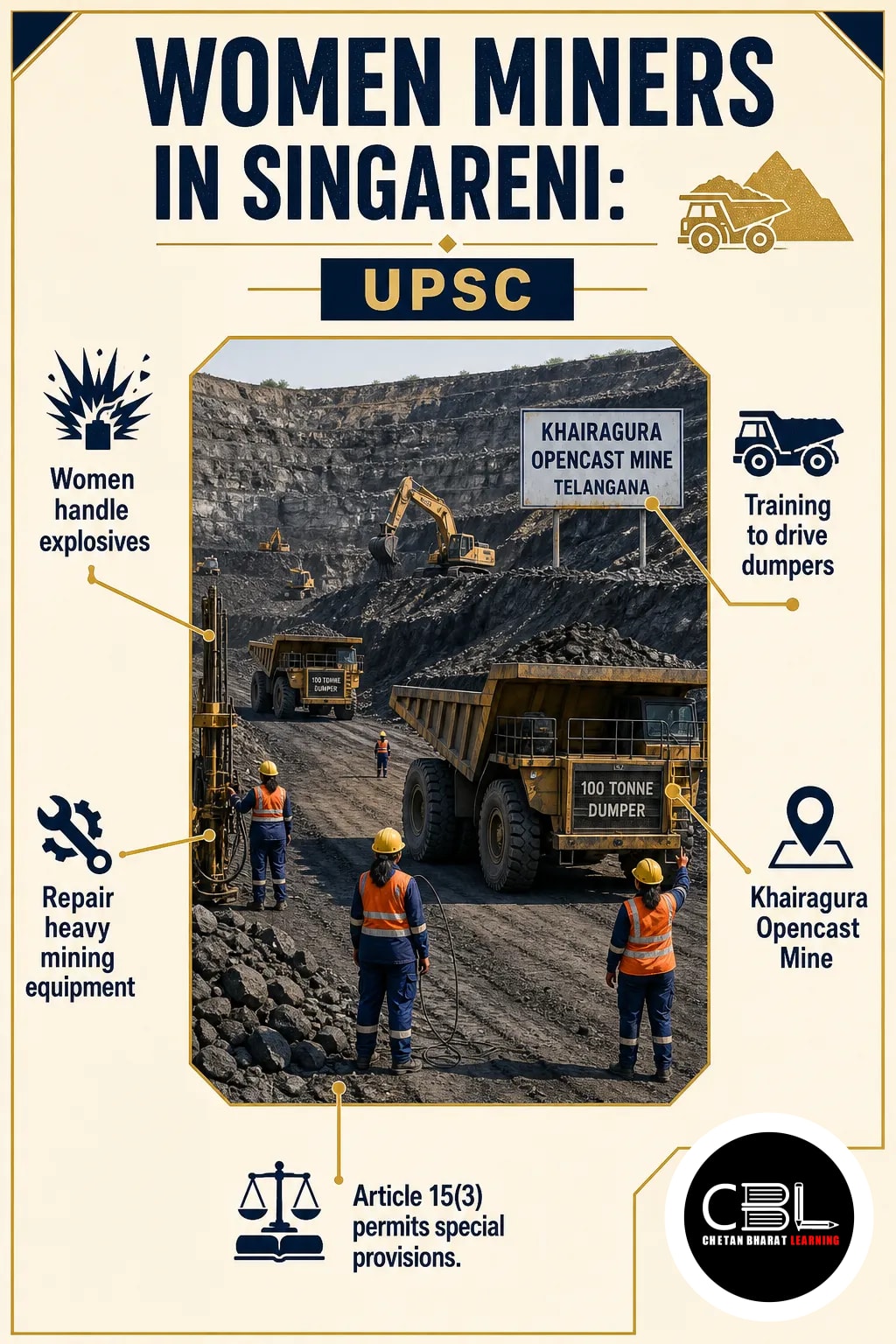
Women miners in Singareni are taking on technical and supervisory roles in Telangana’s coal industry. Their experience connects workplace safety with gender equality and social issues relevant to UPSC.
Quick answer: Women miners in Singareni handle explosives, repair equipment and supervise underground operations at state-owned Singareni Collieries Company Limited in Telangana. Some are also training to drive 100-tonne dumpers. The report links this shift to amendments to the Mines Act, while highlighting the broader question of equal access to safe work.
What roles are women taking up in mining?
Women at Singareni Collieries Company Limited (SCCL) now perform technical, operational and supervisory work. For example, an explosives team prepares blast sites at Khairagura Opencast Mine in Kumuram Bheem Asifabad district.
Elsewhere in the company, women repair heavy mining equipment and supervise underground operations. In addition, some are training to operate 100-tonne dumpers; training should not be confused with a claim that they have all completed it.
The report describes Tumram Priya’s transition from aviation to a mine-area office. A commerce graduate and former flight attendant, she manages personnel and vehicles and is familiar with controlled explosives. She entered SCCL through the dependent quota after her father took voluntary retirement for health reasons.
Her experience illustrates one route into mining employment, not the route taken by every woman worker. Nevertheless, the range of tasks shows why job access must extend beyond office-based roles.
Why are women miners in Singareni in the news?
The Hindu highlights women’s participation in roles traditionally associated with a male workforce. It links the change to amendments to the Mines Act that helped open such work to women.
However, the supplied report does not specify the amendment’s date, section or detailed conditions. Therefore, aspirants should not assume that every mining task or shift is open without applicable safeguards. The available account also does not give the number or share of women employed by SCCL.
The immediate example is an opencast coal mine, where operations take place at the surface. Underground supervision is a separate role mentioned in the report; consequently, the two working environments should not be treated as identical.
Which constitutional principles are relevant?
Equality, public employment and humane working conditions provide the constitutional framework for analysing women’s access to mining jobs. The following provisions offer distinct principles rather than a mining-specific recruitment code.
| Provision | Relevance |
|---|---|
| Article 14 | Equality before the law and equal protection of laws. |
| Article 15(3) | Permits the State to make special provisions for women and children. |
| Article 16 | Provides equality of opportunity in public employment, subject to constitutional provisions. |
| Article 39(d) | Directs the State towards equal pay for equal work for men and women. |
| Article 42 | Calls for just and humane conditions of work and maternity relief. |
Articles 39(d) and 42 are Directive Principles of State Policy. In contrast, Articles 14, 15 and 16 are Fundamental Rights. Thus, a Mains answer should distinguish the two categories rather than treat their enforceability as identical.
Why does wider participation matter?
Access to skilled mining work can expand women’s occupational choices and support more inclusive public employment. However, entry alone does not establish equal opportunities throughout a career.
- Skills and mobility: Training for equipment and supervisory roles can create pathways beyond initial entry-level assignments.
- Economic agency: Access to paid technical work can strengthen individual financial independence; earnings, however, depend on actual employment terms.
- Institutional equality: Fair selection, pay and promotion processes can turn formal eligibility into meaningful opportunity.
- Safety for everyone: Better risk assessment and protective equipment can benefit the entire workforce, not only women.
These are potential benefits, not measured outcomes from the SCCL report. Therefore, evidence on recruitment, retention, training and advancement would help assess whether the shift is sustained.
What workplace issues need attention?
Mining employers must combine equal access with safeguards suited to hazardous and remote workplaces. The following are policy considerations; the source does not establish that each is a specific failure at SCCL.
- Occupational risk: Explosives, heavy vehicles and underground work require task-specific training, supervision and emergency preparedness.
- Protective equipment: Employers should ensure that safety gear fits the worker and the task; poorly fitting equipment can undermine protection.
- Facilities and transport: Suitable sanitation, changing facilities and safe travel arrangements can support participation at remote sites and across shifts.
- Career progression: Transparent access to training and promotion matters; otherwise, formal entry may not lead to senior roles.
- Workplace dignity: Effective complaint mechanisms and protection against harassment are necessary alongside physical safety measures.
In addition, care responsibilities may affect workers’ ability to accept shifts or training. Flexible support should therefore address practical constraints without assuming that all women have identical needs.
What should the way forward be?
Mining policy should pair non-discriminatory opportunity with enforceable, task-specific safety standards. First, employers should publish clear eligibility criteria and offer training for technical and supervisory work.
Second, safety planning should cover equipment fit, emergency response, transport and suitable workplace facilities. Moreover, worker consultation can identify barriers that formal rules alone may miss.
Finally, organisations should track recruitment, retention, pay and promotion by gender while protecting personal information. Such evidence can distinguish a change in permitted roles from durable equality in actual employment.
Source: The Hindu, 30 October 2026
Punjab PCS and Haryana HCS can test constitutional equality, occupational safety and women’s participation in the workforce. In addition, candidates can use the case to discuss how state institutions support safe and equitable employment.
Prelims Practice Corner
Mains Practice Questions
Frequently Asked Questions
What work do women at Singareni mines do?
They handle explosives, repair equipment and supervise underground operations. In addition, some are training to drive 100-tonne dumpers.
Where is Khairagura Opencast Mine?
It is in Kumuram Bheem Asifabad district, Telangana. The report also describes a women’s explosives team preparing a blast site there.
Which constitutional article refers to equal pay for equal work?
Article 39(d) refers to equal pay for equal work for men and women. It is also a Directive Principle of State Policy.
Does the report specify the date of the mining law amendment?
No, the supplied material does not specify the date or section. It nevertheless links amendments to the Mines Act with wider access to mining jobs.
Related Current Affairs
Preparing for UPSC, PCS or HCS?
Talk to a mentor at Chetan Bharat Learning, Chandigarh. Free guidance on choosing the right exam and building a study plan.
Chat on WhatsAppCall 97793 53345UPSC / IAS / PCS coaching in Chandigarh · Trusted by aspirants across Punjab & Haryana
Leave a Reply
You must be logged in to post a comment.