
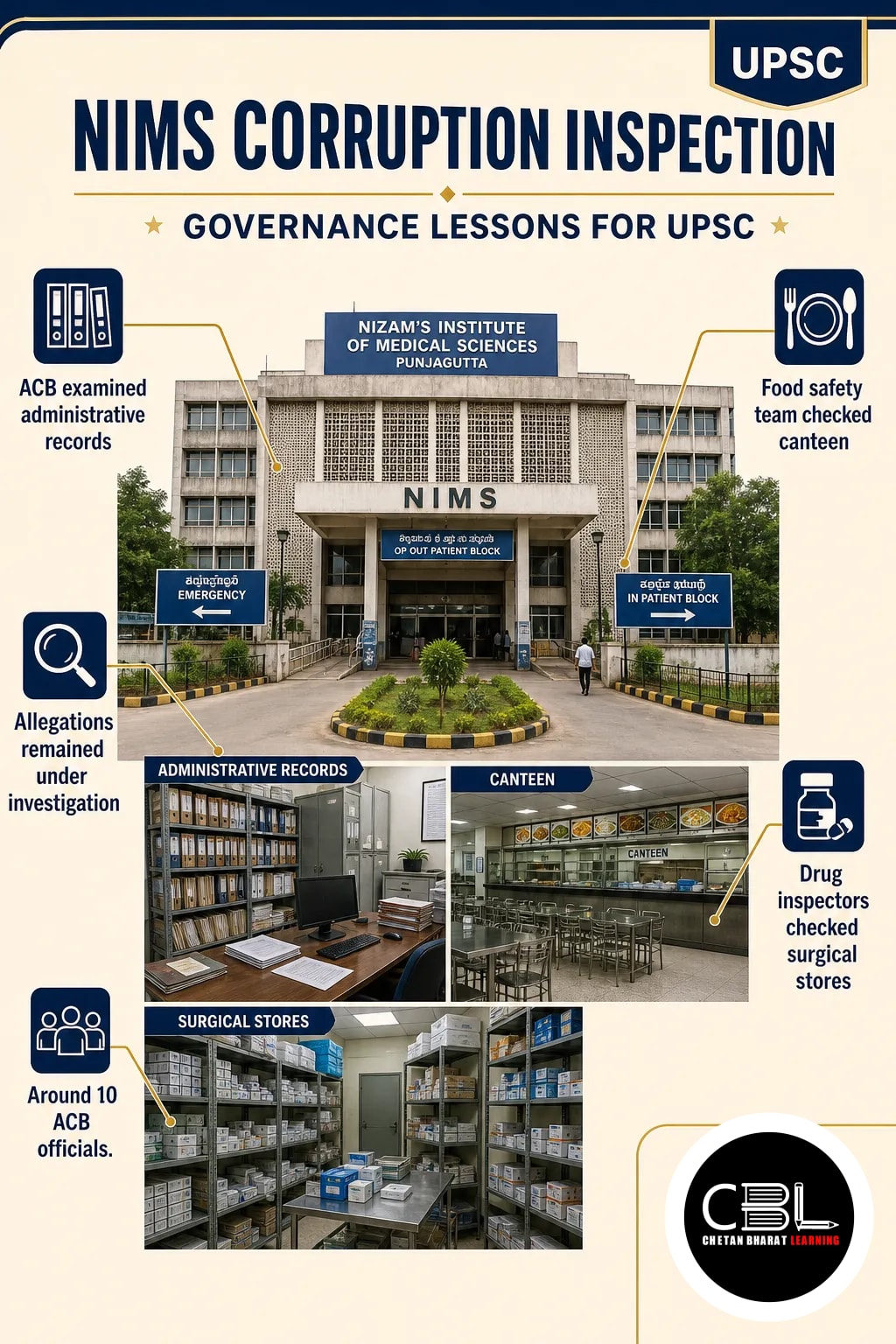
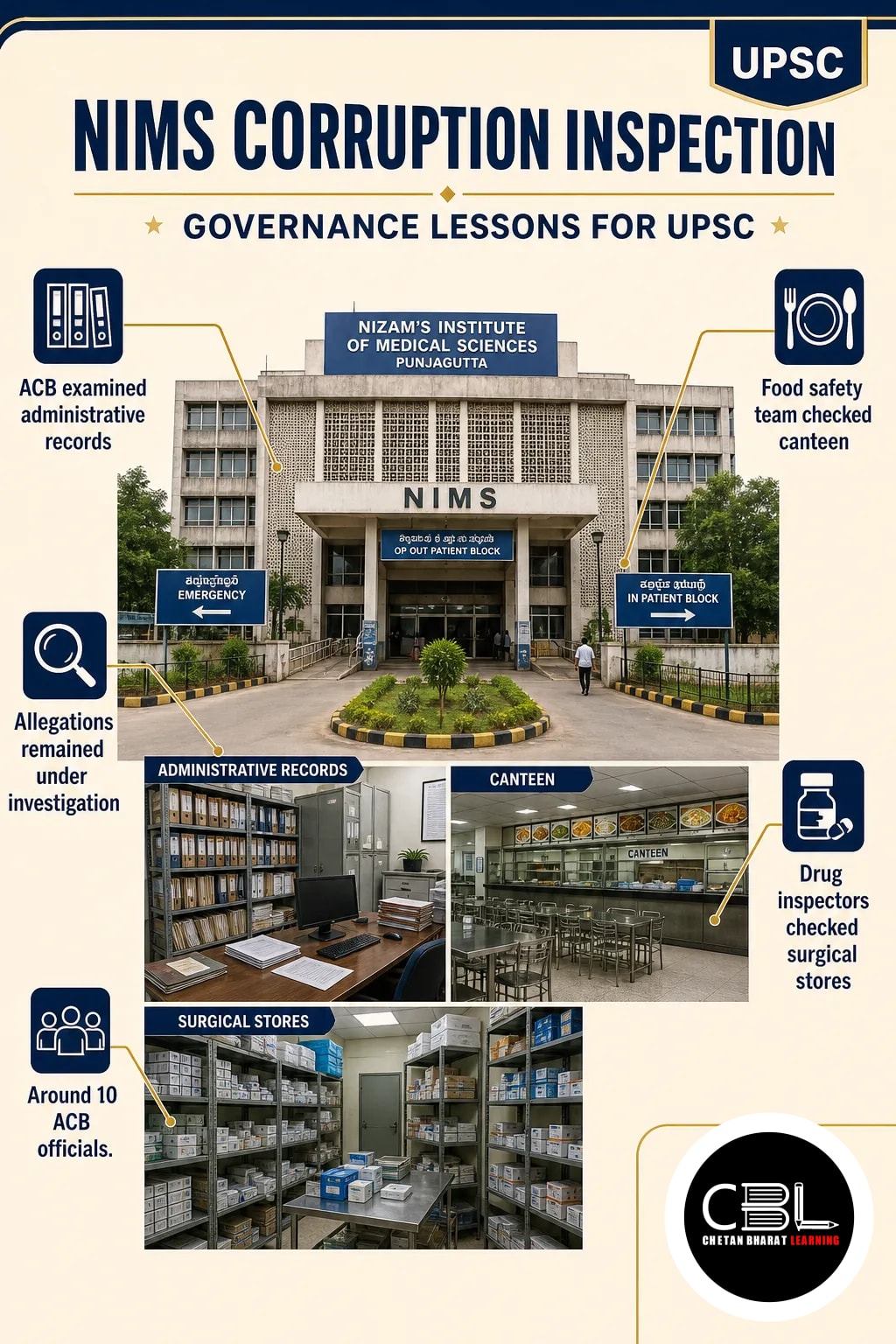
NIMS corruption inspection has brought hospital administration, food safety and drug storage under simultaneous scrutiny. The development offers a case study in public-sector governance, while the allegations remain under investigation.
Quick answer: The NIMS corruption inspection took place on Thursday at Nizam’s Institute of Medical Sciences in Punjagutta, Telangana. Following allegations of corruption and irregularities, anti-corruption officials checked administrative records, four food safety inspectors visited the canteen, and four drug inspectors examined surgical stores. The source does not establish the allegations as proven.
What happened at NIMS?
Three teams inspected separate areas of the hospital after allegations of corruption and irregularities. The Anti-Corruption Bureau (ACB) examined administrative records, while food safety and drug control officials inspected service and storage areas.
Around 10 ACB officials formed the bureau’s team. Deputy Superintendent of Police (DSP) Lakshmi Kanth Reddy of the Central Investigation unit led it. Meanwhile, the other teams each had four inspectors.
| Team | Inspection focus |
|---|---|
| ACB | Records in the administrative section |
| Food safety | Hospital canteen |
| Drug control | Medicines, medical equipment and storage records in surgical stores |
The source says an ACB statement was expected on Friday. However, it does not provide findings, identify specific violations or establish individual responsibility. An inspection is therefore not, by itself, proof of wrongdoing.
Why does hospital oversight require multiple agencies?
Hospital oversight spans financial administration, patient-facing services and the quality of medical supplies. Consequently, a single inspection lens cannot fully address every governance risk.
Administrative accountability
Administrative records can help investigators trace decisions and identify who authorised them. For example, comparing approvals, invoices and receipt records can reveal inconsistencies that merit further examination. However, discrepancies still require verification and an opportunity for explanation.
Food and medical supplies
Canteen oversight concerns the safety of food served on hospital premises. Similarly, checks on medicines and storage records can help assess whether supplies are handled appropriately. Neither concern should be treated as a confirmed violation in this case.
For related regulatory context, see CBL’s coverage of food safety enforcement in Uttar Pradesh and the drug safety questions raised by a Kerala probe.
What are the governance implications?
The inspection highlights how administrative integrity and service quality intersect in hospitals. The following are general governance risks, not findings against NIMS.
- Procurement integrity: Weak scrutiny of purchases can compromise value for public funds; therefore, decision trails matter.
- Supply chain: Poor inventory controls can obscure shortages or expiry; consequently, stock records need regular reconciliation.
- Patient safety: Unsafe food or improperly stored medicines can harm patients; hence, technical checks complement financial oversight.
- Institutional trust: Unresolved complaints can undermine confidence; however, public communication must distinguish allegations from findings.
- Coordination: Separate agencies examine different issues; therefore, clear referral and follow-up procedures can reduce gaps.
The distinction between purchasing controls and clinical safety also matters. A compliant tender does not automatically guarantee correct storage, while a storage check alone cannot establish procurement integrity. CBL’s discussion of public procurement reforms provides a wider administrative context.
What safeguards can improve hospital accountability?
Hospitals need traceable decisions, independent checks and timely corrective action. These measures should protect patients while respecting due process for those concerned.
- Document decisions: Maintain accessible records of approvals, purchases, receipts and stock movements; also define who can amend them.
- Check physical stocks: Reconcile inventory records with actual supplies; moreover, investigate discrepancies through a documented process.
- Inspect service areas: Schedule food and storage checks using clear criteria; then track whether deficiencies receive corrective action.
- Protect complaints: Provide confidential reporting channels and protect complainants from retaliation; meanwhile, prevent disclosure of sensitive patient information.
- Publish follow-up: Share verified outcomes where lawful; however, avoid prejudging individuals or disclosing protected information.
Overall, the NIMS corruption inspection illustrates why an effective response must connect investigation with routine internal controls. The evidence and final conclusions, however, depend on the competent authorities’ findings.
Source: The Hindu, 30 October 2026
Punjab PCS and Haryana HCS can test this case through state responsibilities for hospital administration, food safety and drug regulation. In addition, candidates should connect inspections with record-keeping, interdepartmental coordination and procedural fairness.
Prelims Practice Corner
Mains Practice Questions
Frequently Asked Questions
Where did the NIMS corruption inspection take place?
It took place at Nizam’s Institute of Medical Sciences in Punjagutta, Telangana. The teams examined different parts of the hospital, including its administrative section.
What did the drug inspectors check at NIMS?
They checked medicines, medical equipment and storage records in the surgical stores. In addition, four inspectors formed the drug control team.
Did the inspection establish corruption at NIMS?
No, the source does not establish corruption as proven. It describes inspections following allegations and says an ACB statement was expected.
Related Current Affairs
Preparing for UPSC, PCS or HCS?
Talk to a mentor at Chetan Bharat Learning, Chandigarh. Free guidance on choosing the right exam and building a study plan.
Chat on WhatsAppCall 97793 53345UPSC / IAS / PCS coaching in Chandigarh · Trusted by aspirants across Punjab & Haryana
Leave a Reply
You must be logged in to post a comment.