
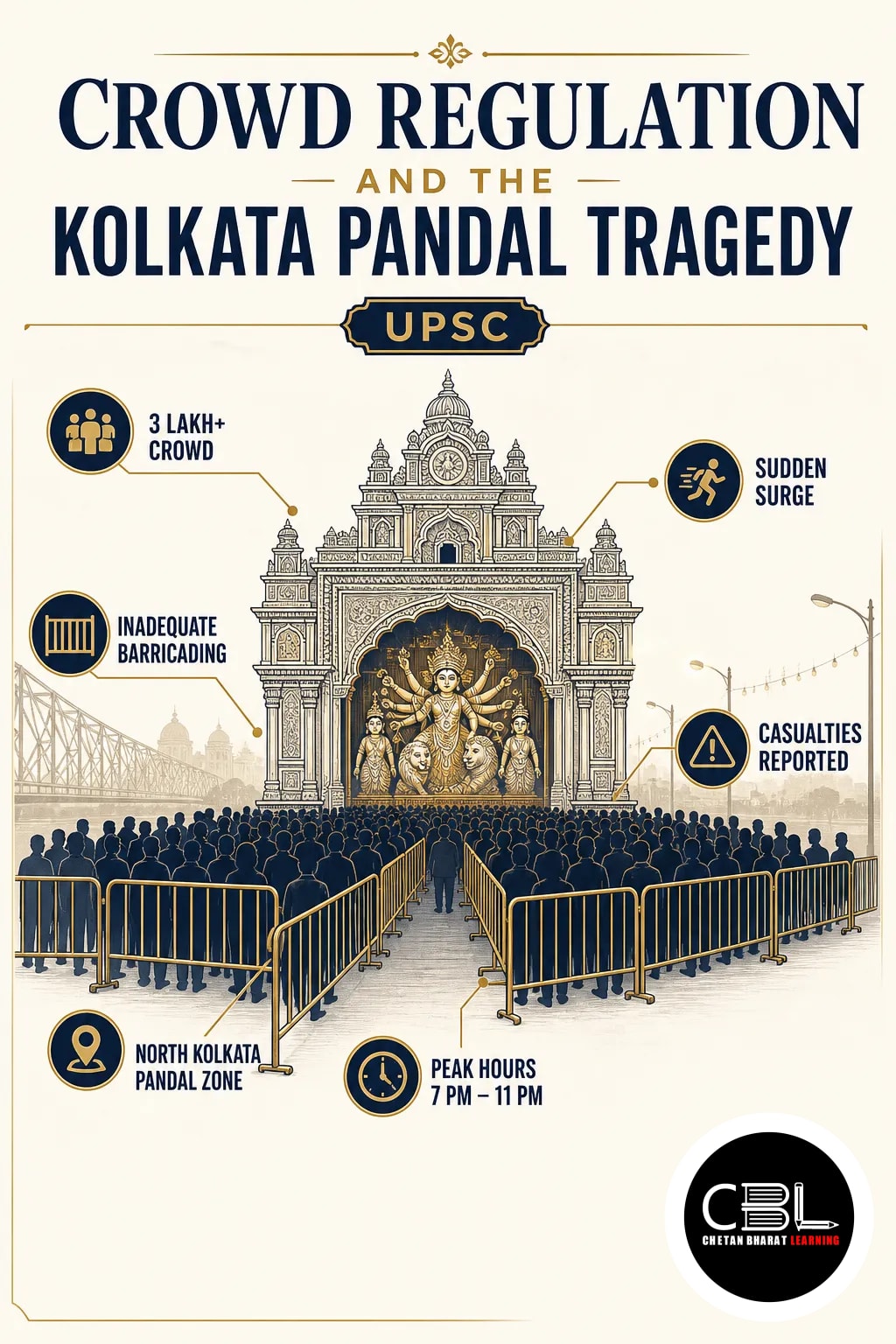

Crowd regulation became the central issue after the Kolkata pandal tragedy, where a sudden surge at Girish Park led to avoidable loss of life. For broader context on public-event safety, see safety failures in hazardous public gatherings.
What is crowd regulation?
Crowd regulation means the planned management of large gatherings so movement remains orderly, safe and predictable. It involves entry control, exit design, route planning, trained personnel and quick response systems.
In India, such regulation matters at festivals, rallies, transport hubs and religious gatherings. The idea is simple: when organisers and police anticipate pressure points, they reduce the risk of panic and crush injuries.
Why in News?
The editorial links the Kolkata tragedy to weak crowd planning during a major public festival. It argues that the fatal surge could have been prevented if authorities had managed the venue better.
The article also notes that narrow lanes, a restricted entry-exit arrangement and weather-related panic worsened the situation. This makes festival safety and public order the key policy concerns.
Key Features
- Risk mapping identifies bottlenecks before crowds arrive. Organisers must assess lane width, access roads and possible choke points.
- Controlled entry and exit prevents simultaneous inflow and outflow. Separate routes reduce jostling and confusion.
- Real-time monitoring helps officers spot dangerous surges. CCTV, volunteers and field supervisors can alert command teams quickly.
- Police-led coordination ensures that organisers, local administration and emergency services work under one plan. This is crucial for dense urban spaces.
- Weather-sensitive planning matters during rain, storms or heat. Sudden environmental stress can trigger panic and movement surges.
- Emergency evacuation protocol supports safe dispersal. Clear announcements and trained marshals can guide people without causing alarm.
Challenges
- Overcrowding for spectacle often pushes safety to the background. Large festivals may prioritise visibility and scale over discipline.
- Narrow urban spaces limit the scope for safe crowd flow. Old city lanes and temporary structures can create severe bottlenecks.
- Poor coordination between organisers and police creates gaps. If responsibility is unclear, response becomes slow and fragmented.
- Inadequate personnel deployment weakens on-ground supervision. Temporary or inexperienced staff may miss early warning signs.
- Panic-driven movement can turn a manageable crowd into a deadly crush. Sudden announcements about structural safety may worsen fear.
Way Forward
Authorities should require event-specific safety plans for all large gatherings. These plans must include crowd limits, route maps, emergency exits and medical support.
Police deployment should be based on venue complexity, not only on crowd size. Regular drills, better signage and strict accountability can make crowd regulation more effective.
Urban local bodies and district administrations should also audit temporary structures before permissions are granted. A festival can remain vibrant only when safety is treated as part of the celebration.
Source: The Hindu, October 19, 2026
This issue is relevant for state PCS questions on district administration, police management and disaster preparedness during religious or cultural gatherings. It also connects with urban governance, local bodies and the legal duty to maintain public order.
FAQ
Why does crowd regulation matter in festivals?
It reduces the risk of panic, crushing and blocked exits. Safe crowd flow allows people to enter and leave without sudden pressure on one point.
What usually causes stampedes?
Stampedes often begin with panic, narrow pathways, poor signalling or sudden announcements. The danger increases when crowd size exceeds what the venue can handle safely.
What should authorities do before giving permission for large gatherings?
They should check venue capacity, exit routes, emergency access and policing arrangements. A safety plan and on-ground supervision are essential for public events.
Related Current Affairs
Preparing for UPSC, PCS or HCS?
Talk to a mentor at Chetan Bharat Learning, Chandigarh. Free guidance on choosing the right exam and building a study plan.
Chat on WhatsAppCall 97793 53345UPSC / IAS / PCS coaching in Chandigarh · Trusted by aspirants across Punjab & Haryana
Leave a Reply
You must be logged in to post a comment.