
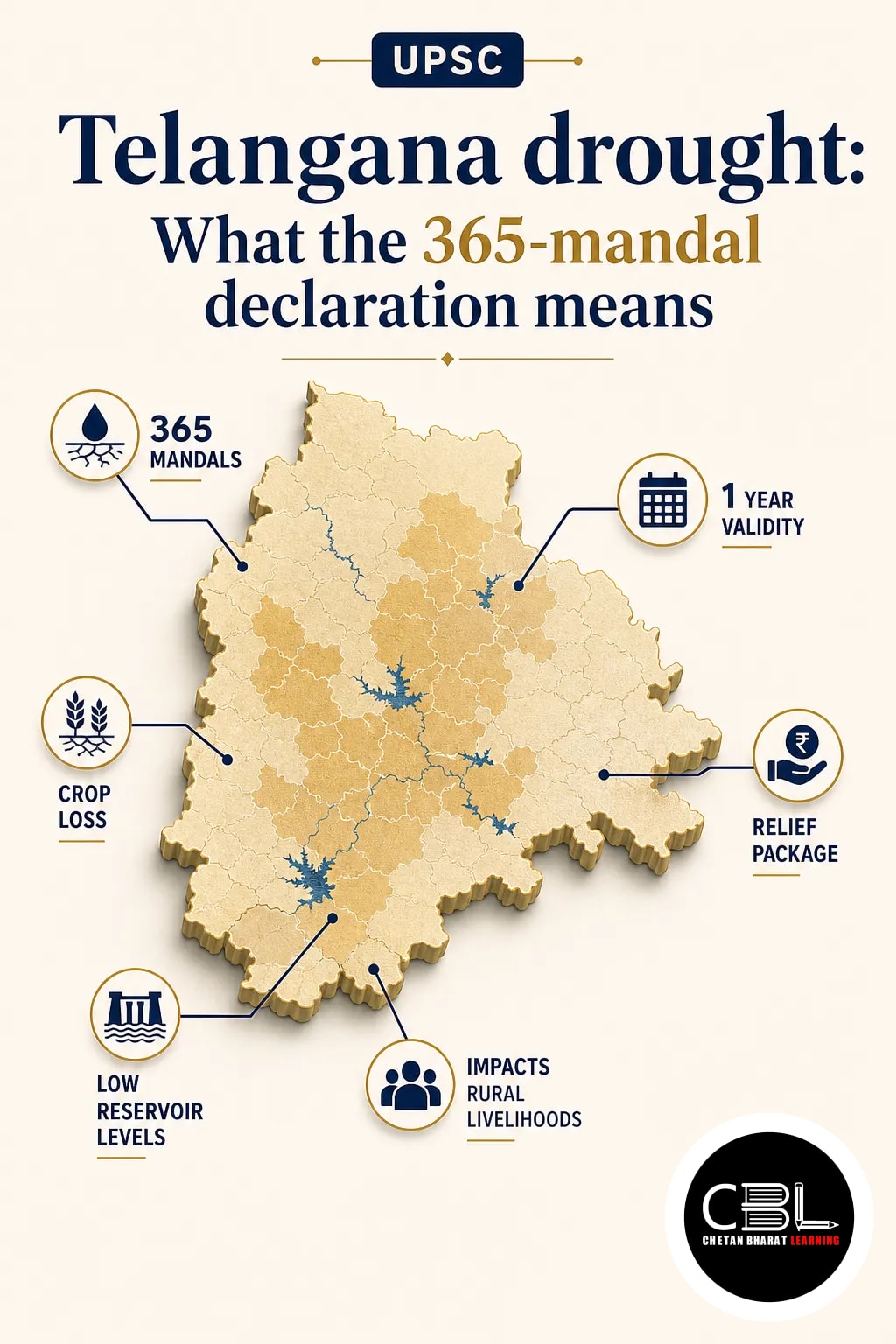

Telangana drought has entered a formal relief phase after the State notified 365 mandals as affected. Read the wider disaster-management context in CBL current affairs coverage while the government begins district-level action.
What is Telangana drought?
The Telangana drought declaration is a formal administrative recognition of acute rainfall stress and crop loss across parts of the State. It allows officials to activate relief, compensation and monitoring measures under the disaster-response framework.
Under the current order, the State has classified mandals as severely or moderately drought-affected. The decision rests on rainfall, dry-spell, crop and groundwater indicators, not on a single trigger.
Why in News?
The Telangana government declared 365 mandals drought-affected for the 2026 kharif season after deficient monsoon rainfall and prolonged dry spells. Of these, 111 mandals were placed in the severe category.
The declaration follows a scientific assessment and a Cabinet subcommittee review of El Niño and drought conditions. It also comes after the Assembly urged the Centre to extend drought relief and additional support.
Key Features
- Scientific basis: The assessment used rainfall data, dry-spell records, crop-sown area, vegetation condition, soil moisture and groundwater indicators.
- Wide administrative coverage: The notification covers 31 districts and remains valid for six months.
- Crop stress: Kharif area in 18 districts was affected, showing the drought’s spread across farming regions.
- Paddy decline: Paddy cultivation fell from 69.19 lakh acres to 57 lakh acres, reflecting lower sowing and water stress.
- Storage concerns: Reservoir storage has fallen sharply, which affects drinking water, livestock and power supply.
- Immediate relief: District Collectors must arrange input subsidy, drinking water support, fodder, cattle camps and employment measures.
Challenges
- Water scarcity: Low reservoir storage can create pressure on rural drinking water supply and irrigation planning.
- Farmer distress: Crop loss and reduced acreage can weaken farm incomes and raise debt stress.
- Livestock stress: Fodder shortages and limited water availability can hurt animal husbandry.
- Administrative speed: Relief benefits must reach farmers quickly, especially where DBT and beneficiary verification are involved.
- Inter-department coordination: Revenue, agriculture, horticulture, animal husbandry and civil supplies departments must act together.
Way Forward
Relief will depend on fast execution of DBT subsidies, drinking water augmentation and fodder supply. The State also needs village-level monitoring so that severely affected mandals receive support without delay.
Longer-term, Telangana will need stronger drought preparedness through water conservation, crop planning and climate-risk management. Better storage, resilient cropping patterns and groundwater recharge can reduce future vulnerability.
Source: The Hindu, 28 October 2026
- Yojana Summary June 2023 (24 Jun 2023)
This topic links directly to state GS questions on disaster management, irrigation dependence and crop-loss compensation. Punjab and Haryana aspirants should also connect it with groundwater stress, monsoon variability and administrative relief mechanisms.
FAQ
Why did Telangana declare drought-affected mandals?
The State acted after a rainfall deficit, prolonged dry spells and visible crop stress during the 2026 kharif season. The notification helps activate relief, subsidy and drinking water measures.
What relief measures have been ordered?
The order asks district officials to arrange input subsidy, drinking water support, fodder, cattle camps and employment measures. It also directs the State to seek Central assistance under the NDRF.
Why is this relevant for UPSC?
The issue combines climate variability, agriculture, disaster management and Centre-State coordination. It is useful for both Prelims concepts and GS Paper III answers.
Related Current Affairs
Preparing for UPSC, PCS or HCS?
Talk to a mentor at Chetan Bharat Learning, Chandigarh. Free guidance on choosing the right exam and building a study plan.
Chat on WhatsAppCall 97793 53345UPSC / IAS / PCS coaching in Chandigarh · Trusted by aspirants across Punjab & Haryana
Leave a Reply
You must be logged in to post a comment.