

UPSC Mapping
Prelims
- I4C, MHA, Cybercrime Reporting Portal, Helpline 1930 and CERT-In
Mains
- GS Paper 3: Internal Security and Cybersecurity; GS Paper 2: Governance
| Established Under | Ministry of Home Affairs |
|---|---|
| Dedicated to Nation | 10 January 2020 |
| Headquarters | New Delhi |
| Financial Fraud Helpline | 1930 |
Article
What is the Cybercrime Coordination Centre (I4C)?
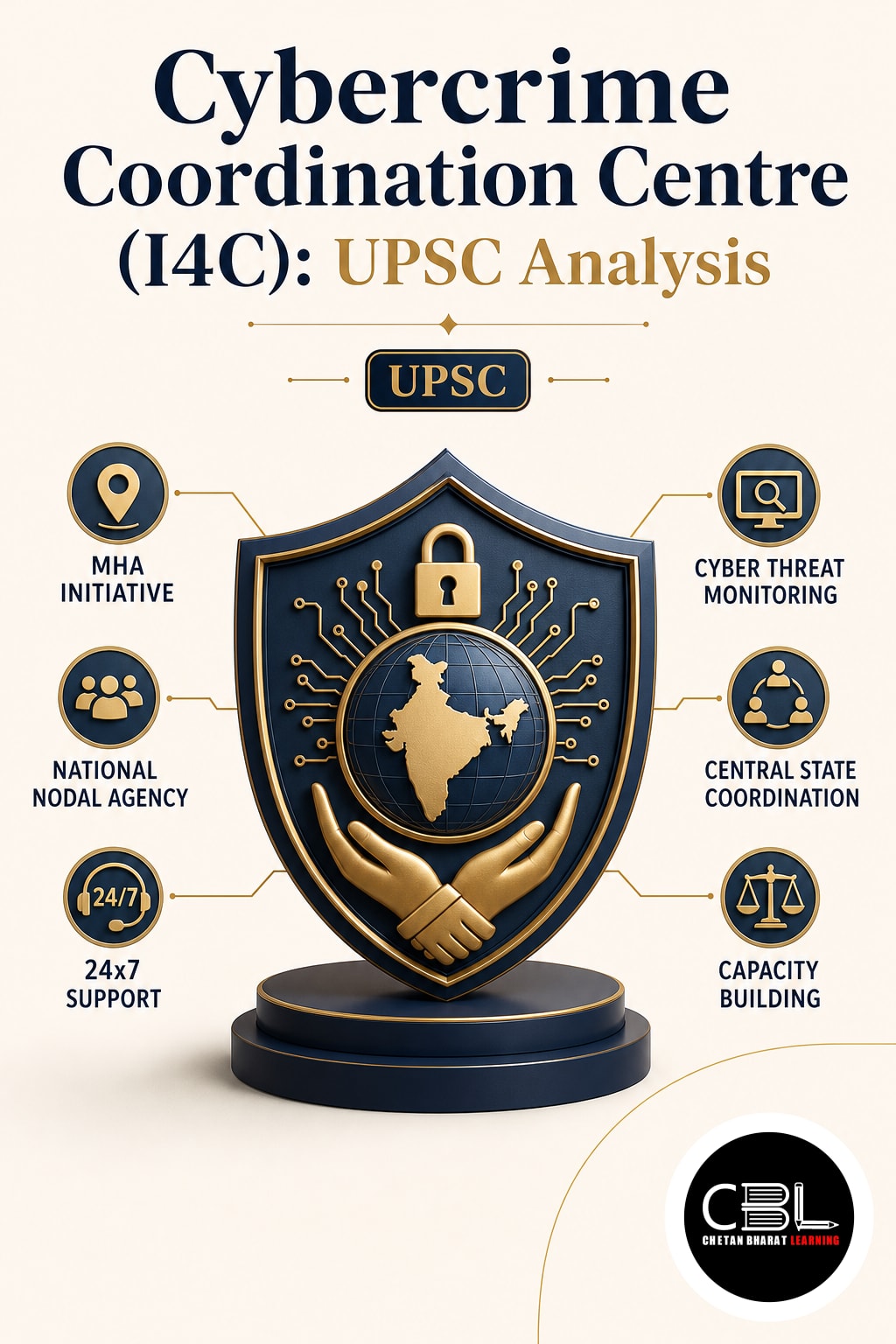
The Indian Cybercrime Coordination Centre (I4C) is an initiative of the Ministry of Home Affairs that provides a coordinated framework for addressing cybercrime across India. It functions as a national-level nodal mechanism for improving cooperation among law enforcement agencies.
The Ministry of Home Affairs dedicated I4C to the nation on 10 January 2020. Its headquarters are located in New Delhi.
I4C facilitates collaboration between government agencies, academia, industry and other stakeholders. It supports cybercrime prevention, detection, investigation and prosecution through coordinated institutional mechanisms.
Its significance arises from the cross-border and technologically complex nature of cybercrime. Offenders may operate across multiple jurisdictions, making information exchange and specialised investigative capabilities essential.
Why in News?
The Indian Cyber Crime Coordination Centre recently drew attention in connection with an alleged financial fraud involving deceptive online advertisements. These ads reportedly used manipulated visuals of senior political leaders to lend credibility to fraudulent investment opportunities. The case underscores how cybercriminals exploit public trust, AI-based manipulation and digital advertising systems, causing financial losses and eroding confidence in online transactions.
Objectives of the Indian Cybercrime Coordination Centre
- National coordination: Develop an institutional framework for tackling cybercrime through cooperation among relevant authorities.
- Protection of vulnerable groups: Strengthen responses to cybercrime against women and children.
- Information sharing: Facilitate exchange of data on cybercrime trends and threats.
- Early warning mechanism: Enable proactive identification of emerging cyber risks.
- Cybercrime prevention: Improve public awareness and support preventive action.
- Capacity building: Train police officers, prosecutors and judicial officials.
- Research and development: Foster innovative investigative technologies.
- Legal and policy support: Recommend improvements to cybercrime laws.
- International cooperation: Coordinate mutual legal assistance with foreign authorities.
Seven Major Components of I4C
The I4C framework includes seven components to bolster India’s cybercrime response:
1. National Cybercrime Threat Analytics Unit
Analyzes cybercrime threats, trends and patterns to inform law enforcement.
2. National Cybercrime Reporting Portal
Provides a central platform for citizens to report cybercrime incidents, especially online financial fraud and crimes against women and children. Access the portal at cybercrime.gov.in.
3. National Cybercrime Training Centre
Develops specialised skills among law enforcement and justice officials in handling digital evidence and technical investigations.
4. National Cybercrime Research and Innovation Centre
Encourages R&D into emerging cybercrime challenges and investigative tools.
5. Platform for Joint Cyber Crime Coordination Team
Facilitates inter-agency coordination on cases spanning multiple jurisdictions.
6. Cybercrime Ecosystem Management Unit
Engages government, industry, academia and other stakeholders to strengthen prevention and response.
7. National Cybercrime Forensic Laboratory (Investigation) Ecosystem
Provides digital forensic support essential for examining electronic evidence.
Major Initiatives Under I4C
Citizen Financial Cyber Fraud Reporting and Management System (CFCFRMS)
Coordinates action on complaints involving online financial fraud to enable timely intervention.
National Cybercrime Helpline 1930
Offers a dedicated channel for citizens to report suspected financial cyber fraud.
National Cyber Crime Reporting Portal
Streamlines online complaint submission and routes cases to appropriate authorities.
Pratibimb Geospatial Crime Mapping Platform
Maps cybercrime locations and infrastructure to aid multi-region investigations.
Samanvaya Portal
Web-based platform for inter-agency sharing of cybercrime information and analytics.
Difference Between I4C and CERT-In
| Basis | I4C | CERT-In |
|---|---|---|
| Full Name | Indian Cybercrime Coordination Centre | Indian Computer Emergency Response Team |
| Ministry | Ministry of Home Affairs | Ministry of Electronics and Information Technology |
| Primary Role | Coordination, reporting and investigative support | Incident response, alerts and technical assistance |
| Institutional Framework | National cybercrime coordination initiative | Agency under Section 70B of the IT Act, 2000 |
| Main Focus | Law enforcement support against cybercrime | Technical cybersecurity incident management |
Challenges in Combating Cybercrime
- Cross-border operations: Jurisdictional hurdles in multi-country investigations.
- AI misuse: Deepfakes and automated scams increase deception.
- Jurisdictional complexity: Victims, perpetrators and infrastructure span states.
- Limited cyber awareness: Low public recognition of phishing and fraud.
- Skill gaps: Ongoing need for specialised training.
- Digital evidence: Preservation and admissibility challenges.
- Fast transactions: Rapid money movements reduce intervention time.
- Privacy concerns: Balancing enforcement with data rights.
Way Forward
- Strengthen coordination: Enhance data sharing among agencies and banks.
- Increase public awareness: Educate citizens on spotting and reporting scams.
- Expand training: Update investigators on cyber forensics and AI risks.
- Improve reporting systems: Ensure timely follow-up on official complaints.
- Address new tech: Build capabilities for deepfake and AI-driven fraud detection.
- Financial cooperation: Streamline bank and regulator responses to fraud alerts.
- Protect rights: Uphold lawful data use and accountability.
Punjab & Haryana PCS Angle
For Punjab PCS and Haryana HCS aspirants, this topic links with internal security, cyber policing, digital governance and grievance redressal. Understand how state police coordinate with national cybercrime bodies and guide citizens on reporting through Helpline 1930 and the National Cyber Crime Reporting Portal. State-level questions may also probe digital literacy, online financial scams and special cybercrime police stations.
Prelims Practice Corner
Q1. The Indian Cybercrime Coordination Centre (I4C) functions under which ministry?
(a) MEITY (b) MHA (c) Finance (d) Defence
Answer: (b) MHA
Q2. When was I4C dedicated to the nation?
(a) 10 January 2020 (b) 15 August 2018 (c) 26 January 2022 (d) 2 October 2021
Answer: (a) 10 January 2020
Q3. Which national helpline number is associated with reporting financial cyber fraud?
(a) 1098 (b) 1930 (c) 108 (d) 14567
Answer: (b) 1930
Q4. Consider the following statements:
1. I4C operates under the Ministry of Home Affairs.
2. CERT-In functions under the Ministry of Electronics and Information Technology.
3. CERT-In is the national agency for incident response under Section 70B of the IT Act, 2000.
Which are correct?
(a) 1 & 2 (b) 2 & 3 (c) 1 & 3 (d) 1, 2 & 3
Answer: (d) All three.
Q5. Which platform maps cybercriminal locations and related infrastructure?
(a) DigiLocker (b) Pratibimb (c) SWAYAM (d) e-NAM
Answer: (b) Pratibimb
Mains Practice Questions
Q1. Discuss the objectives and institutional significance of the Indian Cybercrime Coordination Centre in strengthening India’s response to cybercrime. (150 words, 10 marks)
Answer Structure:
- Intro: I4C as an MHA initiative, dedicated Jan 2020.
- Body: National coordination, reporting portal, information sharing, training (CFCFRMS, 1930 helpline).
- Conclusion: Emphasise institutional capacity and citizen protection.
Q2. Cybercrime is a major internal security challenge in India’s digital economy. Critically examine the role of institutional coordination, digital forensics and public awareness in combating cyber-enabled financial fraud. (250 words, 15 marks)
Answer Structure:
- Intro: Complexity of AI-enabled cyber fraud.
- Body: Role of I4C, inter-state cooperation, forensics, reporting, bank coordination, awareness; evaluate barriers.
- Conclusion: Recommend capacity building, rapid reporting, rights-respecting governance.
Frequently Asked Questions
What is the Indian Cybercrime Coordination Centre (I4C)?
I4C is a national-level initiative under the Ministry of Home Affairs that supports coordinated action against cybercrime in India through information sharing, reporting and capacity building.
How does I4C differ from CERT-In?
I4C focuses on cybercrime coordination and investigative support under MHA, while CERT-In under MeitY handles cybersecurity incident response, alerts and technical assistance.
Where can citizens report online financial fraud in India?
Citizens can call Helpline 1930 or submit complaints via the National Cyber Crime Reporting Portal at cybercrime.gov.in.
Related Current Affairs
Preparing for UPSC, PCS or HCS?
Talk to a mentor at Chetan Bharat Learning, Chandigarh. Free guidance on choosing the right exam and building a study plan.
Chat on WhatsAppCall 97793 53345UPSC / IAS / PCS coaching in Chandigarh · Trusted by aspirants across Punjab & Haryana
Leave a Reply
You must be logged in to post a comment.