

UPSC Mapping
| Exam | Topics |
|---|---|
| Prelims | Indian Navy, iDEX, Defence Innovation and Maritime Technologies |
| Mains | GS Paper 3: Defence Technology, Indigenisation and Security |
What is Swavlamban 2026?
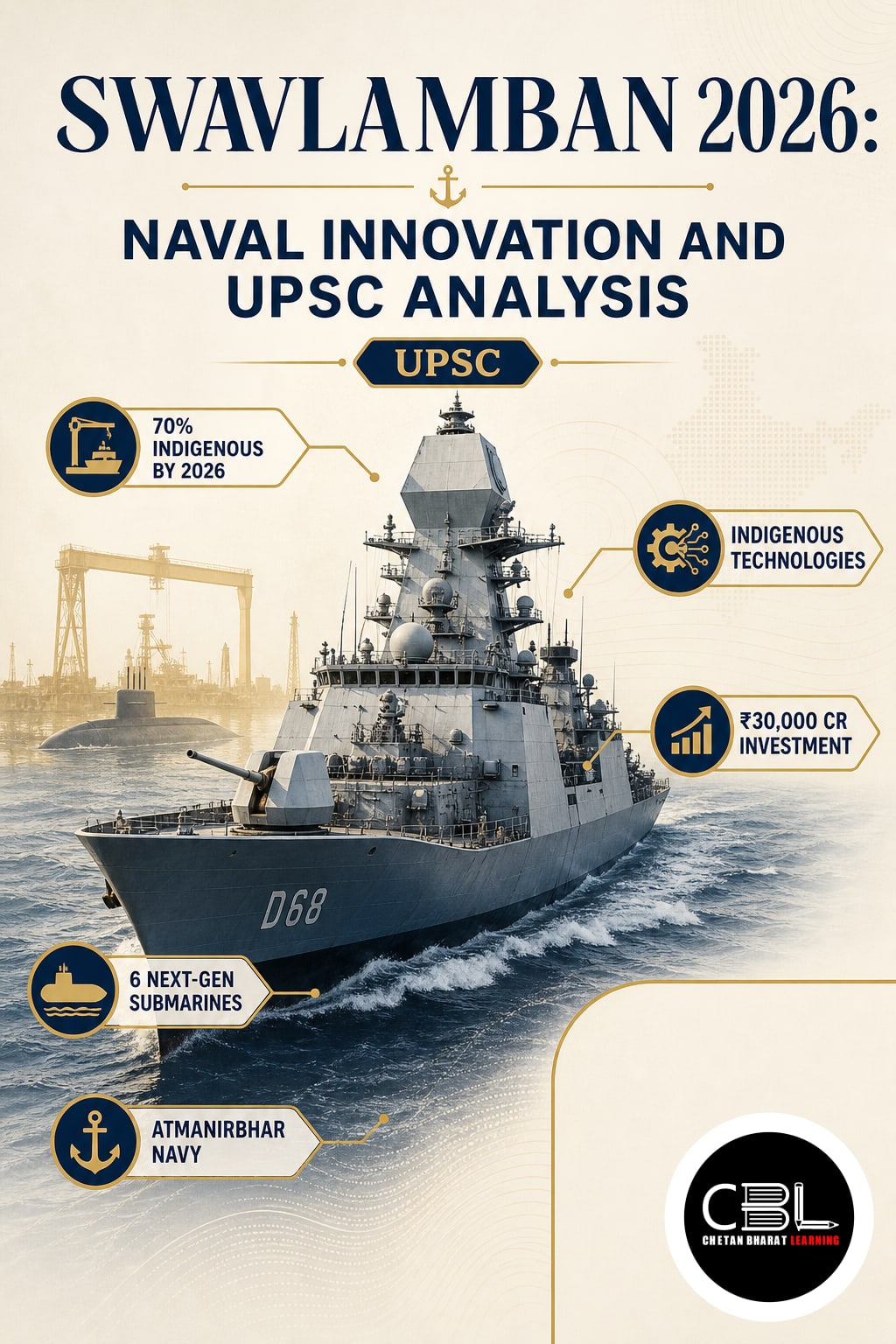
Swavlamban 2026 is the fifth edition of the Indian Navy’s flagship Naval Innovation and Indigenisation Seminar. The initiative encourages collaboration between the Navy and India’s expanding defence innovation ecosystem.
Its principal objective is to convert indigenous technological innovations into capabilities that address operational requirements. This process involves moving beyond laboratory demonstrations towards testing, validation, production and deployment.
The seminar reflects the wider Aatmanirbhar Bharat approach to strengthening domestic defence capabilities. It also seeks to create opportunities for Indian enterprises to contribute to national maritime security.
Why in News?
The Indian Navy organised the fifth edition of its innovation and indigenisation seminar at the Manekshaw Centre in New Delhi. The two-day event brought together technology developers, startups, MSMEs, academic institutions, investors and representatives of the Defence Forces.
The programme focused on translating indigenous technological developments into practical solutions for naval operations. It also examined opportunities for financing, commercialisation and closer cooperation between innovators and defence users.
According to the event information, participation has increased significantly since the first edition. The seminar now attracts nearly 3,000 participants annually and involves more than 100 technology sectors.
Such participation indicates growing interest in defence innovation across the public, private and academic sectors. The event provides a platform for connecting technological solutions with operational demand.
Key Features of Swavlamban 2026
- Indigenous naval technology: The seminar showcases technologies developed within India for maritime security, naval operations and operational efficiency.
- Innovation-to-deployment approach: The programme emphasises converting promising technical ideas into systems that can meet real operational requirements.
- Defence startup participation: Startups and MSMEs interact with naval users to understand challenges and demonstrate potential solutions.
- Industry-academia collaboration: Universities, research organisations and defence manufacturers exchange knowledge and explore joint development opportunities.
- Technology exhibition: Exhibits cover maritime surveillance, artificial intelligence, cybersecurity, underwater systems and autonomous technologies.
- Financing and investment: Discussions include self-reliance, funding opportunities and commercialisation pathways for Indian technology enterprises.
- Institutional cooperation: The programme receives support from the Government of India, the Society of Indian Defence Manufacturers and the Defence Innovation Organisation.
- Expanding participation: The event demonstrates increasing engagement among defence users, research institutions and private innovators.
Major Technologies Highlighted
Maritime Surveillance Systems
Modern naval operations require continuous monitoring of maritime activity and emerging security threats. Indigenous surveillance technologies can support situational awareness, information processing and timely operational decisions.
Advanced sensors and data integration can strengthen the Navy’s ability to monitor coastal and offshore environments. Such technologies also support wider maritime domain awareness.
Artificial Intelligence and Autonomous Systems
Artificial intelligence can help process large volumes of surveillance information and support decision-making. Autonomous platforms may perform selected tasks without requiring personnel at every operational location.
The seminar highlights the importance of developing such capabilities according to military reliability and safety requirements. Testing and human oversight remain essential before operational deployment.
Counter-Unmanned Aerial Systems
Unmanned aerial platforms create both opportunities and threats in contemporary military operations. Counter-UAS technology focuses on detecting, tracking and responding to hostile drone activity.
Developing indigenous solutions can reduce dependence on foreign suppliers for critical defensive technologies. Integration with existing naval systems remains an important technical challenge.
Underwater Technologies
Underwater systems support naval operations in environments where communication, navigation and sensing are particularly difficult. Innovations in this field may improve surveillance, inspection and other specialised maritime tasks.
The event also highlights emerging capabilities in underwater robotics and related engineering applications. These systems require reliable performance in demanding marine conditions.
Cybersecurity and Digital Operations
Naval platforms increasingly rely on sophisticated electronic networks and digital infrastructure. Cybersecurity technologies help protect communications, information systems and operational data from unauthorised access or disruption.
Indigenous cyber capabilities can contribute to technological sovereignty and reduce vulnerabilities within critical defence systems. Continuous testing, secure design and skilled personnel remain necessary.
Significance for India’s Defence Sector
Strengthening Defence Self-Reliance
Indigenous defence innovation can reduce dependence on imported components and specialised technologies. Domestic capabilities also create opportunities for maintenance, upgrades and lifecycle support within India.
Self-reliance requires more than local assembly. It depends on sustained investment in research, manufacturing capabilities, intellectual property and skilled human resources.
Improving Naval Preparedness
The Navy operates in a complex environment involving surface, underwater, aerial and cyber threats. New technologies can help improve surveillance, coordination and operational efficiency.
Platforms developed through collaboration with naval users may better reflect real deployment conditions. User feedback during development helps identify limitations before large-scale production.
Encouraging Startups and MSMEs
Defence innovation programmes offer emerging enterprises access to challenging technology requirements. Participation can encourage entrepreneurship and create opportunities for specialised manufacturing and research.
The Innovations for Defence Excellence (iDEX) framework is an important example of India’s defence innovation ecosystem. Aspirants can consult the Department of Defence Production for wider policy context.
Supporting Maritime Security
India’s maritime interests include the security of sea routes, coastal regions and offshore infrastructure. Strong naval capabilities contribute to protecting these interests and supporting stability in the surrounding maritime region.
Technological indigenisation provides an additional foundation for long-term strategic preparedness.
Challenges in Naval Indigenisation
- Prototype-to-production gap: Promising innovations may struggle to achieve the reliability and scale required for military deployment.
- High development costs: Advanced defence technologies often require substantial investment and lengthy testing cycles.
- Limited startup resources: Small enterprises may face difficulties accessing specialised infrastructure, certification facilities and sustained financing.
- Technology dependencies: Some critical materials, components and manufacturing processes may continue to depend on international suppliers.
- Procurement complexity: Defence acquisition procedures must reconcile operational safety, competitive selection and timely innovation.
- Cybersecurity vulnerabilities: Greater digital integration increases the importance of secure software, protected data and resilient communications.
Way Forward
- Strengthen research partnerships: Encourage long-term collaboration between the Navy, universities, research laboratories and domestic industry.
- Improve testing infrastructure: Provide suitable facilities for evaluating prototypes under realistic maritime conditions.
- Support emerging enterprises: Expand appropriate mentoring, financing and market-access opportunities for startups and MSMEs.
- Simplify innovation pathways: Improve coordination between technology development, operational trials and procurement decisions.
- Develop critical technologies: Prioritise domestic expertise in sensors, electronics, autonomous systems, cyber capabilities and specialised marine engineering.
- Measure operational outcomes: Evaluate innovation programmes through successful testing, deployment readiness and practical capability improvements.
Prelims Practice Corner
- Q1. Swavlamban 2026 is associated with which organisation? (a) Indian Air Force (b) Indian Navy (c) Indian Coast Guard only (d) Border Security Force
Answer: (b) - Q2. Where was the fifth edition of Swavlamban held? (a) Kochi (b) Mumbai (c) Manekshaw Centre, New Delhi (d) Visakhapatnam
Answer: (c) - Q3. Which of the following technologies were highlighted at Swavlamban 2026? 1. Maritime surveillance 2. Counter-UAS systems 3. Underwater technologies 4. Cybersecurity
(a) 1 and 2 only (b) 2 and 3 only (c) 1, 3 and 4 only (d) 1, 2, 3 and 4
Answer: (d) - Q4. The Innovations for Defence Excellence initiative primarily aims to: (a) Regulate international shipping tariffs (b) Support defence innovation involving startups and industry (c) Conduct national population surveys (d) Manage civilian port customs
Answer: (b) - Q5. Which of the following best describes the central objective of the Swavlamban initiative? (a) Expanding foreign dependence for naval equipment (b) Converting indigenous innovations into operational naval capabilities (c) Replacing all civilian research programmes (d) Restricting participation by private enterprises
Answer: (b)
Mains Practice Questions
- Q1. Examine the significance of Swavlamban 2026 in strengthening indigenous naval technology and India’s defence self-reliance. (150 words, 10 marks)
Answer Structure:
– Intro: Identify the seminar and its connection with naval innovation and indigenous technology.
– Body: Discuss self-reliance, emerging naval technologies, startup participation and operational capability development. Mention financing and testing challenges.
– Conclusion: Emphasise sustained collaboration and successful conversion of innovation into deployment-ready technologies. - Q2. Defence indigenisation requires an integrated ecosystem involving the Armed Forces, private industry, startups and research institutions. Critically analyse with reference to India’s maritime security requirements. (250 words, 15 marks)
Answer Structure:
– Intro: Explain the importance of technology-based self-reliance in modern naval warfare.
– Body: Examine user-driven innovation, iDEX, industry-academia collaboration and emerging maritime technologies. Analyse funding limitations, component dependencies, procurement challenges and prototype-to-production gaps.
– Conclusion: Recommend coordinated research, faster validation pathways and reliable domestic manufacturing capabilities.
Frequently Asked Questions
- What is Swavlamban 2026? It is the fifth edition of the Indian Navy’s flagship Naval Innovation and Indigenisation Seminar. The event promotes domestic technology development and collaboration with India’s defence innovation ecosystem.
- Where was Swavlamban 2026 held? The fifth edition was held at the Manekshaw Centre in New Delhi. The two-day event brought together representatives from the defence sector, industry, research institutions and startups.
- What was the primary focus of Swavlamban 2026? Its central focus was converting indigenous technological innovations into practical operational capabilities for the Indian Navy. The seminar also highlighted financing, commercialisation and collaboration across the defence innovation ecosystem.
Related Current Affairs
Preparing for UPSC, PCS or HCS?
Talk to a mentor at Chetan Bharat Learning, Chandigarh. Free guidance on choosing the right exam and building a study plan.
Chat on WhatsAppCall 97793 53345UPSC / IAS / PCS coaching in Chandigarh · Trusted by aspirants across Punjab & Haryana
Leave a Reply
You must be logged in to post a comment.