
UPSC Mapping
- Prelims: Health and Government Programmes
- Mains: GS Paper 2 – Health, Governance and Social Justice
Article
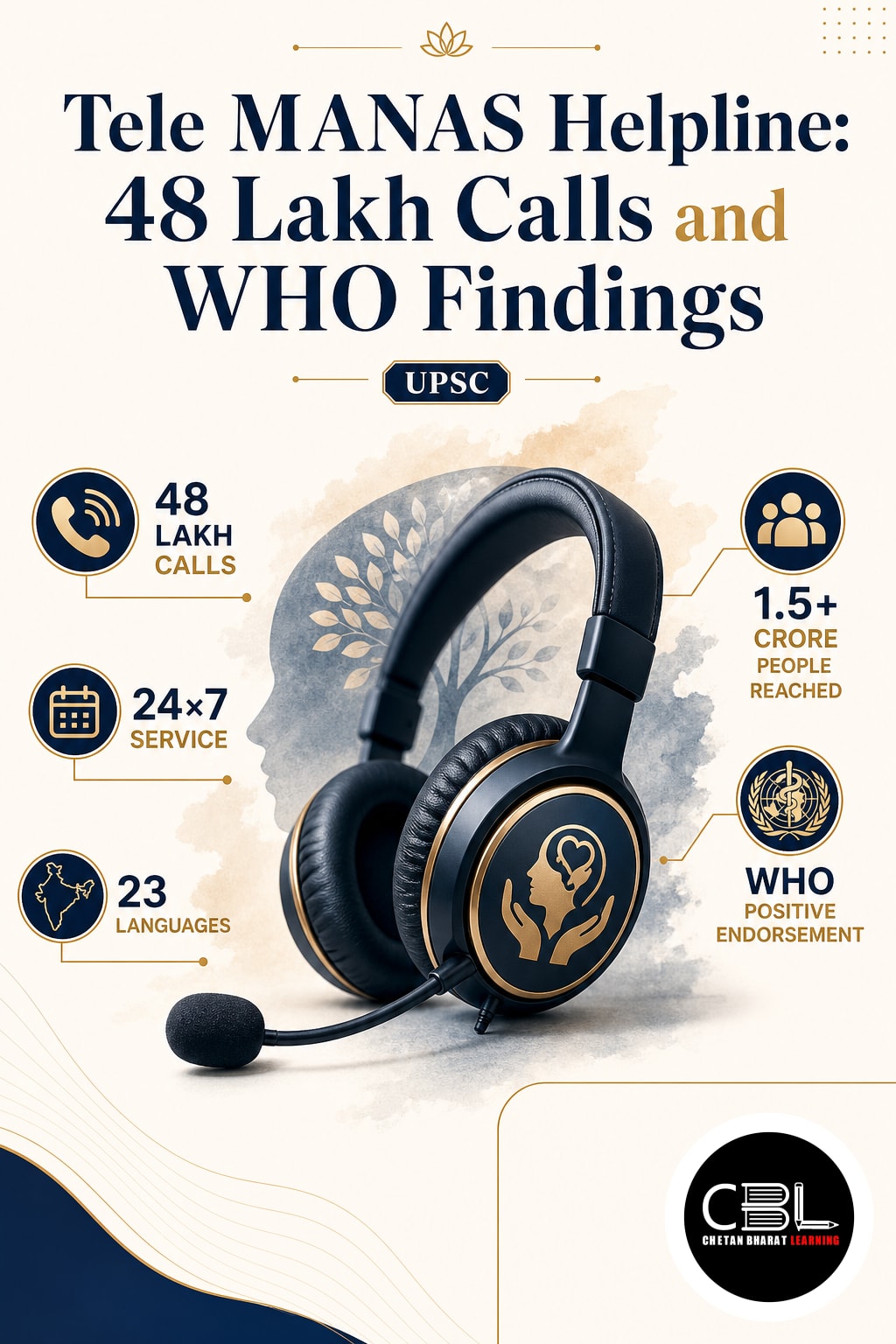
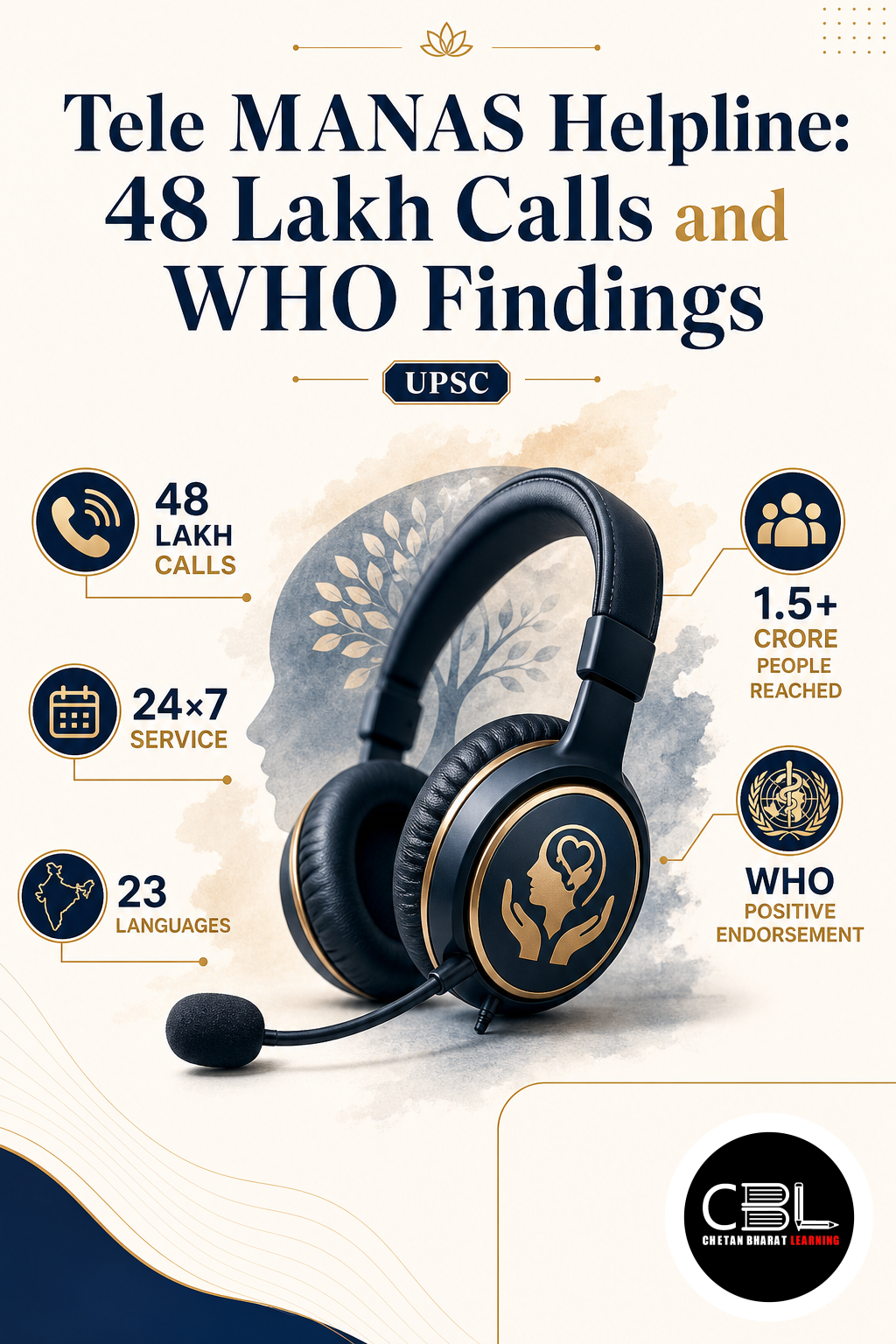
The Tele MANAS Helpline has received nearly 48 lakh calls since its launch in October 2022, highlighting the growing demand for accessible mental healthcare in India. At the same time, a new World Health Organization (WHO) publication has highlighted the continued global dependence on psychiatric hospitals and the slow transition towards community-based mental healthcare. These developments underline the need for early intervention, decentralised services and rights-based treatment.
| Launch Date | 10 October 2022 |
|---|---|
| Helpline Number | 14416 |
| Calls Received | 47.75+ lakh |
| Operational Cells | 53 across 36 States and UTs |
What is the Tele MANAS Helpline?
Tele-MANAS stands for Tele-Mental Health Assistance and Networking Across States. It is India’s free, confidential and round-the-clock tele-mental health service, launched on 10 October 2022 under the National Tele Mental Health Programme. Through the national toll-free number 14416, individuals can receive initial counselling, emotional support and guidance for appropriate mental health services, with referrals to specialised professionals when necessary.
Why in News?
As Tele-MANAS completed four years in October 2026, the Union Health Ministry reported 47,75,644 calls received since its launch. On 9 October 2026, WHO released guidance titled Supporting the Transition to Community-Based Mental Health and Social Care, calling for reduced long-term institutionalisation and strengthened community services. These updates coincided with World Mental Health Day 2026, under the theme Lived Experiences Heard: Real Voices, Real Change.
Key Findings: Tele-MANAS and WHO Mental Healthcare Data
| Indicator | Reported Finding |
|---|---|
| Tele-MANAS calls since October 2022 | 47,75,644 calls |
| Operational Tele-MANAS cells | 53 |
| Callers aged 18–45 years | 73.2% of analysed profiles |
| Women among analysed callers | 43.78% |
| Countries completed transition | 9% |
| Countries at early transition | 53% |
| Psychiatric admissions > 6 months | 28% |
| Admissions > 1 year | 16% |
| Expenditure on psychiatric hospitals | ~47% (49-country sample) |
Sources: Union Health Ministry (October 2026); WHO Mental Health Atlas 2024 and WHO guidance October 2026.
Key Features of Tele-MANAS
- Round-the-clock counselling: 24/7 toll-free support.
- Multilingual services: Counselling in regional languages.
- Confidential assistance: Support without stigma.
- Early intervention: Help for stress, anxiety, sleep issues.
- Specialist referrals: Access to qualified professionals.
- Nationwide coverage: Cells in all States and UTs.
- Digital integration: Linked with district mental health services.
About the WHO Report on Community Mental Healthcare
WHO’s October 2026 guidance on deinstitutionalisation calls for transitions from long-term hospital care to community settings with clinical and social support. Only about 9% of reporting countries have fully shifted away from psychiatric hospitals, while 53% remain in early stages. The report emphasises housing, employment, family support, rehabilitation and continuity of care.
India’s Mental Healthcare Policy Framework
| Initiative | Significance |
|---|---|
| National Mental Health Programme (1982) | Access and integration with general healthcare |
| District Mental Health Programme (1996) | District-level services and referrals |
| National Mental Health Policy (2014) | Rights-based, inclusive care |
| Mental Healthcare Act (2017) | Legal protections and rights |
| Ayushman Arogya Mandirs | Primary care integration |
| Tele-MANAS (2022) | Nationwide tele-counselling |
By October 2026, DMHP had been sanctioned for 767 districts and integrated into over 1.83 lakh Ayushman Arogya Mandirs, strengthening community referral pathways.
Significance for Public Health Governance
- Improved accessibility: Reduces travel for initial help.
- Early help-seeking: Prevents severe distress.
- Working-age support: Relevant for 18–45 age group.
- Reduced stigma: Confidential outreach.
- Decentralisation: Links telehealth and local care.
- Patient-centred reform: Emphasises dignity and choice.
Challenges to Accessible Mental Healthcare
- Specialist shortage: Uneven specialist distribution.
- Weak infrastructure: Gaps in counselling and rehabilitation.
- Institutional dependence: Lack of community alternatives.
- Financial limits: Underinvestment in community care.
- Social discrimination: Persistent stigma.
- Referral gaps: Limited follow-up treatment.
- Digital barriers: Access and literacy issues.
Way Forward
- Strengthen community services: Counselling, rehab and housing.
- Improve referral links: Tele-MANAS to local facilities.
- Increase investment: Prevention and workforce development.
- Include lived experiences: Involve service users in design.
- Expand awareness: Campaigns like MANN Jaagriti.
- Monitor outcomes: Beyond call volumes, track satisfaction and continuity.
Prelims Practice Corner
-
In which year was Tele-MANAS launched?
- 2017
- 2020
- 2022
- 2024
Answer: (c) Tele-MANAS was launched on 10 October 2022.
-
Consider the following statements about Tele-MANAS:
1. It operates under the Ministry of Health and Family Welfare.
2. It provides round-the-clock tele-mental health assistance.
3. Its services are restricted to metropolitan cities. Which are correct?- 1 and 2 only
- 2 and 3 only
- 1 and 3 only
- 1, 2 and 3
Answer: (a) Statements 1 and 2 are correct. It operates across all States and UTs.
-
What is the national toll-free helpline number for Tele-MANAS?
- 112
- 1098
- 181
- 14416
Answer: (d) 14416.
-
According to WHO findings, what proportion of reporting countries had completed the transition to community-based mental healthcare?
- 53%
- 9%
- 47%
- 81%
Answer: (b) Approximately 9%.
-
Which best describes deinstitutionalisation in mental healthcare?
- Replacing professionals with digital systems
- Ending all inpatient care
- Shifting long-term care to community-based services
- Restricting care to specialised hospitals
Answer: (c) Supported transitions to community-based care with treatment and rehabilitation.
Mains Practice Questions
Q1. Digital mental healthcare initiatives such as Tele-MANAS can improve access to public health services, but cannot independently resolve structural treatment gaps. Critically examine. (15 marks)
Answer Structure
- Intro: Overview of Tele-MANAS and its impact.
- Body: Accessibility benefits, rural outreach, specialist shortages, referral gaps, infrastructure and stigma.
- Conclusion: Need for integration with funded community services.
Q2. WHO has emphasised the transition from institution-centred psychiatric care to rights-based community mental healthcare. Discuss its significance for India’s health governance. (10 marks)
Answer Structure
- Intro: Define deinstitutionalisation and WHO findings.
- Body: Patient rights, community support, primary care, funding and specialist availability.
- Conclusion: Recommend a sustainable, patient-centred system with clinical and social support.
Frequently Asked Questions
- What is Tele-MANAS and when was it launched?
- Tele-MANAS is India’s national tele-mental health assistance programme, launched on 10 October 2022. It provides free, confidential 24/7 support via 14416.
- How many calls has Tele-MANAS received?
- It received 47,75,644 calls from October 2022 to October 2026, operating through 53 cells across all States and UTs.
- What did WHO report about community-based mental healthcare?
- WHO found only about 9% of reporting countries fully shifted from psychiatric hospitals to community-based care, while 53% were in early reform stages, calling for stronger services and support.
Related Current Affairs
Preparing for UPSC, PCS or HCS?
Talk to a mentor at Chetan Bharat Learning, Chandigarh. Free guidance on choosing the right exam and building a study plan.
Chat on WhatsAppCall 97793 53345UPSC / IAS / PCS coaching in Chandigarh · Trusted by aspirants across Punjab & Haryana
Leave a Reply
You must be logged in to post a comment.