
Ukraine food corridors entered diplomatic focus after President Volodymyr Zelenskyy said India was ready to mediate their establishment. The proposal links shipping safety with food security; explore more international relations current affairs.
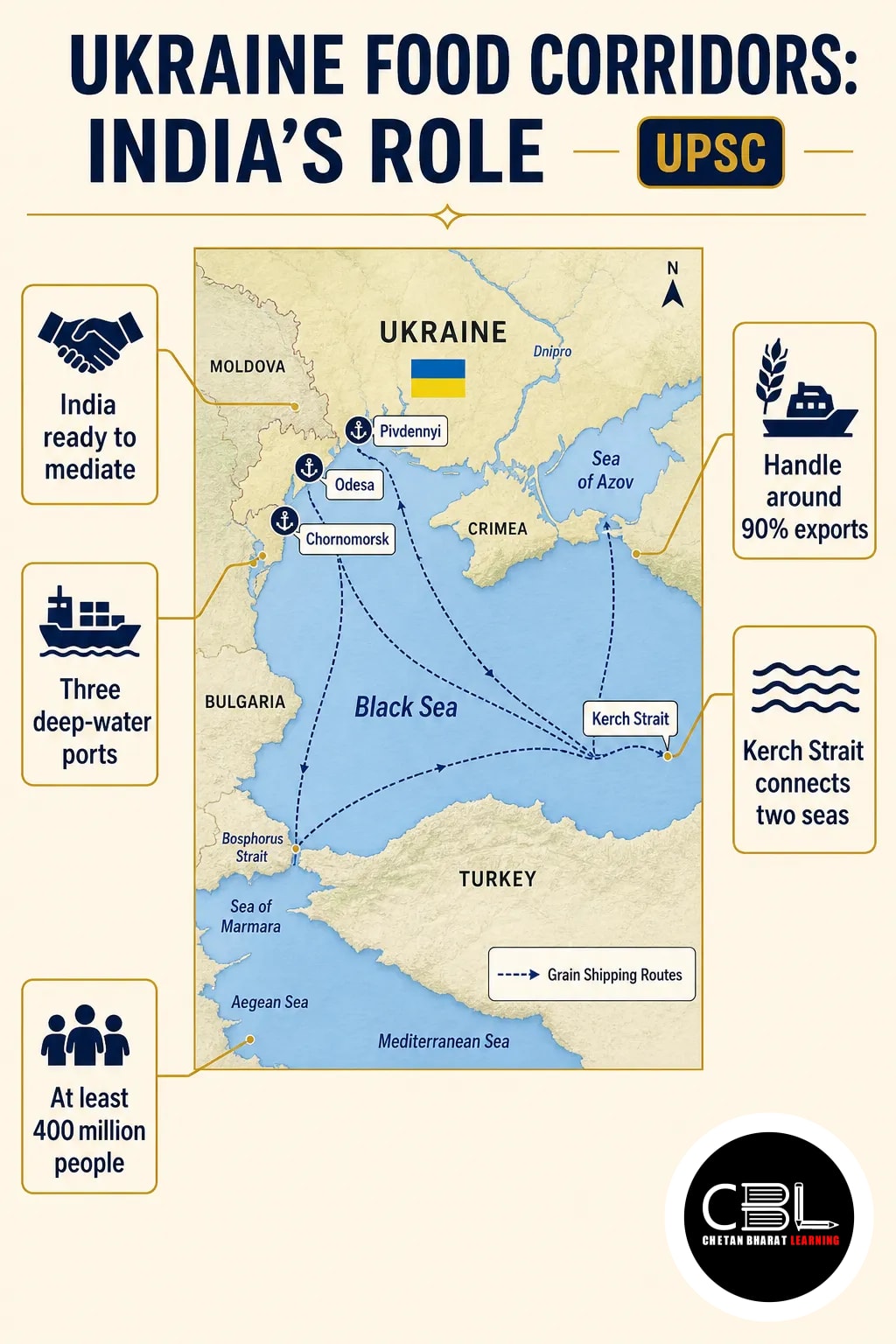
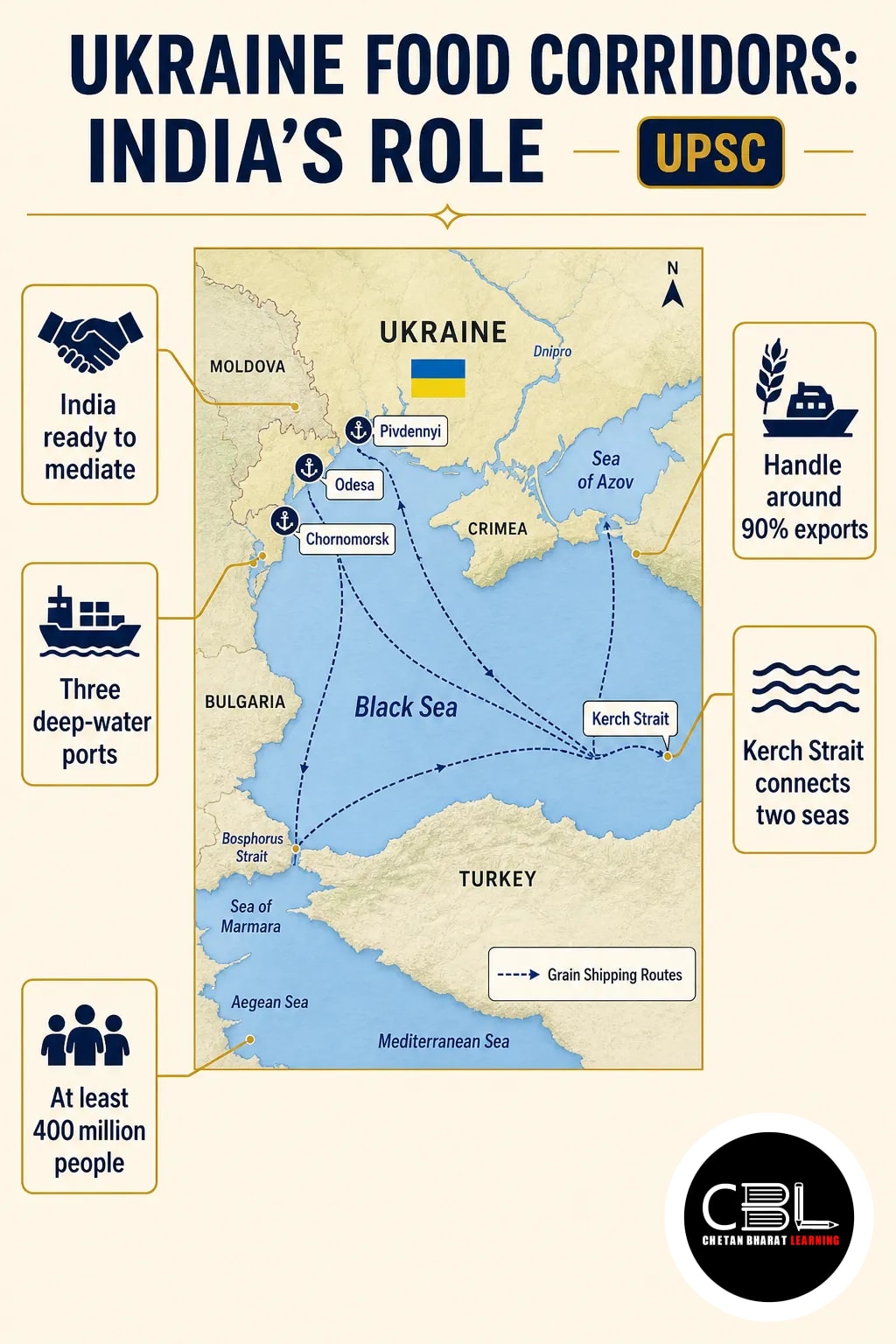
Quick answer: After a call with Prime Minister Narendra Modi, Zelenskyy said India was ready to mediate Ukraine food corridors through the Black Sea. The discussion preceded United States-brokered Russia-Ukraine talks in Abu Dhabi. Three Ukrainian deep-water ports in the Greater Odesa region handle around 90% of the country’s agricultural exports.
What happened after the Modi-Zelenskyy call?
Zelenskyy said India was ready to mediate food corridors after discussing blocked Black Sea grain exports with Modi. He also said their teams would remain in contact on the issue and other bilateral matters.
Meanwhile, Modi reiterated India’s commitment to contribute towards a peaceful resolution. External Affairs Minister S Jaishankar also discussed the conflict and diplomatic initiatives with Russian Foreign Minister Sergey Lavrov.
The contacts preceded two-day, United States-brokered Russia-Ukraine talks in Abu Dhabi. However, Zelenskyy’s statement describes a readiness to mediate, not an operational corridor or a completed agreement. For the wider context, see CBL’s coverage of developments involving Ukraine and its partners.
What do Ukraine food corridors seek to achieve?
The proposed corridors aim to enable agricultural exports to move safely through a conflict-affected maritime region. A corridor would require practical arrangements for ships and ports; diplomatic intent alone cannot guarantee safe passage.
According to the source, the broader Indian proposal includes easing fighting around the Black Sea. It also envisages Russia halting attacks on Ukrainian energy infrastructure and Ukraine refraining from attacks on Russian positions along the line of contact. These are reported contours of a proposal, not confirmed commitments by the parties.
Earlier, Jaishankar described India’s conversations with both sides on shipping safety, grain and energy exports, and possibilities for non-attack. Thus, the food corridor is one potential confidence-building measure within a wider diplomatic effort.
Why are Black Sea ports important?
The Black Sea connects major agricultural exporters with overseas markets, making secure maritime routes important for food supplies. The source identifies these key locations and export figures:
| Location or indicator | Significance |
|---|---|
| Odesa, Chornomorsk and Pivdennyi | Three deep-water ports in Ukraine’s Greater Odesa region; together they handle around 90% of its agricultural exports. |
| Kerch Strait | Connects the Sea of Azov to the Black Sea. |
| Azov-Black Sea region | Carries approximately 42–44 million tonnes of Russian grain exports, or 77–81% of its total grain exports. |
Russia has targeted port facilities and vessel operations around Greater Odesa. Since mid-July, Ukraine has also stepped up attacks on grain vessels, maritime infrastructure and ports around the Sea of Azov and Kerch Strait. For more maritime context, read the Black Sea shipping crisis analysis.
What is the significance for India and food security?
India’s engagement connects its diplomatic access to both parties with a shared interest in safer trade. Moreover, the proposed focus on food offers a limited issue on which dialogue could proceed even without a comprehensive settlement.
Diplomatic and humanitarian dimensions
- Dialogue with both sides: India can convey concerns to Kyiv and Moscow; however, mediation depends on their willingness to negotiate.
- Food security: The source warns that fighting in the region could put at least 400 million people across Africa, West Asia and Asia at risk of shortages, malnutrition and hunger.
- Supply-chain stability: Safer shipping could reduce disruption to export flows; however, its effects on individual importing countries would vary.
- Humanitarian priorities: Protecting civilian access to food gives negotiations an objective beyond territorial and military questions.
For India, the initiative also illustrates how a country can pursue dialogue while supporting a peaceful resolution. However, willingness to facilitate talks should not be confused with authority to impose terms.
What challenges could prevent a corridor?
Continuing attacks and distrust could prevent ships from using a route even if negotiators reach a political understanding.
- Security: Ports, vessels and connected infrastructure remain exposed to hostilities; therefore, a route needs credible protection.
- Reciprocity: Both parties must accept and observe the relevant commitments; otherwise, allegations of violations can undermine cooperation.
- Verification: Negotiators would need to decide how to monitor compliance and respond to incidents.
- Commercial viability: Shipping operators need confidence that passage will remain safe; consequently, the arrangement must work in practice.
In addition, the broader proposal links maritime restraint with energy infrastructure and the line of contact. That linkage may widen the scope for negotiation, but it also makes agreement more complex.
What could be the way forward?
A workable arrangement would require mutually accepted security commitments, clear operating rules and a process for resolving incidents. First, India can continue dialogue with both governments while clarifying what each side is prepared to accept.
Second, negotiators could define the routes, port operations and conditions for vessel movement. In addition, a credible monitoring and communication process could help address alleged breaches. These are possible steps for negotiation, not measures announced as part of a final agreement.
Finally, any arrangement should keep the humanitarian objective in view while recognising the security concerns of both parties. A functioning corridor could support wider confidence-building; however, it would not by itself end the war.
Source: The Indian Express, 10 November 2026
- Ukraine Military Support: Leaders in Kyiv, UPSC Notes (29 Aug 2026)
- Black Sea Shipping Crisis: UPSC Maritime Security (27 Jul 2026)
Asked in UPSC: Previous Year Questions
- UPSC CSE Mains 2022 (GS Paper IV): What ethical issues should be considered in launching and continuing the Russia-Ukraine war? Illustrate and justify the issues involved.
UPSC also examines the humanitarian and ethical consequences of conflict, so connect food access with civilian welfare.
State PCS General Studies questions can link Black Sea geography with global grain trade and food security. In addition, candidates should examine how external supply disruptions can affect markets and policy choices without assuming a specific state-level impact.
Prelims Practice Corner
Mains Practice Questions
Frequently Asked Questions
What did Zelenskyy say about India and food corridors?
Zelenskyy said India was ready to mediate in establishing food corridors. He made the statement after discussing Black Sea grain exports with Modi.
Is a new Black Sea food corridor already operational?
No operational corridor is announced in the source. Rather, it describes a proposal and India’s readiness to mediate, as stated by Zelenskyy.
Which Ukrainian ports are important for agricultural exports?
Odesa, Chornomorsk and Pivdennyi are the three key deep-water ports. Together, they handle around 90% of Ukraine’s agricultural exports.
Why does the Kerch Strait matter?
The Kerch Strait connects the Sea of Azov with the Black Sea. Consequently, it forms part of the wider maritime region relevant to grain exports and shipping security.
Related Current Affairs
Preparing for UPSC, PCS or HCS?
Talk to a mentor at Chetan Bharat Learning, Chandigarh. Free guidance on choosing the right exam and building a study plan.
Chat on WhatsAppCall 97793 53345UPSC / IAS / PCS coaching in Chandigarh · Trusted by aspirants across Punjab & Haryana

 Ananya RanaIAS · AIR 60
 Aditya SharmaIAS · AIR 70
 Ria Kaur SethiIPS · AIR 89
 Aman AloonIRS · AIR 295
 Sumer Singh VirkIRS · AIR 335
 Shivani PanchalIAS

Leave a Reply
You must be logged in to post a comment.