

UPSC Mapping
Prelims
- Environmental Laws, EIA, Supreme Court Judgments and Regulatory Bodies
Mains
- GS Paper III – Environmental Conservation; GS Paper II – Judiciary and Governance
Article
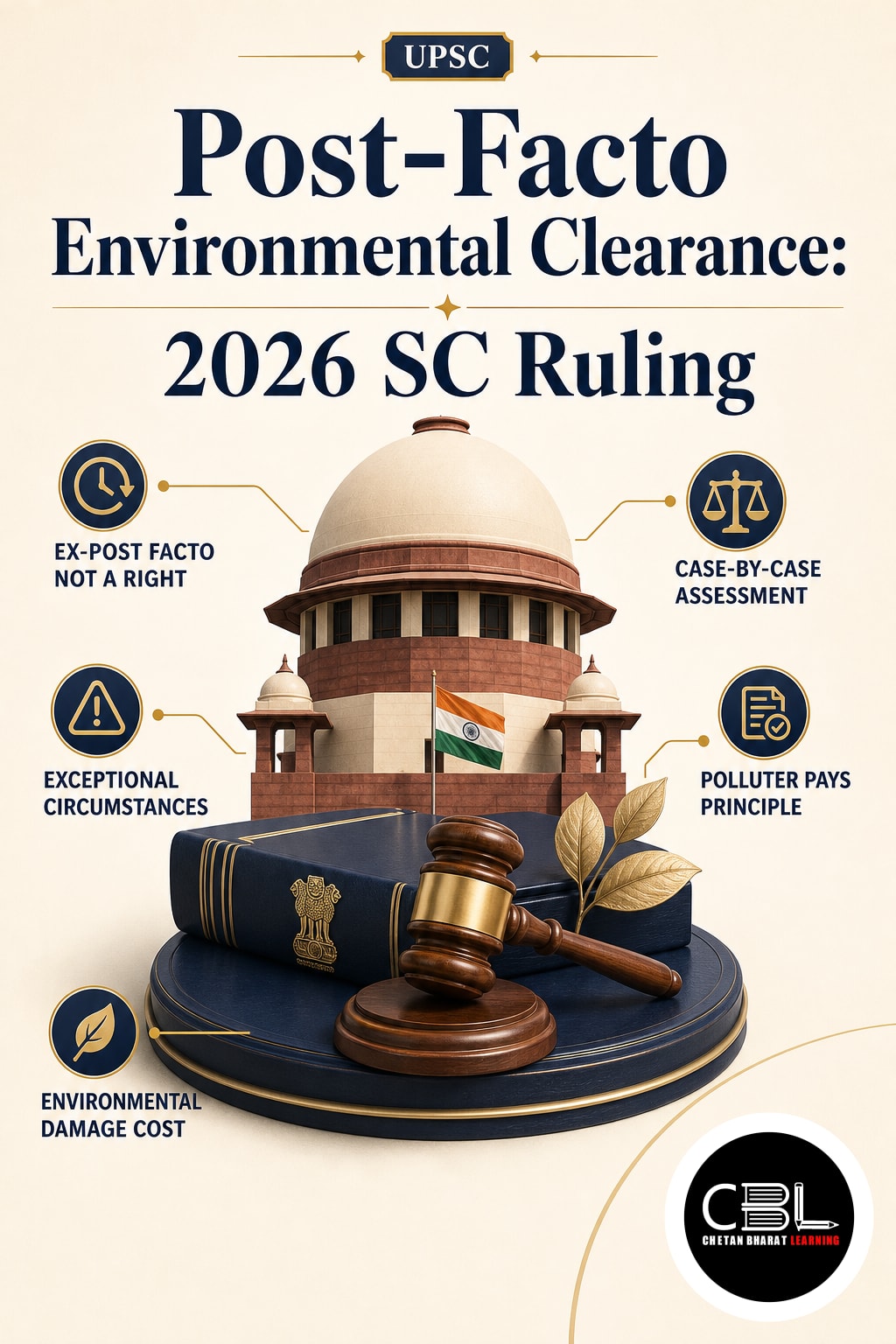
Post-Facto Environmental Clearance has returned to focus after the Union Environment Ministry directed authorities to resume processing certain pending environmental clearance applications in accordance with a Supreme Court judgment. On 29 July 2026, the Supreme Court upheld the limited 2017 environmental clearance notification but prospectively quashed the broader 2021 Office Memorandum. The judgment permits eligible pending applications to be considered while prohibiting fresh applications under those earlier mechanisms. It raises important questions about environmental protection, regulatory accountability and sustainable development.
What is Post-Facto Environmental Clearance?
Post-Facto Environmental Clearance refers to the consideration or granting of environmental approval after a project has already commenced construction, expansion or modernisation without obtaining the mandatory prior Environmental Clearance (EC). It creates a legal difficulty because the project has already begun without following the mandatory preventive procedure.
Why in News?
On 30 September 2026, the Ministry of Environment, Forest and Climate Change directed central and state-level environmental authorities to resume consideration of eligible post-facto clearance applications following the Supreme Court’s judgment of 29 July 2026. The directions covered Expert Appraisal Committees, State Environment Impact Assessment Authorities and other regulatory bodies, while maintaining the prohibition on fresh applications under the 2017 notification and 2021 Office Memorandum.
What the Supreme Court Held
- 2017 notification upheld: The notification dated 14 March 2017 was a valid, time-bound exercise of delegated power under the Environment (Protection) Act, 1986.
- 2021 memorandum quashed prospectively: The memorandum dated 7 July 2021 was invalid as an open-ended administrative instruction.
- Existing clearances protected: Clearances granted under the 2017 notification or 2021 memorandum remain valid.
- Pending applications: Eligible applications submitted under the two instruments must be processed to their conclusion.
- No fresh applications: Authorities cannot accept new applications under the earlier instruments.
Background and Legal Timeline
| Year / Date | Development |
|---|---|
| 2006 | EIA Notification, 2006 established the framework for mandatory prior environmental clearance. |
| 14 March 2017 | The Centre introduced a one-time violation-management notification. |
| 7 July 2021 | MoEFCC issued an Office Memorandum prescribing a standard procedure for projects that violated prior EC requirements. |
| 29 July 2026 | The Supreme Court upheld the limited 2017 notification and prospectively quashed the 2021 memorandum. |
| 30 September 2026 | MoEFCC directed resumption of processing of eligible existing applications while prohibiting fresh proposals. |
Constitutional and Legal Provisions
| Provision | Relevance |
|---|---|
| Article 14 | Equality before law; relevant to examining arbitrary regulatory exemptions. |
| Article 21 | The right to life includes environmental protections against serious pollution. |
| Article 48A | Directs the State to protect and improve the environment. |
| Article 51A(g) | Fundamental duty of citizens to protect the natural environment. |
| Article 142 | Empowers the Supreme Court to pass orders for complete justice. |
Implications of the Judgment
- Mandatory prior clearance reaffirmed for projects under the EIA Notification, 2006.
- Protection for existing cases, subject to individual legal challenges.
- Limited relief for pending proposals without opening the system to new violators.
- Judicial distinction between valid statutory notifications and administrative memoranda.
- Regulatory accountability discourages avoidance of prior appraisal.
Criticism and Concerns
- Post-facto clearance may weaken incentives for prior approval.
- Environmental harm may be irreversible before assessment.
- Unequal treatment of compliant versus non-compliant projects.
- Public participation may be curtailed if assessment occurs post-construction.
Way Forward
Authorities should process eligible applications transparently and within the Supreme Court’s directions. The government should strengthen early compliance monitoring to prevent violations, require robust impact assessments, and enforce restoration and polluter-pays principles.
Punjab & Haryana PCS Angle
Environmental clearance is relevant to industrial projects, infrastructure development and state-level environmental administration. Candidates should distinguish the roles of SEIAAs, State Expert Appraisal Committees and State Pollution Control Boards. The Vanashakti judgment illustrates judicial review shaping regulatory governance.
Prelims Practice Corner
Q1. Which of the following best describes post-facto environmental clearance?
- (a) Environmental approval granted before project planning
- (b) Environmental approval considered after a project begins without mandatory prior clearance
- (c) Automatic exemption from all environmental laws
- (d) Environmental clearance granted exclusively to forest conservation projects
Answer: (b) Projects that commenced regulated activities without mandatory prior approval and subsequently seek clearance.
Q2. Consider the following statements regarding the Supreme Court’s July 2026 Vanashakti judgment:
1. The time-limited 2017 notification was upheld.
2. The 2021 Office Memorandum was quashed prospectively.
3. Authorities were permitted to accept unlimited fresh applications under the earlier instruments.
- (a) 1 and 3 only
- (b) 2 and 3 only
- (c) 1, 2 and 3
- (d) 1 and 2 only
Answer: (d) Statements 1 and 2 are correct.
Q3. Which legislation provides the principal statutory foundation for the EIA Notification, 2006?
- (a) Environment (Protection) Act, 1986
- (b) Wildlife (Protection) Act, 1972
- (c) Biological Diversity Act, 2002
- (d) Water (Prevention and Control of Pollution) Act, 1974
Answer: (a) The Environment (Protection) Act, 1986.
Q4. Under the EIA Notification, 2006, which authority ordinarily grants environmental clearance for Category B projects?
- (a) National Human Rights Commission
- (b) Comptroller and Auditor General
- (c) State Environment Impact Assessment Authority
- (d) Central Vigilance Commission
Answer: (c) State Environment Impact Assessment Authority.
Q5. Consider the following statements:
1. Article 48A directs the State to protect and improve the environment.
2. Article 142 empowers the Supreme Court to pass orders for complete justice.
3. An executive Office Memorandum can automatically override an existing statutory notification.
- (a) 2 and 3 only
- (b) 1 and 2 only
- (c) 1 and 3 only
- (d) 1, 2 and 3
Answer: (b) Statements 1 and 2 are correct.
Mains Practice Questions
Q1. The Supreme Court’s 2026 Vanashakti judgment highlights the tension between environmental protection and developmental considerations. Examine its major findings and implications for environmental governance in India. (15 marks)
Answer Structure:
- Intro: Explain post-facto environmental clearance and the mandatory prior EC requirement under the EIA Notification, 2006.
- Body: Discuss the 2017 notification, 2021 memorandum, prospective quashing, protection of pending applications, prohibition on fresh proposals, precautionary principle and public-interest considerations.
- Conclusion: Recommend strong preventive enforcement, legally sound regulatory measures and transparent decision-making.
Q2. Explain the role of Environmental Impact Assessment in promoting sustainable development. Why can retrospective environmental clearances weaken the precautionary approach? (10 marks)
Answer Structure:
- Intro: Define EIA and explain its role in evaluating likely impacts before project commencement.
- Body: Discuss preventive assessment, public consultation, regulatory compliance, risks of irreversible damage, retrospective regularisation and institutional responsibilities.
- Conclusion: Highlight the need to preserve prior clearance as the normal rule and ensure accountability for violations.
Frequently Asked Questions
What is post-facto environmental clearance?
Post-facto environmental clearance refers to approval granted after a project has commenced work without obtaining the required prior clearance. Under the EIA Notification, 2006, specified projects must receive approval before beginning regulated activities.
What did the Supreme Court decide in Vanashakti v. Union of India in July 2026?
The Supreme Court upheld the narrowly tailored 2017 notification and quashed the 2021 Office Memorandum prospectively. It protected existing clearances, allowed eligible pending applications to be considered and barred fresh applications under those instruments.
Can a project apply for fresh post-facto environmental clearance after the 2026 judgment?
No fresh application can be entertained under the 2017 notification or 2021 Office Memorandum. The Court also restricted future administrative orders that attempt such regularisation, while recognising the possibility of a valid statutory notification and its own exceptional powers under Article 142.
Related Current Affairs
Preparing for UPSC, PCS or HCS?
Talk to a mentor at Chetan Bharat Learning, Chandigarh. Free guidance on choosing the right exam and building a study plan.
Chat on WhatsAppCall 97793 53345UPSC / IAS / PCS coaching in Chandigarh · Trusted by aspirants across Punjab & Haryana
Leave a Reply
You must be logged in to post a comment.