

UPSC Mapping
Article
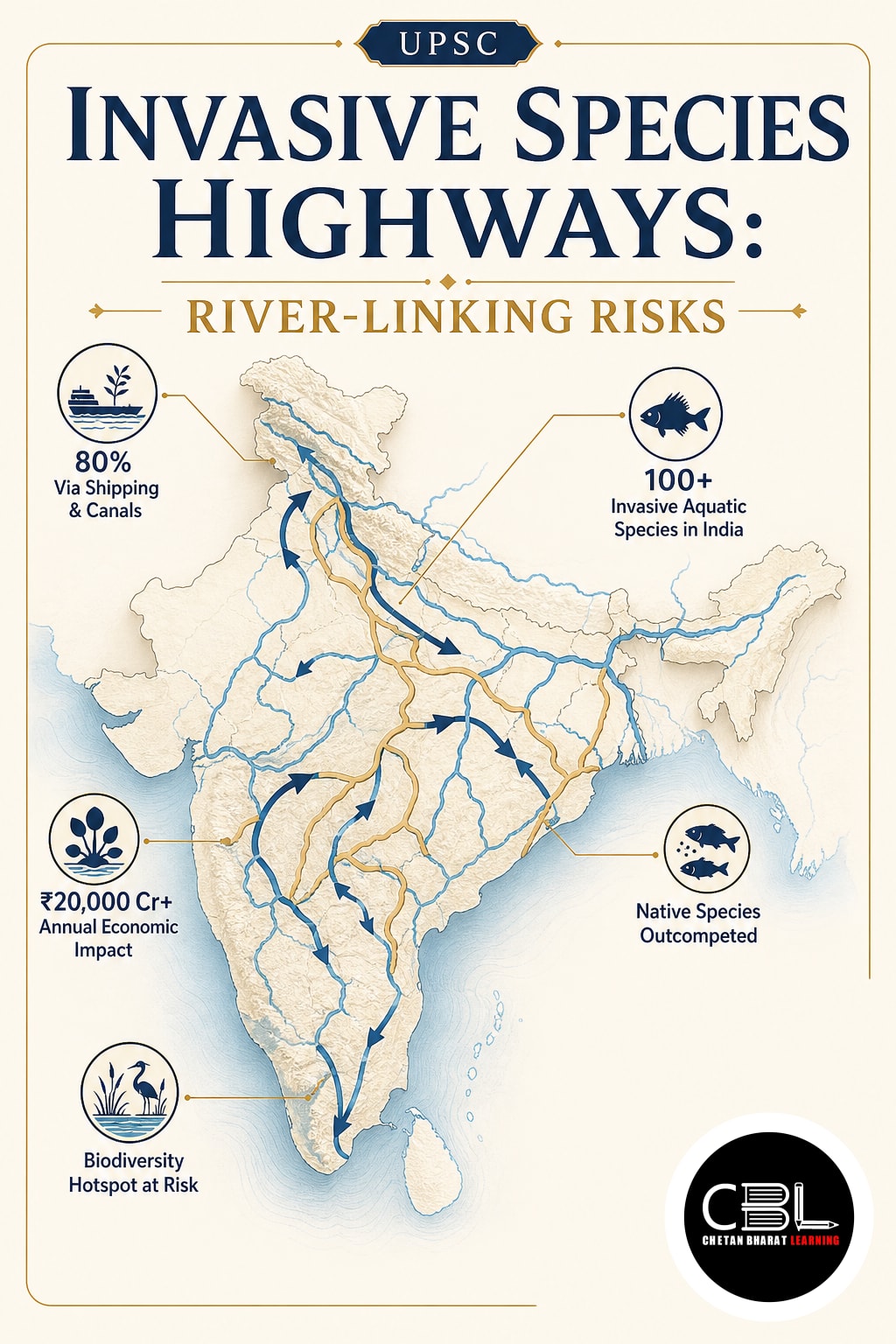
Invasive Species Highways are emerging as a major ecological concern associated with India’s proposed river interlinking programme. A scientific study has warned that connecting previously isolated river basins could create pathways for invasive alien species to spread into new freshwater ecosystems. The findings highlight potential threats to native fish, aquatic plants and other freshwater organisms, particularly in biodiversity-rich regions of Northeast and Peninsular India. The issue raises important questions about balancing water security with ecological conservation. Explore related environmental developments through the daily current affairs archive.
What are Invasive Species Highways?
Invasive Species Highways refer to artificial or modified ecological pathways that enable invasive alien species to spread from one ecosystem into another. In river systems, canals and inter-basin water transfers can create new connections between freshwater habitats that were previously separated by natural geographical barriers.
An invasive alien species (IAS) is a species introduced outside its natural distribution whose establishment and spread threaten native biodiversity or ecological functioning. Not every alien species becomes invasive; the term is used when its spread causes or threatens ecological harm.
In naturally separated river basins, mountains, drainage boundaries and differences in water flow can restrict the movement of aquatic organisms. Interlinking canals may bypass these barriers, enabling fish, aquatic plants, molluscs, pathogens and other organisms to move between ecosystems.
Once introduced, some invasive species reproduce rapidly, compete with native organisms, alter food webs or transform habitats. Their establishment may be difficult and expensive to reverse.
The concern is particularly important for India’s freshwater ecosystems because different river basins contain distinct combinations of native, endemic and threatened species.
Why in News?
A study titled River Interlinking and Biodiversity Risks in Indian Freshwater Ecosystems, published in the journal Scientific Reports on 15 April 2026, examined the potential ecological effects of India’s National River Linking Project.
Researchers assessed the distribution of 15 freshwater invasive alien species across Indian river basins and examined how proposed inter-basin connections might facilitate their spread.
The species examined included eight fish species, four aquatic plants, two molluscs and one reptile. They had originally been introduced for purposes such as ornamental use, biological control, the pet trade or aquaculture.
The study identified Northeast and Peninsular Indian river basins as particularly vulnerable to biological invasions. The Lower Ganga, Brahmaputra and Krishna systems were among the areas showing high richness of invasive species.
A particularly concerning proposed connection involves the Lower Ganga and Mahanadi basins. The Lower Ganga was associated with 13–15 invasive species in the study’s assessment, while the Mahanadi basin supported 69 threatened freshwater species.
The researchers warned that connecting these basins could create an invasion pathway into ecologically sensitive habitats, potentially increasing pressure on threatened native organisms.
These conclusions describe modelled ecological risks, not evidence that every proposed river link has already caused biological invasions. The findings support closer environmental assessment before construction and operation.
The original study published in Scientific Reports provides the research methodology, species distribution patterns and basin-level invasion-risk assessment.
Key Features
1. National River Linking Project
The National River Linking Project (NRLP) aims to transfer water between river basins to address regional differences in water availability, improve irrigation and enhance water security. It is based on the National Perspective Plan (NPP) of 1980, and the National Water Development Agency (NWDA) undertakes studies and prepares feasibility reports for proposed links.
| Feature | Details |
|---|---|
| National Perspective Plan | Formulated in 1980 |
| Nodal Agency | National Water Development Agency |
| Total Proposed Links | 30 |
| Himalayan Component | 14 links |
| Peninsular Component | 16 links |
| First Priority Link Under Implementation | Ken–Betwa Link Project |
According to the Ministry of Jal Shakti’s August 2026 update, the Ken–Betwa Link Project is the first priority link under the NPP to enter implementation, serving Bundelkhand.
2. High-Risk River Basins
- Lower Ganga: 13–15 invasive species, risk to Mahanadi.
- Mahanadi: 69 threatened freshwater species, high sensitivity.
- Krishna: High invasive richness, multiple peninsular links.
- Kaveri: Rich native biodiversity, habitat concerns.
- Brahmaputra: Biodiversity with existing invasives.
- South-Western Ghats: Exceptional biodiversity, conservation needed.
3. Examples of Invasive Freshwater Organisms
Includes invasive aquatic plants such as water hyacinth, water lettuce and giant salvinia, fish, molluscs and other organisms that alter habitats, compete with natives or transmit pathogens.
Challenges
- Loss of natural barriers: Canals bypass drainage boundaries.
- Threats to native biodiversity: Competition, predation, habitat alteration.
- Food-web disruption: Changes in species abundance affect stability.
- Pathogen transmission: New connectivity spreads aquatic diseases.
- Flow alterations: Transfers change sediment, temperature, water quality.
- Fish migration: Altered flows impact breeding.
- Ecological homogenisation: Same invasives across basins reduce uniqueness.
- Monitoring difficulties: Requires specialised surveys over large networks.
Way Forward
Incorporate invasive species risk assessments into project planning and environmental appraisals, adopt a basin-level ecological approach, conduct pre-construction surveys and long-term monitoring, test biosecurity measures, and coordinate among NWDA, environmental authorities, states and research institutions. Complement with water-demand management, efficient irrigation and watershed restoration to balance water security and biodiversity conservation.
Prelims Practice Corner
Q1. What is the primary ecological concern associated with invasive species highways?
(a) Permanent elimination of river sediment (b) Conversion of freshwater into seawater (c) Spread of invasive alien species between previously separated ecosystems (d) Complete prevention of fish movement
Answer: (c) Artificial connectivity between river basins can allow invasive alien species to disperse into ecosystems that were previously separated by natural barriers.
Q2. Consider the following statements regarding India’s National River Linking Project: 1. It is based on the National Perspective Plan formulated in 1980. 2. It includes 14 Himalayan and 16 Peninsular links. 3. Its nodal agency is the National Biodiversity Authority. Which statements are correct?
(a) 1 and 2 only (b) 2 and 3 only (c) 1 and 3 only (d) 1, 2 and 3
Answer: (a) Statements 1 and 2 are correct. The National Water Development Agency is the nodal agency.
Q3. Which proposed river connection was identified as particularly sensitive because invasive species from the Lower Ganga could threaten biodiversity in a basin containing 69 threatened freshwater species?
(a) Narmada–Tapi (b) Sabarmati–Luni (c) Periyar–Pamba (d) Lower Ganga–Mahanadi
Answer: (d) Lower Ganga–Mahanadi.
Q4. Which river interlinking project was the first priority link under the National Perspective Plan to enter implementation?
(a) Damanganga–Pinjal (b) Ken–Betwa (c) Par–Tapi–Narmada (d) Bedti–Varada
Answer: (b) Ken–Betwa Link Project.
Q5. Consider the following statements about invasive alien species: 1. Every alien species introduced into a new ecosystem necessarily becomes invasive. 2. Invasive species can compete with native organisms and modify aquatic habitats. 3. River interlinking may create new dispersal pathways for aquatic invasive species. Which statements are correct?
(a) 1 and 2 only (b) 1 and 3 only (c) 2 and 3 only (d) 1, 2 and 3
Answer: (c) Statements 2 and 3 are correct.
Mains Practice Questions
Q1. India’s river interlinking programme presents both water-security opportunities and ecological challenges. Discuss with reference to the potential spread of invasive alien species across freshwater ecosystems. (15 marks)
Answer Structure:
Intro: Introduce NRLP and concept of invasive species highways.
Body: River connectivity, species dispersal, Lower Ganga–Mahanadi risk, threats to biodiversity, water-security vs ecological safeguards.
Conclusion: Recommend basin-level assessments, monitoring and science-based planning.
Q2. Explain how invasive alien species threaten freshwater biodiversity. Suggest measures to reduce biological invasion risks associated with large water infrastructure projects. (10 marks)
Answer Structure:
Intro: Define invasive alien species and significance.
Body: Competition, predation, habitat modification, pathogen spread, ecological homogenisation; surveys, early detection, EIAs, biosecurity measures.
Conclusion: Emphasise prevention, monitoring and inter-agency cooperation.
Frequently Asked Questions
What are invasive species highways in river interlinking?
Invasive species highways are artificial pathways that allow invasive alien organisms to spread between previously disconnected ecosystems. River interlinking canals connect separate freshwater basins, enabling aquatic organisms to disperse beyond their existing distributions.
Why is the Lower Ganga–Mahanadi river link considered ecologically sensitive?
The 2026 study identified 13–15 invasive species in the Lower Ganga and 69 threatened freshwater species in the Mahanadi basin. Connecting these basins could facilitate movement of invasives into habitats with vulnerable native species, increasing ecological risks.
What is the National River Linking Project and which agency implements it?
The National River Linking Project transfers water between river basins to address water-availability differences. It involves 30 proposed links under the National Perspective Plan of 1980, with the National Water Development Agency under the Ministry of Jal Shakti responsible for planning and studies.
Related Current Affairs
Preparing for UPSC, PCS or HCS?
Talk to a mentor at Chetan Bharat Learning, Chandigarh. Free guidance on choosing the right exam and building a study plan.
Chat on WhatsAppCall 97793 53345UPSC / IAS / PCS coaching in Chandigarh · Trusted by aspirants across Punjab & Haryana
Leave a Reply
You must be logged in to post a comment.