

UPSC Mapping
Prelims
- International Observances
- Social Justice and Government Schemes
Mains
- GS Paper II – Social Justice, Welfare of Vulnerable Sections and Governance
Quick Facts
| Observed On | 1 October |
|---|---|
| Established By | UN General Assembly, 1990 |
| UN Resolution | 45/106 |
| Healthy Ageing Decade | 2021–2030 |
What is International Day of Older Persons?
The International Day of Older Persons is a United Nations observance held annually on 1 October. It recognises the contributions of elderly people and raises awareness about challenges associated with population ageing, including healthcare, social protection, discrimination and accessibility.
The United Nations General Assembly designated the observance on 14 December 1990 through Resolution 45/106. It was first observed in 1991.
The observance builds on international efforts to promote the rights and well-being of older persons. These include the Vienna International Plan of Action on Ageing, adopted in 1982, and the United Nations Principles for Older Persons, adopted in 1991.
The Madrid International Plan of Action on Ageing, adopted in 2002, further encouraged governments to address opportunities and challenges arising from demographic changes. Its broader objective is to promote a society for all ages, where older people can participate in social, economic and community life.
The United Nations observance page provides information about the day’s history, objectives and annual themes.
Why in News?
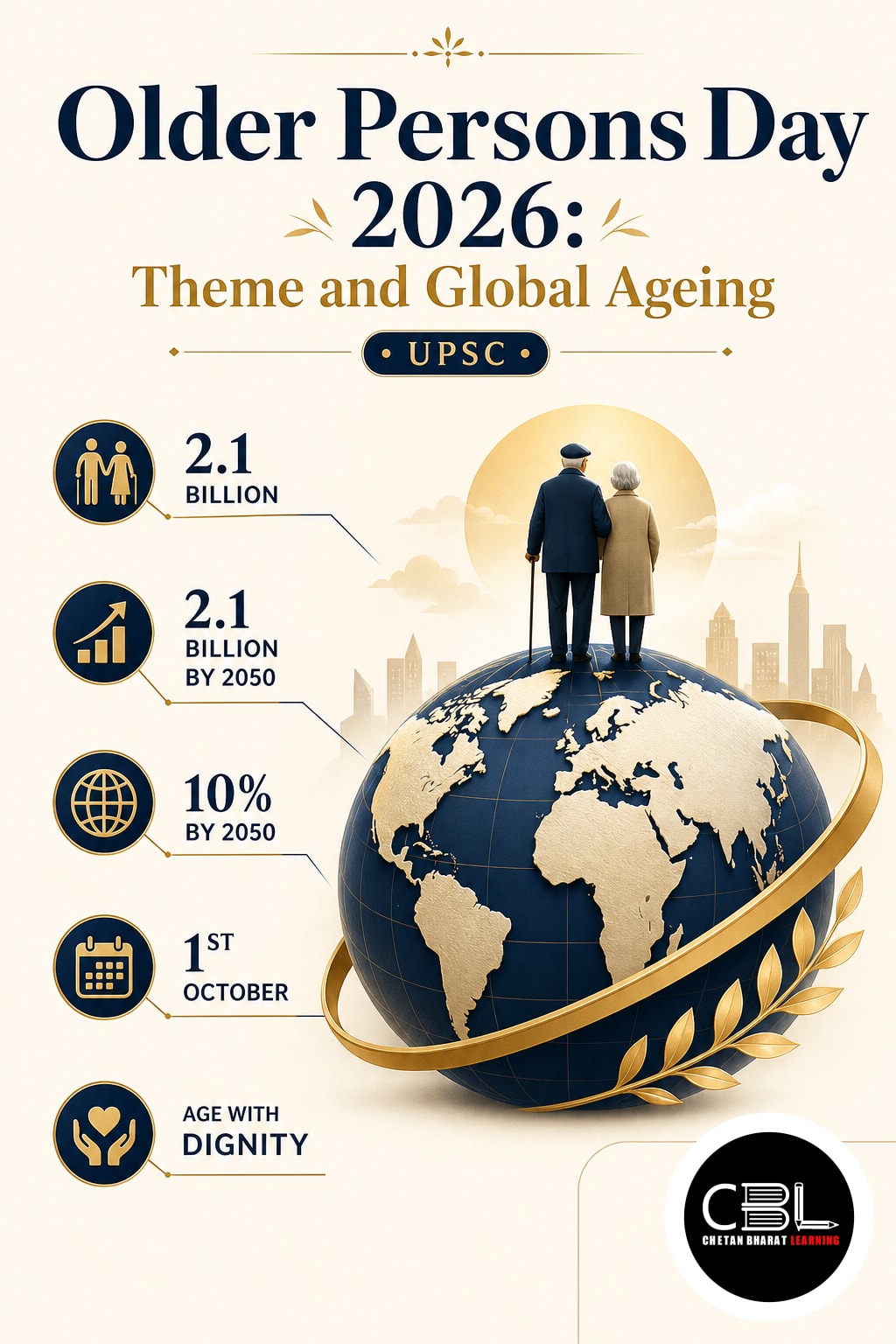
The United Nations observed Older Persons Day 2026 on 1 October with the theme The Age of Longevity: Rethinking Systems for Longer Lives. The theme calls for adapting economic, social and public service systems to the realities of increasing human longevity.
UN Secretary-General António Guterres highlighted the rapid growth of the world’s elderly population. The number of people aged 60 years and above is projected to reach approximately 2.1 billion by 2050, representing around one-fifth of the global population.
Increasing life expectancy represents progress in public health and living standards. However, longer lives also require more sustainable healthcare systems, financial security, accessible housing and opportunities for continued participation in society.
The 2026 observance emphasised intergenerational solidarity, encouraging cooperation between younger and older generations. The objective is to ensure that additional years of life are accompanied by dignity, independence, security and meaningful opportunities.
The United Nations Secretary-General’s message dated 1 October 2026 outlines the theme and major concerns associated with global population ageing.
Key Features
- Recognition of elderly rights: The observance promotes dignity, independence, participation, care and protection from age-based discrimination.
- Healthy ageing: Governments are encouraged to strengthen preventive healthcare, geriatric services, rehabilitation and long-term care systems.
- Financial security: Adequate pensions, social assistance and accessible financial services help older people maintain economic independence.
- Age-friendly infrastructure: Accessible public transport, housing, healthcare facilities and digital services support independent living.
- Intergenerational solidarity: The observance encourages cooperation among different age groups and recognises the continuing contributions of older persons.
- UN Decade of Healthy Ageing: The United Nations declared 2021–2030 the Decade of Healthy Ageing, with the World Health Organization leading international implementation.
- Global cooperation: Governments, civil society, researchers and international organisations collaborate to improve elderly welfare and reduce age-related inequalities.
The UN Decade of Healthy Ageing (2021–2030) focuses on four major areas: combating ageism, developing age-friendly communities, providing person-centred integrated healthcare and ensuring access to long-term care.
In India, the Maintenance and Welfare of Parents and Senior Citizens Act, 2007 provides a legal framework for supporting older persons. The Atal Vayo Abhyuday Yojana (AVYAY) supports their welfare through institutional care, assistive devices and other services.
Article 41 of the Indian Constitution also directs the State, within its economic capacity and development, to make effective provision for public assistance in cases including old age.
Challenges
- Population ageing: The increasing proportion of elderly citizens creates rising demand for healthcare, pensions and long-term support services.
- Healthcare inequalities: Many older people face difficulties accessing affordable treatment, preventive services and specialised geriatric care.
- Economic insecurity: Older persons without adequate savings, pensions or family support may face financial vulnerability.
- Age discrimination: Negative attitudes towards ageing can restrict employment opportunities, social participation and access to services.
- Social isolation: Changing family structures, migration and limited community support can increase loneliness among elderly individuals.
- Digital exclusion: Limited digital literacy and inaccessible technology can prevent older persons from using essential public and financial services.
- Rural service gaps: Inadequate transport, healthcare infrastructure and specialised support create additional challenges for older people in remote areas.
Way Forward
Governments should strengthen age-friendly healthcare systems through accessible primary care, geriatric services, preventive screening and affordable long-term support. Public health planning must recognise the changing needs of ageing populations.
Social protection policies should improve pension coverage, financial security and assistance for vulnerable elderly citizens. Accessible public transport, barrier-free buildings and inclusive housing can support independent living.
Digital literacy programmes and simplified public service platforms can help older persons access government benefits and financial services. Community centres and lifelong learning opportunities can encourage active participation and reduce isolation.
India should strengthen coordination among healthcare institutions, local governments, civil society organisations and social welfare departments. The Department of Social Justice and Empowerment’s AVYAY framework provides an institutional basis for several elderly welfare interventions.
The message of Older Persons Day extends beyond recognising elderly citizens. It calls for public policies that transform longer life expectancy into healthier, more secure and dignified lives. Related social justice developments can be followed through the daily current affairs archive.
Punjab & Haryana PCS Angle
For Punjab PCS and Haryana HCS, this observance is relevant to elderly welfare, social justice, healthcare accessibility and local governance. Candidates should understand the role of state governments and local bodies in providing pensions, healthcare, accessible infrastructure and social protection for senior citizens. Article 41, the Maintenance and Welfare of Parents and Senior Citizens Act, 2007, and the UN Decade of Healthy Ageing are important concepts for State PCS General Studies.
Prelims Practice Corner
Q1. On which date is the International Day of Older Persons observed annually?
- a) 1 October
- b) 1 September
- c) 10 December
- d) 14 November
Answer: a) 1 October
Q2. Which of the following was the official theme of International Day of Older Persons 2026?
- a) Ageing with Equality and Justice
- b) Healthy Ageing for Sustainable Development
- c) The Age of Longevity: Rethinking Systems for Longer Lives
- d) Older Persons Driving Local and Global Action
Answer: c) The Age of Longevity: Rethinking Systems for Longer Lives
Q3. Consider the following statements regarding the UN Decade of Healthy Ageing: 1. It covers the period 2021–2030. 2. The World Health Organization leads its implementation. 3. It focuses exclusively on providing old-age pensions. Which statements are correct?
- a) 1 and 3 only
- b) 1 and 2 only
- c) 2 and 3 only
- d) 1, 2 and 3
Answer: b) 1 and 2 only
Q4. Which United Nations General Assembly resolution designated 1 October as the International Day of Older Persons?
- a) Resolution 75/131
- b) Resolution 46/91
- c) Resolution 70/1
- d) Resolution 45/106
Answer: d) Resolution 45/106
Q5. Consider the following statements: 1. Article 41 of the Indian Constitution refers to public assistance in cases including old age. 2. The Maintenance and Welfare of Parents and Senior Citizens Act was enacted in 2007. 3. Atal Vayo Abhyuday Yojana is implemented under the Ministry of Defence. Which statements are correct?
- a) 1 and 2 only
- b) 2 and 3 only
- c) 1 and 3 only
- d) 1, 2 and 3
Answer: a) 1 and 2 only
Mains Practice Questions
Q1. Population ageing presents both opportunities and challenges for social and economic development. Discuss the importance of age-friendly public policies in ensuring dignity and social security for older persons. (15 marks)
Answer Structure:
- Intro: Explain population ageing and the significance of increasing life expectancy.
- Body: Discuss healthcare demand, pension coverage, economic security, age discrimination, accessibility, intergenerational solidarity and the UN Decade of Healthy Ageing.
- Conclusion: Recommend inclusive social protection, age-friendly infrastructure and integrated healthcare policies for dignified ageing.
Q2. Examine the role of constitutional provisions and government welfare programmes in protecting the rights and well-being of senior citizens in India. (10 marks)
Answer Structure:
- Intro: Introduce elderly welfare as an important component of social justice and inclusive governance.
- Body: Explain Article 41, the Maintenance and Welfare of Parents and Senior Citizens Act, 2007, AVYAY, healthcare access, social pensions and implementation challenges.
- Conclusion: Highlight coordinated action by central and state governments, local bodies and communities to strengthen elderly welfare.
Frequently Asked Questions
What was the theme of International Day of Older Persons 2026?
The official theme was The Age of Longevity: Rethinking Systems for Longer Lives. It emphasised adapting healthcare, pensions, employment and social systems to ensure longer lives are accompanied by dignity, security and meaningful participation.
When was International Day of Older Persons established?
The United Nations General Assembly designated 1 October as the International Day of Older Persons through Resolution 45/106 on 14 December 1990. The observance was first celebrated in 1991.
What is the UN Decade of Healthy Ageing?
The UN Decade of Healthy Ageing covers 2021–2030 and is led by the World Health Organization. It promotes age-friendly communities, integrated healthcare, long-term care and action against age discrimination to improve the lives of older people.
Related Current Affairs
Preparing for UPSC, PCS or HCS?
Talk to a mentor at Chetan Bharat Learning, Chandigarh. Free guidance on choosing the right exam and building a study plan.
Chat on WhatsAppCall 97793 53345UPSC / IAS / PCS coaching in Chandigarh · Trusted by aspirants across Punjab & Haryana
Leave a Reply
You must be logged in to post a comment.