
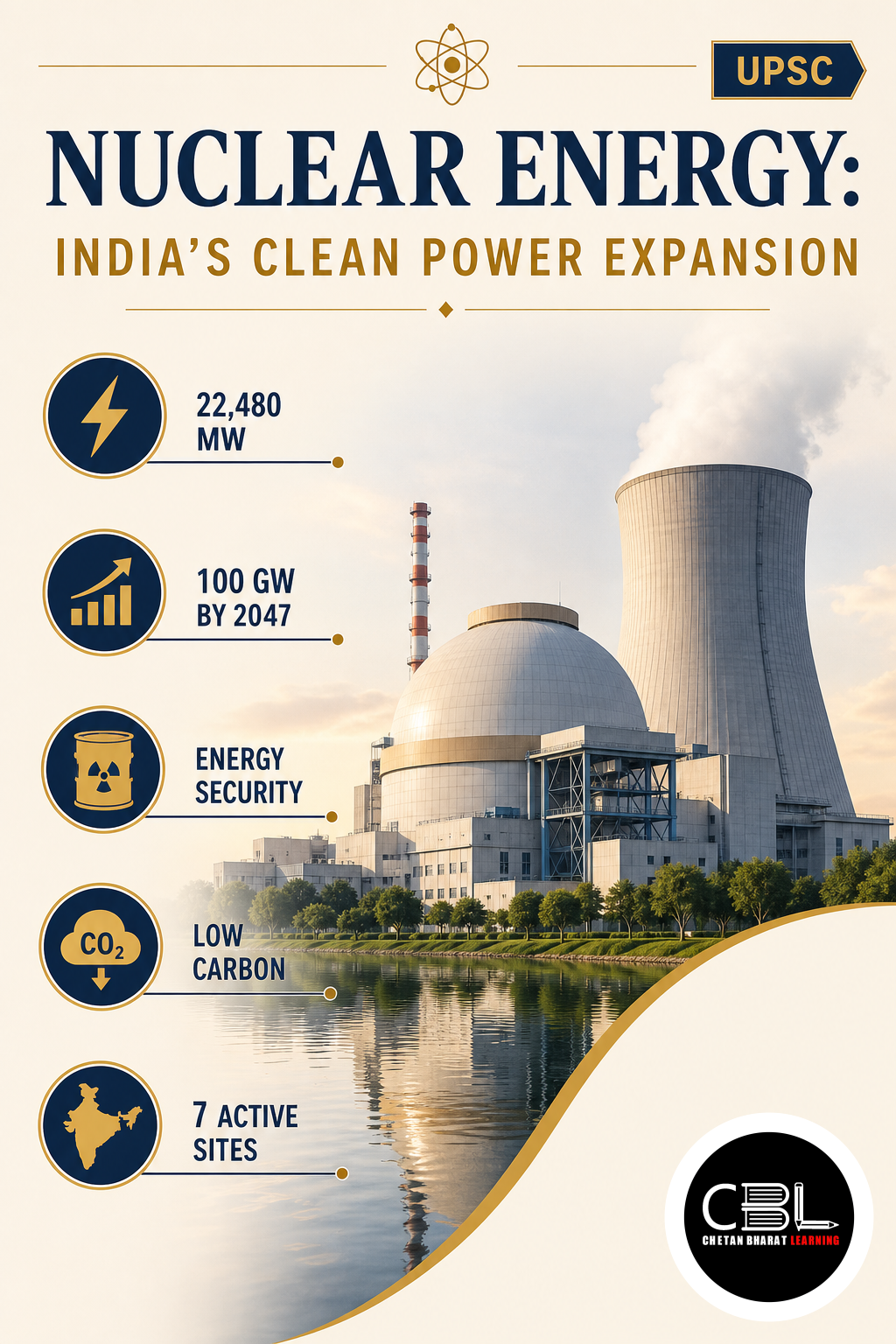

The government is aggressively expanding Nuclear Energy to achieve long-term climate targets effectively. This strategic push targets massive carbon-free baseload power generation across the national grid. Clean power transitions remain crucial for achieving our net-zero targets by the year 2070. The policy framework encourages extensive domestic manufacturing of advanced reactor components.
You can track more updates in our daily current affairs archive.
UPSC Mapping
| Prelims | Mains |
|---|---|
| Science & Tech | GS Paper 3 |
Quick Facts
| Current Capacity | Target Capacity | Regulator | New Tech |
|---|---|---|---|
| 8.78 GW | 100 GW by 2047 | AERB | Small Modular Reactors |
What is Nuclear Energy?
Nuclear Energy represents a highly efficient baseload power source that operates continuously without emitting greenhouse gases. Advanced fission reactors split heavy uranium atoms to generate immense thermal heat for electricity production. This capability completely outpaces intermittent renewable sources when providing stable grid support round the clock.
The initiative primarily operates through a rigorous three-stage domestic program utilizing abundant thorium reserves eventually. The Atomic Energy Regulatory Board enforces stringent safety protocols across all operational facilities nationwide. The government aims to establish a complete ecosystem covering fuel fabrication, reactor construction, and radioactive waste management.
Industry experts consider this clean baseload power the cornerstone of future deep decarbonization strategies globally. Heavy sectors like steel manufacturing and chemical processing cannot easily rely on variable solar or wind power alone. Replacing fossil fuels with sustainable atomic alternatives provides the only viable pathway to eliminate stubborn industrial carbon emissions entirely.
The government also envisions creating specialized export hubs for indigenous reactor technologies to serve international markets. Developing nations equipped with specialized grids will eventually import compact pressurized heavy water reactors to meet their growing electricity demands. This technological diplomacy network will firmly establish the country as a dominant global supplier of clean baseload solutions.
Why is Nuclear Energy in News?
The Union Cabinet recently approved substantial financial outlays to accelerate indigenous Small Modular Reactor development. Several state governments have also announced complementary policies to attract massive private investments into the heavy engineering sector. A recent PIB release highlighted the successful commissioning of new gamma radiation processing facilities under this framework.
International partnerships are simultaneously expanding uranium supply access for domestic reactors entering the global fuel markets. Global demand for clean baseload power continues to rise sharply as developed nations enforce stricter carbon border taxes. These regulatory shifts create highly lucrative opportunities for domestic manufacturers scaling up their heavy engineering operations rapidly.
Recent diplomatic engagements have secured multiple bilateral agreements to jointly develop advanced production technologies and safety standards. These international collaborations significantly reduce the financial risks associated with pioneering such complex and capital-intensive energy projects. Foreign direct investment is expected to surge as global conglomerates seek reliable long-term technology supply contracts.
Domestic research institutions are simultaneously working on reducing the heavy reliance on expensive imported zirconium alloys. Innovations in alternative cladding materials could dramatically lower the overall capital expenditure required for setting up new reactor cores. Such technological breakthroughs remain absolutely essential for making the hardware commercially competitive against established global alternatives.
Key Features
- Indigenous Reactors: The program heavily relies on domestically designed Pressurized Heavy Water Reactors for widespread deployment across the national grid.
- Small Modular Reactors: The recent budget allocates massive funds to develop compact, factory-assembled units specifically designed for remote and off-grid areas.
- Diverse Applications: The technology actively supports critical healthcare diagnostics, agricultural mutagenesis, and advanced semiconductor manufacturing processes nationwide.
- Defence in Depth: All plants incorporate multiple redundant physical barriers and independent shutdown systems to prevent catastrophic accidents effectively.
- Waste Vitrification: Researchers successfully convert high-level radioactive liquid waste into highly stable glass blocks for secure long-term geological storage.
Challenges
- High Capital Costs: Constructing large-scale reactors requires massive upfront investments and frequently suffers from severe multi-year construction delays.
- Land Acquisition: Securing vast contiguous land parcels near coastal water bodies triggers intense opposition from local fishing communities.
- Fuel Scarcity: Domestic uranium reserves remain insufficient to support the ambitious long-term expansion targets independently without foreign imports.
- Waste Disposal: Finding geologically stable deep underground repositories for high-level waste remains a persistent political and environmental challenge.
- Liability Laws: Strict civil liability frameworks continue to deter foreign equipment suppliers from entering the domestic market confidently.
Way Forward
The government must aggressively pursue international technology transfer agreements to localize advanced Small Modular Reactor manufacturing capabilities. Establishing joint ventures with global leaders will rapidly bridge existing technological gaps in domestic supply chains. A comprehensive Department of Atomic Energy strategy should also prioritize skilling programs to create a specialized workforce capable of managing these complex facilities.
Developing robust domestic demand mandates for Nuclear Energy in heavy industries will provide crucial initial market certainty for private investors entering the sector. Simultaneously, policymakers must streamline environmental clearances for establishing dedicated fuel fabrication plants across designated industrial corridors. Long-term success ultimately depends on creating a self-sustaining commercial ecosystem independent of perpetual state financial subsidies.
Policymakers must also introduce standardized safety protocols and certification mechanisms to build confidence among international partners and domestic consumers. Harmonizing these regulatory frameworks with established global standards will eliminate unnecessary trade barriers and facilitate smoother cross-border technology transactions. A unified national certification authority could oversee quality control across all regional manufacturing hubs.
Integrating massive renewable energy grids with atomic baseload facilities requires advanced smart grid technologies and high-capacity frequency regulation systems. Upgrading the existing national transmission infrastructure will prevent curtailment issues and ensure maximum utilization of generated clean electricity. These complementary investments will ultimately determine the true environmental integrity and economic feasibility of the entire value chain.
Prelims Practice Corner
Q1. Which regulatory body oversees the safety of nuclear power plants in India?
(a) Central Electricity Authority (b) Atomic Energy Regulatory Board (c) Bureau of Indian Standards (d) NITI Aayog
Answer: (b) The Atomic Energy Regulatory Board (AERB) oversees all safety and waste management activities.
Q2. What is the targeted nuclear power capacity under the recent mission by 2047?
(a) 22 GW (b) 50 GW (c) 100 GW (d) 250 GW
Answer: (c) The Nuclear Energy Mission aims to achieve 100 GW of nuclear power capacity by 2047.
Q3. Which principle guides the radiological protection measures in Indian nuclear plants?
(a) Maximum Tolerable Dose (b) As Low As Reasonably Achievable (c) Zero Radiation Exposure (d) Linear No-Threshold
Answer: (b) Plants follow the ALARA (As Low As Reasonably Achievable) principle to minimise radiation exposure.
Q4. What technology does BARC use to manage high-level radioactive waste safely?
(a) Deep Sea Dumping (b) Vitrification Technology (c) Atmospheric Venting (d) Chemical Neutralization
Answer: (b) Vitrification technology converts high-level radioactive waste into stable glass blocks for safe long-term management.
Q5. Which recent legislative act strengthens the framework for safe nuclear expansion in India?
(a) SHANTI Act, 2025 (b) Atomic Energy Act, 1962 (c) Civil Liability Act, 2010 (d) Environment Protection Act, 1986
Answer: (a) The SHANTI Act, 2025, further strengthens the framework for safe, secure, and future-ready expansion.
Mains Practice Questions
Q1. Discuss the potential of Small Modular Reactors in democratizing access to clean baseload power in India. What are the key infrastructural and regulatory bottlenecks hindering their immediate success? (250 words)
Answer Structure: Intro: Define the mission and its core objective to achieve 100 GW capacity through advanced compact reactors. Body: Discuss potential in providing stable off-grid power, reducing land footprint, and supporting heavy industries. Highlight bottlenecks like high capital costs, fuel scarcity, and strict civil liability frameworks. Conclusion: Emphasize the need for international technology partnerships and specialized skilling programs to ensure commercial viability.
Q2. Expanding the domestic nuclear fleet requires balancing stringent safety protocols with commercial viability. Analyze this statement in the context of global energy transitions and India’s climate ambitions. (150 words)
Answer Structure: Intro: Explain the concept of Defence in Depth and its role in ensuring radiological safety for local communities. Body: Link stringent AERB regulations to public trust and investor confidence. Discuss how balancing safety with streamlined environmental clearances can accelerate project execution. Conclusion: Conclude that a transparent regulatory ecosystem acts as the foundational launchpad for achieving long-term net-zero targets.
FAQs on Nuclear Energy
What is the main advantage of Small Modular Reactors over traditional large plants?
Small Modular Reactors feature compact designs that can be factory-assembled and transported to remote locations easily. They require significantly less land and capital upfront while providing reliable baseload power to off-grid areas.
How does India manage its high-level radioactive waste safely?
The Bhabha Atomic Research Centre utilizes advanced vitrification technology to convert liquid radioactive waste into highly stable glass blocks. These blocks are then stored in secure, deep geological repositories to prevent any environmental contamination.
Why is the three-stage nuclear program crucial for India’s long-term energy security?
The three-stage program strategically transitions the country from limited uranium reserves to its massive, abundant thorium deposits. This indigenous fuel cycle ensures complete energy independence and eliminates reliance on foreign fuel imports entirely.
Related Current Affairs
Preparing for UPSC, PCS or HCS?
Talk to a mentor at Chetan Bharat Learning, Chandigarh. Free guidance on choosing the right exam and building a study plan.
Chat on WhatsAppCall 97793 53345UPSC / IAS / PCS coaching in Chandigarh · Trusted by aspirants across Punjab & Haryana
Leave a Reply
You must be logged in to post a comment.