

UPSC Mapping
| Exam Type | Paper/Topic |
|---|---|
| Prelims | Agriculture & Animal Husbandry |
| Mains | GS Paper 3 (Agriculture & Animal Husbandry) |
Quick Facts
| Launch | September 2019 |
|---|---|
| Target | FMD eradication by 2030 |
Article
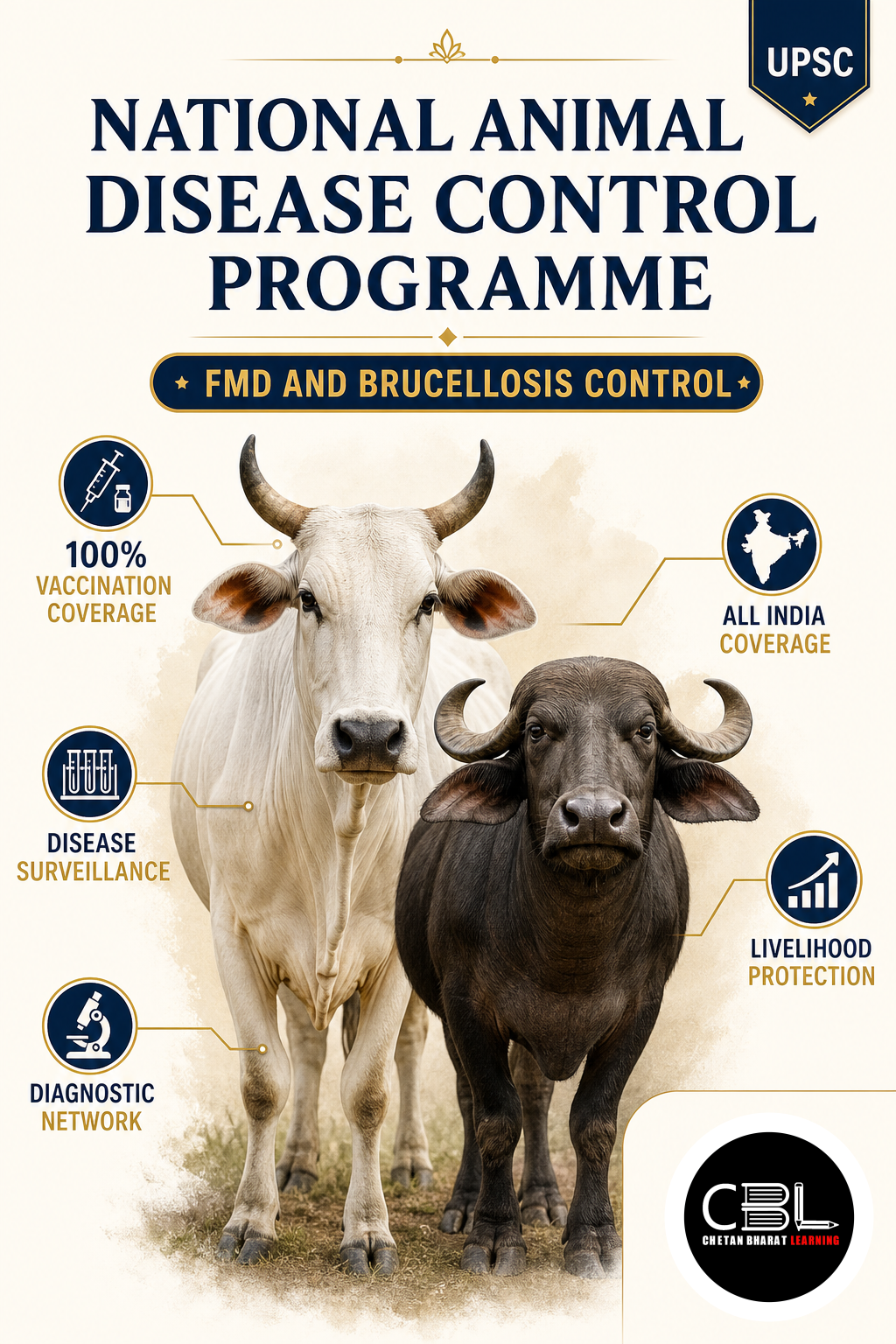
The National Animal Disease Control Programme (NADCP) has made significant strides in reducing the incidence of Foot and Mouth Disease (FMD) and Brucellosis in India through mass vaccination and enhanced veterinary infrastructure. Launched in September 2019 as a 100% centrally funded scheme, NADCP aims to control and eventually eradicate these diseases, which have serious implications for livestock productivity and farmer livelihoods.
What is the National Animal Disease Control Programme?
The NADCP is a central sector scheme launched in 2019 with the aim of controlling and eradicating FMD and Brucellosis in livestock. It targets 100% vaccination of all livestock against FMD twice a year and one-time vaccination against Brucellosis in 4–8 month old female bovine calves. The programme operates through a network of veterinary institutions and involves extensive surveillance and infrastructure strengthening. Under the revised Livestock Health and Disease Control Programme (LHDCP), NADCP has been subsumed along with the Pashu Aushadhi initiative into a single umbrella scheme to facilitate coordinated implementation.
Why is the National Animal Disease Control Programme in News?
NADCP has been in the spotlight due to its remarkable achievements in reducing disease outbreaks. FMD cases declined from 132 in 2019 to 40 by 2025, while Brucellosis outbreaks fell from 22 to 15 in the same period. These reductions have significant economic implications, including improved milk yield, fertility and reduced trade barriers. The scheme’s integration into LHDCP and the government’s commitment to eradicate FMD by 2030 have further increased its prominence.
Key Features of NADCP
- 100% Central Funding: Ensures adequate resources for vaccination and surveillance.
- Mass Vaccination: Biannual FMD vaccination for all livestock and one-time Brucellosis vaccination for female calves.
- Eradication Goal: Aims to eradicate FMD by 2030.
- Infrastructure Strengthening: Enhances veterinary services and laboratory capacity.
- Integrated Scheme: Subsumed under LHDCP for better coordination.
Challenges in Disease Control
- Vaccine Coverage: Reaching remote and hard-to-access areas.
- Disease Surveillance: Timely detection and response to outbreaks.
- Multiple FMD Serotypes: Vaccines must cover O, A and Asia-1 strains.
- Endemic Brucellosis: No curative treatment; prevention via vaccination is critical.
- Farmer Awareness: Ensuring stakeholders understand vaccination benefits.
Way Forward for Livestock Health
Sustained efforts are essential to meet eradication targets. Priorities include enhancing surveillance, improving vaccine efficacy, strengthening veterinary services and farmer outreach. Continued investment in R&D for new vaccines and diagnostics, along with public-private partnerships, will be crucial for scaling up interventions.
Prelims Practice Corner
Q1. When was the National Animal Disease Control Programme launched?
(a) 2017 (b) 2018 (c) 2019 (d) 2020
Answer: (c) 2019. NADCP was launched in September 2019.
Q2. Which of the following diseases does NADCP aim to control?
(a) Rabies & Anthrax (b) FMD & Brucellosis (c) Bird Flu & Swine Fever (d) Tuberculosis & Leptospirosis
Answer: (b) FMD & Brucellosis.
Q3. What is the target for FMD eradication under NADCP?
(a) 2025 (b) 2028 (c) 2030 (d) 2035
Answer: (c) 2030.
Q4. Which agency is responsible for implementing NADCP?
(a) Ministry of Agriculture (b) Ministry of Fisheries, Animal Husbandry & Dairying (c) Ministry of Health (d) NITI Aayog
Answer: (b) Ministry of Fisheries, Animal Husbandry & Dairying.
Q5. What is the main cause of Brucellosis in livestock?
(a) Virus (b) Bacterium Brucella abortus (c) Fungus (d) Parasite
Answer: (b) Bacterium Brucella abortus.
Mains Practice Questions
Q1. “The National Animal Disease Control Programme is a critical intervention for improving livestock productivity and farmer livelihoods.” Discuss its achievements and challenges. (250 words, 15 marks)
Answer Structure:
- Intro: Introduce NADCP and its objectives of controlling FMD and Brucellosis.
- Body: Highlight achievements (outbreak reduction, vaccination coverage), discuss challenges (logistics, surveillance, serotypes).
- Conclusion: Emphasise need for sustained efforts, LHDCP integration and stakeholder engagement.
Q2. “Animal health is integral to India’s agricultural growth and food security.” Examine the role of government schemes in addressing livestock diseases. (250 words, 15 marks)
Answer Structure:
- Intro: Link between animal health and rural livelihoods.
- Body: Discuss importance of disease control, role of NADCP and LHDCP integration.
- Conclusion: Suggest strengthening surveillance, research, and public-private partnerships.
FAQs on National Animal Disease Control Programme
What is the target of NADCP regarding FMD?
NADCP aims to eradicate Foot and Mouth Disease (FMD) by 2030 through biannual mass vaccinations for all livestock and lifetime calf vaccinations.
What is Brucellosis and how does it affect livestock?
Brucellosis is a reproductive disease of cattle and buffaloes caused by the bacterium Brucella abortus. It leads to abortion, infertility and reduced milk and meat production.
What is the Livestock Health and Disease Control Programme (LHDCP)?
LHDCP is an umbrella scheme that integrates NADCP and the Pashu Aushadhi initiative to facilitate coordinated livestock health management and disease control interventions.
Related Current Affairs
Preparing for UPSC, PCS or HCS?
Talk to a mentor at Chetan Bharat Learning, Chandigarh. Free guidance on choosing the right exam and building a study plan.
Chat on WhatsAppCall 97793 53345UPSC / IAS / PCS coaching in Chandigarh · Trusted by aspirants across Punjab & Haryana
Leave a Reply
You must be logged in to post a comment.