
UPSC Mapping
| Prelims | Science & Technology |
|---|---|
| Mains | GS Paper 3 (Science & Technology & Security) |
Quick Facts
| Satellite Constellation | 4,408 satellites |
|---|---|
| Orbit Altitude | 540-570 km (LEO) |
What is Starlink India Launch?
Starlink India Launch refers to the planned introduction of SpaceX’s satellite internet service in India. Starlink is a low-earth orbit (LEO) satellite constellation of 4,408 satellites orbiting at 540-570 km, capable of providing around 600 Gbps bandwidth over India. The service can offer connectivity to remote, underserved, and difficult-to-reach areas where fibre or mobile towers are not feasible.
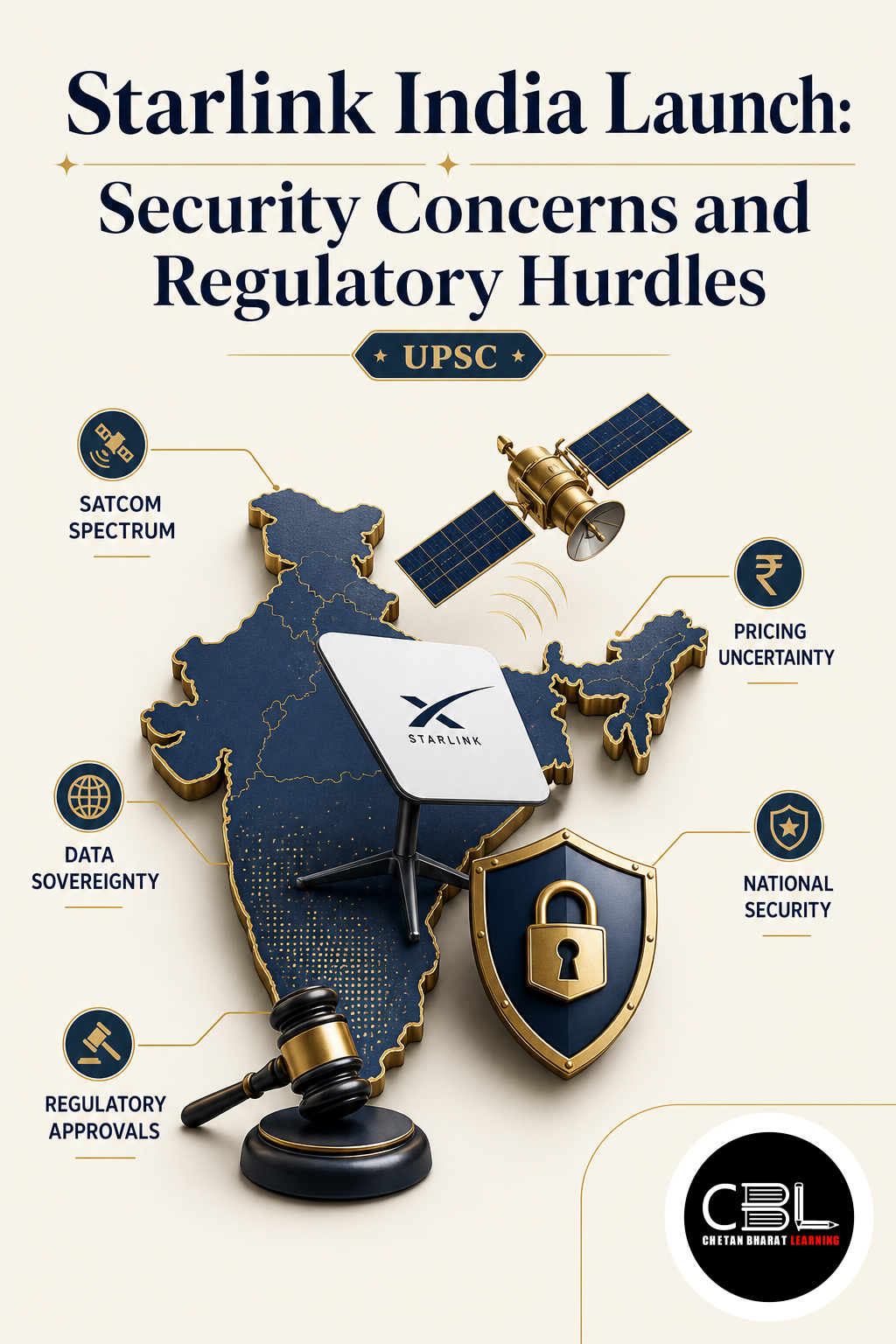
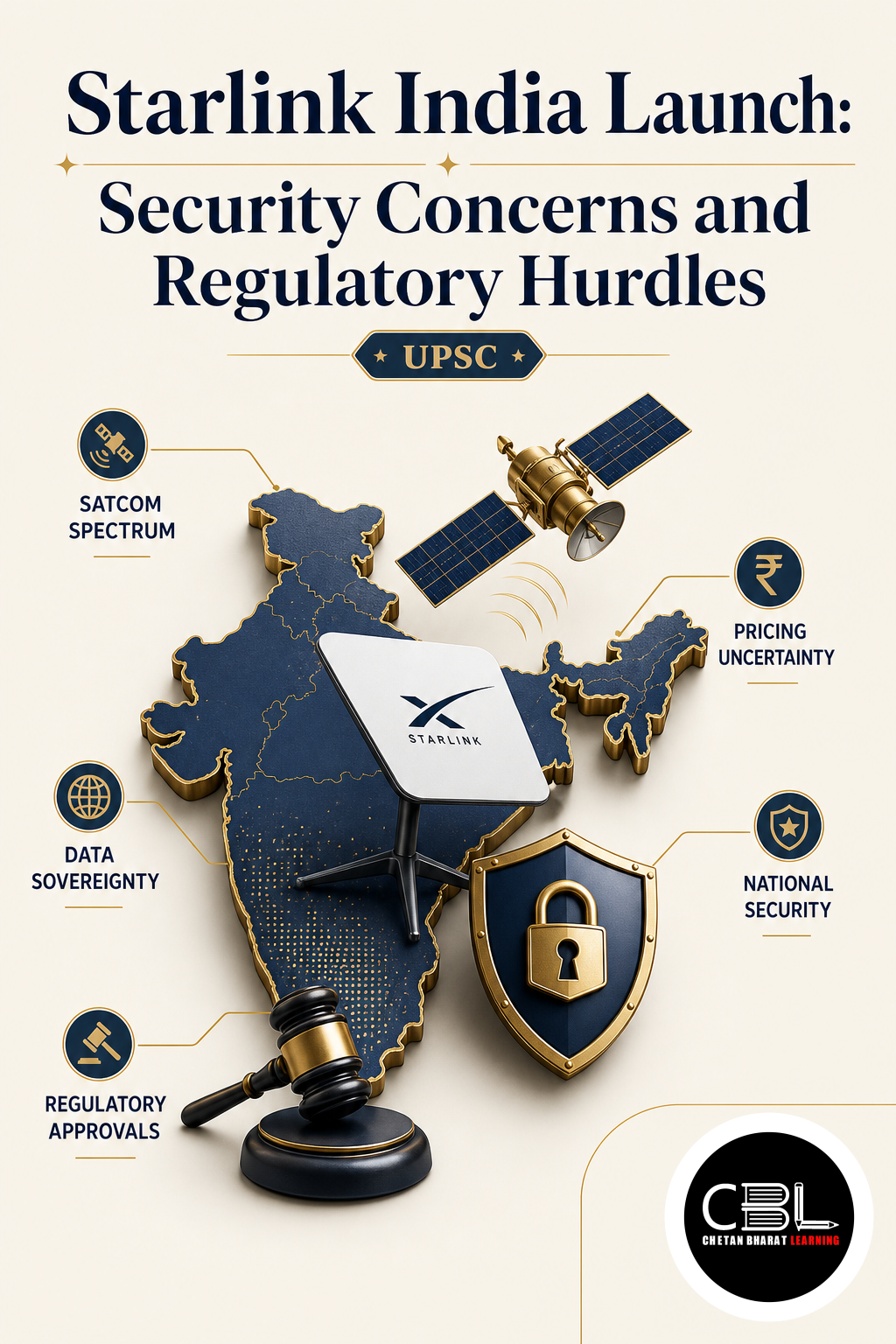
Despite receiving regulatory clearance, the launch has been delayed due to security concerns. The Department of Telecommunications (DoT) has issued guidelines requiring companies to set up local manufacturing, ensure data localisation, use domestic navigation systems (NavIC), implement blocking mechanisms, and cooperate with law enforcement agencies.
Why is Starlink India Launch in News?
Starlink India Launch is in the news because Elon Musk recently stated that Starlink could provide connectivity to India’s underserved regions, even as the service awaits formal launch, a year after securing licenses. The government’s concerns revolve around foreign operators potentially bypassing Indian gateways, raising national security and data sovereignty issues.
DoT guidelines require satellite communication companies to ensure that no user traffic is routed through gateways outside India, share data with NavIC for encryption, and achieve at least 20% indigenisation of their ground segment. For more details, refer to this PIB release.
Key Features of Starlink India Launch
- LEO Constellation: 4,408 satellites in low-earth orbit for low-latency connectivity.
- Bandwidth: Capable of providing ~600 Gbps bandwidth over India.
- Coverage: Can connect remote, rural, and difficult-to-reach areas.
- DoT Guidelines: Data localisation, NavIC integration, indigenisation, and law enforcement cooperation.
- Security Concerns: Foreign operators potentially bypassing Indian gateways.
Challenges in Starlink India Launch
- National Security: Data security, surveillance, network control, and lawful interception concerns.
- Data Sovereignty: Ensuring that Indian user data is not routed through foreign gateways.
- Affordability: High equipment and subscription costs may limit access.
- Space Debris: More LEO satellites increase orbital congestion and collision risk.
- Regulatory Compliance: Meeting DoT’s indigenisation and data localisation requirements. For more on technology regulation, visit the governance section.
Way Forward for Starlink India Launch
To facilitate Starlink India Launch, the government should establish clear and transparent guidelines for satellite communication services, balancing security concerns with the need for connectivity. A phased approach, starting with pilot projects in remote areas, can address security and operational issues. International cooperation on spectrum coordination and space debris management is essential.
India’s own satellite communication capabilities, including the NavIC system, should be strengthened to reduce dependence on foreign operators. A level playing field for domestic and foreign operators, with clear data sovereignty rules, can encourage investment. For international best practices, refer to the ITU.
Prelims Practice Corner
Q1. What is the altitude of Starlink satellites?
(a) 100-200 km (b) 300-400 km (c) 540-570 km (d) 1000-1200 km
Answer: (c) Starlink satellites orbit at 540-570 km.
Q2. What is the bandwidth capacity of Starlink over India?
(a) 100 Gbps (b) 300 Gbps (c) 600 Gbps (d) 1 Tbps
Answer: (c) Starlink can provide ~600 Gbps bandwidth over India.
Q3. Which Indian navigation system must be used by satcom operators?
(a) GPS (b) GLONASS (c) NavIC (d) Galileo
Answer: (c) DoT guidelines require the use of NavIC.
Q4. What is the minimum indigenisation target for satcom ground segment?
(a) 10% (b) 20% (c) 30% (d) 50%
Answer: (b) The target is at least 20% indigenisation.
Q5. What is a key security concern with Starlink?
(a) High cost (b) Foreign operators bypassing Indian gateways (c) Low speed (d) Lack of demand
Answer: (b) The government is concerned about foreign operators bypassing Indian gateways.
Mains Practice Questions
Q1. Discuss the regulatory and security challenges in launching satellite internet services like Starlink in India. (250 words, 15 marks)
Intro: Introduce Starlink and the launch delay.
Body: Discuss the benefits of satellite internet (connectivity, disaster management) and the regulatory framework (DoT guidelines). Analyse security concerns: data sovereignty, gateway control, NavIC integration, indigenisation. Suggest a balanced approach.
Conclusion: Emphasise the need for clear, transparent, and balanced regulation.
Q2. What is the difference between LEO and GEO satellite systems? (150 words, 10 marks)
Intro: Define LEO and GEO.
Body: LEO satellites are closer (540-570 km) with lower latency but require more satellites. GEO satellites are farther (~36,000 km) with wider coverage but higher latency.
Conclusion: Conclude that LEO is better for broadband, GEO for broadcasting.
FAQs on Starlink India Launch
What is Starlink?
A satellite internet constellation by SpaceX providing low-latency broadband via LEO satellites.
Why is Starlink’s launch in India delayed?
Due to security concerns, data sovereignty issues, and DoT guidelines on indigenisation and NavIC integration.
What is the role of DoT in regulating satellite internet?
The Department of Telecommunications issues licenses and guidelines for spectrum, security, and compliance.
Related Current Affairs
Preparing for UPSC, PCS or HCS?
Talk to a mentor at Chetan Bharat Learning, Chandigarh. Free guidance on choosing the right exam and building a study plan.
Chat on WhatsAppCall 97793 53345UPSC / IAS / PCS coaching in Chandigarh · Trusted by aspirants across Punjab & Haryana
Leave a Reply
You must be logged in to post a comment.