
UPSC Mapping
| Prelims | Mains |
|---|---|
| Infrastructure & Economy | GS Paper 3 (Infrastructure & Economic Development) |
Quick Facts
| Capex (2014–15) | ₹2 lakh crore |
|---|---|
| Capex (2026–27) | ₹12.2 lakh crore |
| Operational Airports | 165 |
What is Infrastructure Transformation?
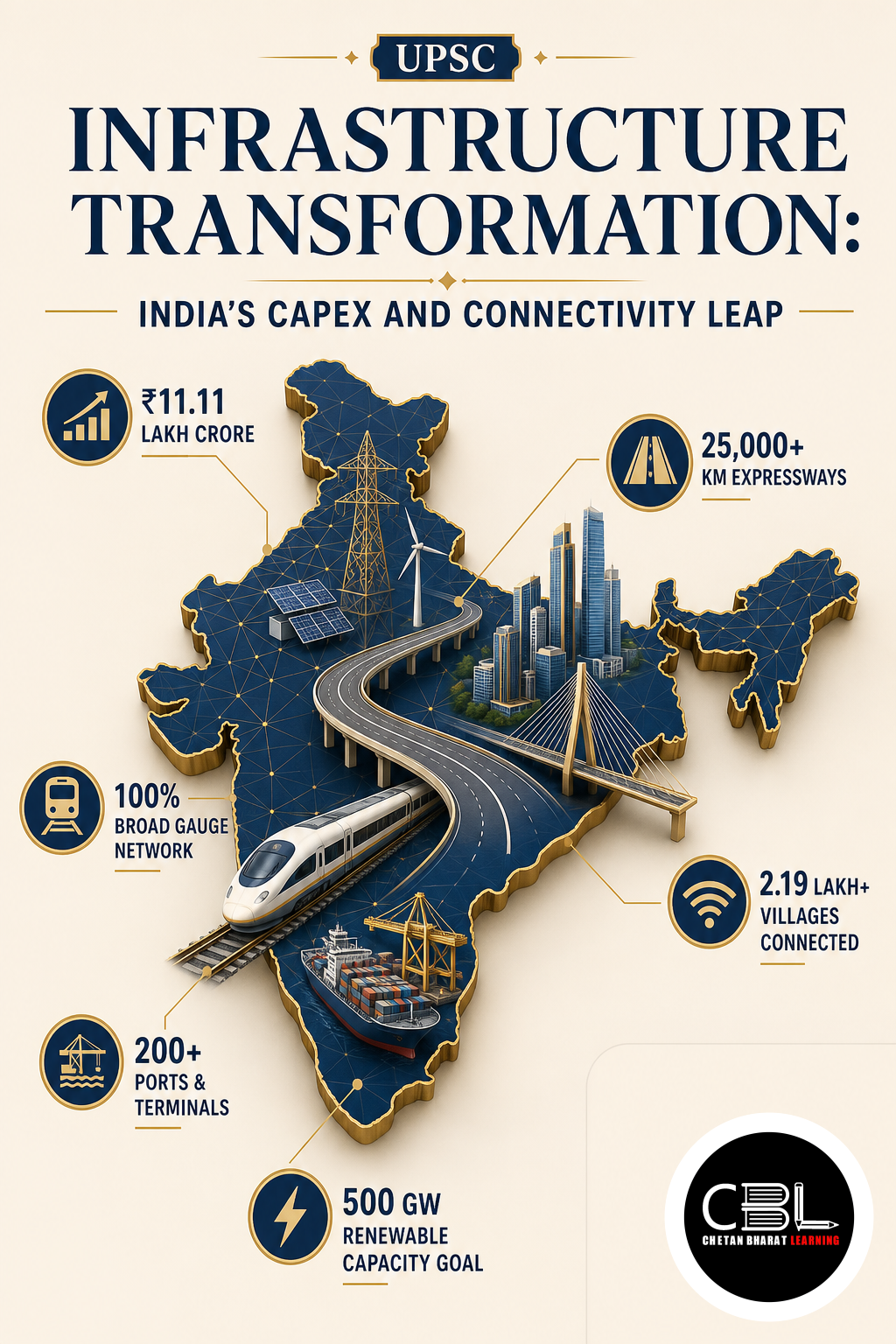
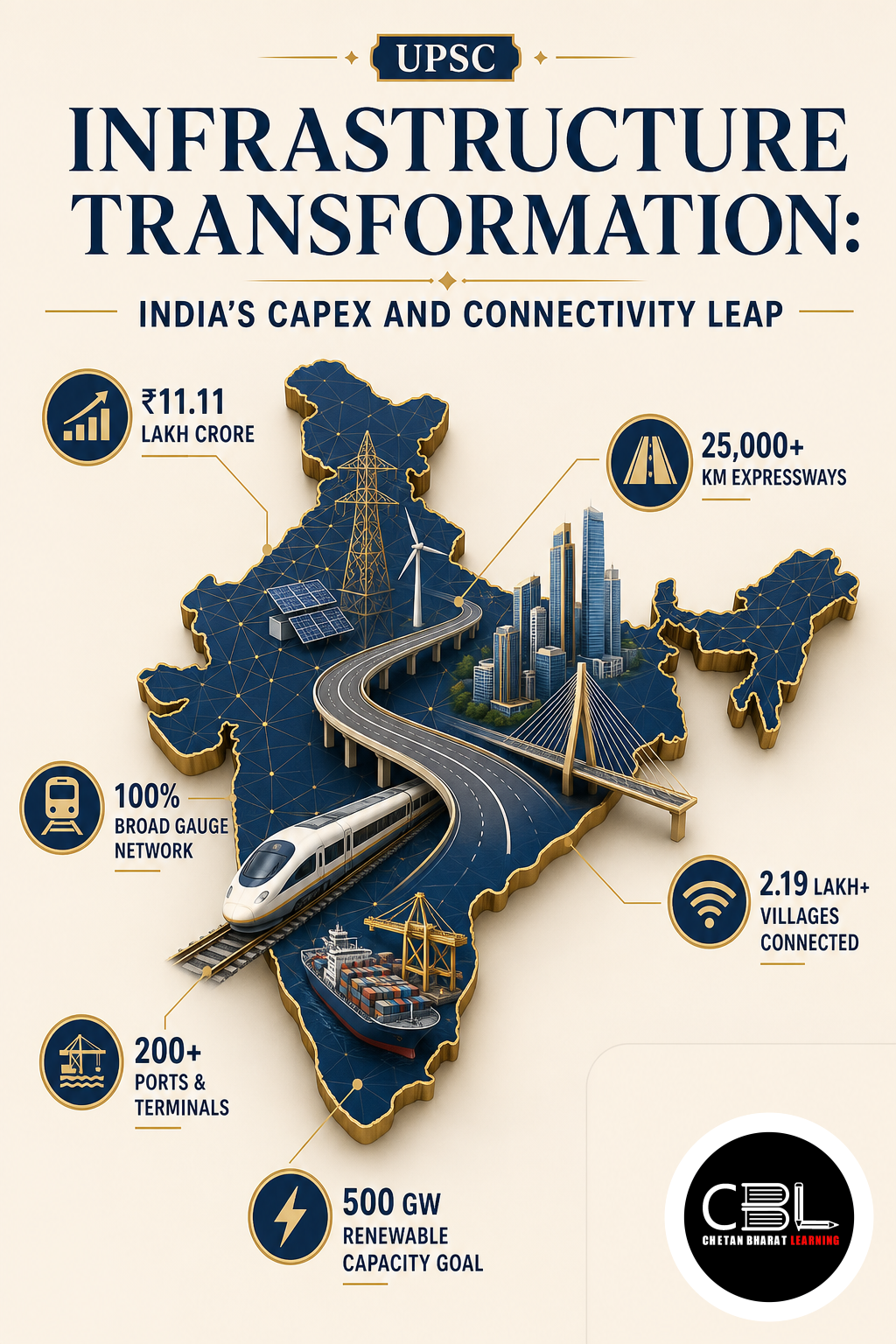
Infrastructure Transformation refers to India’s massive public investment in roads, railways, ports, airports, and industrial parks. The railway budget has increased to ₹2.78 lakh crore in FY 2026–27. Kavach Version 4.0 has been commissioned on 2,633 route km. The Mumbai–Ahmedabad High-Speed Rail Corridor is designed with a speed of 350 kmph. 261 stations have been redeveloped under the Amrit Bharat Station Scheme. India’s first indigenously developed hydrogen fuel cell trainset was launched in July 2026.
India has the world’s second-largest road network at 63.73 lakh km. National highways increased by about 61% to 1,46,572 km. Under Pradhan Mantri Gram Sadak Yojana, road length increased to 4.11 lakh km during 2014–2026. Under Bharatmala, 22,590 km of roads have been completed. Major bridges include the Chenab Bridge (world’s highest railway arch bridge), Anji Khad Bridge (first cable-stayed railway bridge), and the Pamban Bridge (first vertical-lift railway sea bridge).
Why is Infrastructure Transformation in News?
Infrastructure Transformation is in the news as the government highlights the quantum jump in public capex and the completion of iconic projects. The Chenab Bridge (2025), Anji Khad Bridge (2025), Pamban Bridge (2025), Z-Morh/Sonamarg Tunnel (2025), Sudarshan Setu (2024), and Atal Tunnel (2020) have reshaped India’s connectivity landscape.
Operational airports increased from 74 in 2014 to 165 in July 2026. Major ports’ cargo handling capacity doubled from 873 MMTPA in 2014 to 1,728 MMTPA in 2026. India became the world’s No. 1 ship-recycling nation in 2025. For more details, refer to this PIB release.
Key Features of Infrastructure Transformation
- Rail Mobility: Kavach 4.0, high-speed rail, station redevelopment, hydrogen fuel cell trains.
- Roads: World’s second-largest network, NH expansion, PMGSY, Bharatmala.
- Bridges and Tunnels: Chenab, Anji Khad, Pamban, Z-Morh, Atal Tunnel, Sudarshan Setu.
- Aviation: 165 operational airports, 25 greenfield airports approved, Digi Yatra.
- Maritime: Sagarmala, 111 national waterways, world’s No. 1 ship-recycling.
Challenges in Infrastructure Transformation
- Funding: Sustaining high capex requires fiscal discipline and private investment.
- Land Acquisition: Delays in land acquisition affect project timelines.
- Execution Capacity: Ensuring timely and quality execution of mega projects.
- Maintenance: New infrastructure requires long-term maintenance and upkeep.
- Environmental Impact: Balancing development with environmental sustainability.
Way Forward for Infrastructure Transformation
To sustain Infrastructure Transformation, the government should promote public-private partnerships to attract private investment. Strengthening project monitoring and implementation capacity is essential. Adopting sustainable construction practices and green technologies can minimise environmental impact.
Integrating infrastructure planning with urban and industrial development can maximise economic benefits. For international best practices, refer to the World Bank.
Prelims Practice Corner
-
Q1. What is India’s public capex in FY 2026–27?
(a) ₹5 lakh crore (b) ₹8 lakh crore (c) ₹12.2 lakh crore (d) ₹15 lakh crore
Answer: (c) Public capex is ₹12.2 lakh crore.
-
Q2. Which is the world’s highest railway arch bridge?
(a) Pamban Bridge (b) Chenab Bridge (c) Anji Khad Bridge (d) Atal Tunnel
Answer: (b) The Chenab Bridge is the world’s highest railway arch bridge.
-
Q3. How many operational airports does India have as of July 2026?
(a) 74 (b) 100 (c) 165 (d) 200
Answer: (c) India has 165 operational airports.
-
Q4. What is the length of India’s national highway network in March 2026?
(a) 1,00,000 km (b) 1,46,572 km (c) 2,00,000 km (d) 63.73 lakh km
Answer: (b) National highways are 1,46,572 km.
-
Q5. India became the world’s No. 1 ship-recycling nation in which year?
(a) 2023 (b) 2024 (c) 2025 (d) 2026
Answer: (c) India became No. 1 in ship-recycling in 2025.
Mains Practice Questions
-
Q1. Discuss the key achievements and challenges of India’s infrastructure transformation since 2014. (250 words, 15 marks)
Answer Structure:
- Intro: Introduce the capex growth and sectoral achievements.
- Body: Discuss railways, roads, bridges, aviation, and maritime achievements. Analyse challenges: funding, execution, maintenance. Suggest a way forward.
- Conclusion: Emphasise the need for sustainable and inclusive infrastructure.
-
Q2. What is the significance of the PM GatiShakti National Master Plan in infrastructure development? (150 words, 10 marks)
Answer Structure:
- Intro: Define PM GatiShakti as an integrated planning platform.
- Body: Explain its role in coordinating 58 ministries, reducing logistics costs, and enabling multimodal connectivity.
- Conclusion: Conclude that it is a game-changer for infrastructure planning.
FAQs on Infrastructure Transformation
-
What is the scale of India’s infrastructure investment?
Public capex has grown from ₹2 lakh crore in FY2014-15 to ₹12.2 lakh crore in FY2026-27.
-
What are the key achievements in rail infrastructure?
Kavach 4.0, high-speed rail, station redevelopment, and hydrogen fuel cell trains.
-
What are the major bridges completed?
Chenab, Anji Khad, Pamban, Sudarshan Setu, and Atal Tunnel.
Related Current Affairs
Preparing for UPSC, PCS or HCS?
Talk to a mentor at Chetan Bharat Learning, Chandigarh. Free guidance on choosing the right exam and building a study plan.
Chat on WhatsAppCall 97793 53345UPSC / IAS / PCS coaching in Chandigarh · Trusted by aspirants across Punjab & Haryana
Leave a Reply
You must be logged in to post a comment.