

UPSC Mapping
Important for
| Level | Topic |
|---|---|
| Prelims | Polity & Consumer Protection |
| Mains | GS Paper 2 (Polity & Governance) |
Quick Facts
| Key | Details |
|---|---|
| Total Pendency | 5.7 lakh cases |
| NCDRC Jurisdiction | Above ₹2 crore |
Article
What is NCDRC Pendency?
NCDRC Pendency refers to the backlog of cases pending before the National Consumer Disputes Redressal Commission (NCDRC), the apex body of the three-tier consumer dispute redressal system in India. Established in 1988 under the Consumer Protection Act, 1986, and now operating under the Consumer Protection Act, 2019, it is headed by a sitting or retired Supreme Court Judge or High Court Chief Justice, assisted by members with expertise in law, commerce, and public administration.
The three-tier structure includes District Forums (DCDRC) for complaints up to ₹50 lakh, State Commissions (SCDRC) for ₹50 lakh to ₹2 crore, and the NCDRC for complaints above ₹2 crore. The NCDRC also has appellate and revisional jurisdiction over State Commission decisions. An original NCDRC order can be appealed to the Supreme Court within 30 days.
Why is NCDRC Pendency in News?
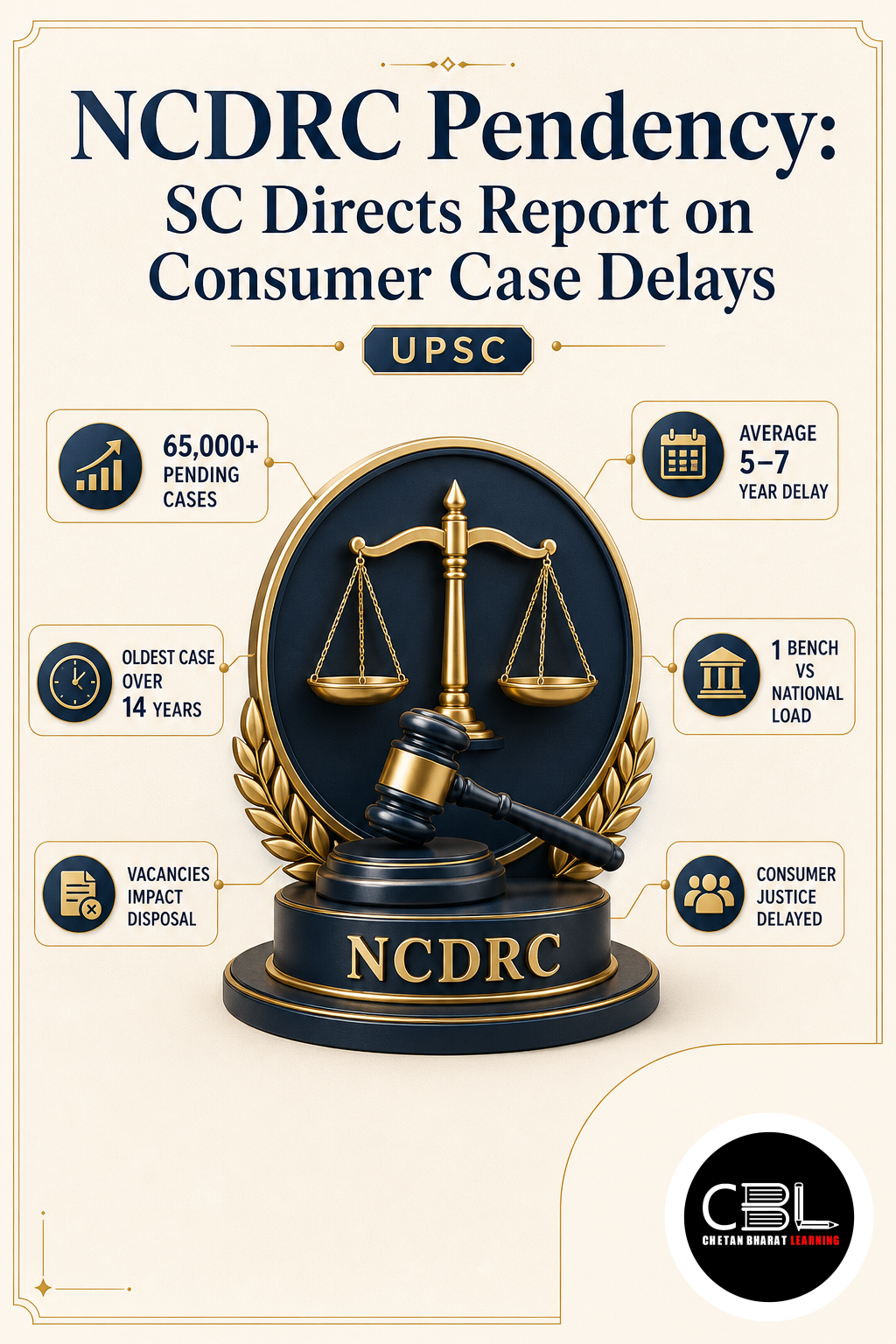
NCDRC Pendency is in the news because the Supreme Court directed the Commission to report on case pendency and vacancies, citing 5.7 lakh pending cases across the consumer dispute redressal system. The Court’s intervention highlights the urgent need to address the backlog and ensure timely justice for consumers.
The pendency issue is exacerbated by vacancies in the consumer commissions at all levels. For more details, refer to the PIB release.
Key Features of NCDRC Pendency
- Apex Body: NCDRC is the highest consumer dispute redressal forum.
- Three-Tier Structure: District Forums, State Commissions, and National Commission.
- Pecuniary Jurisdiction: NCDRC hears complaints above ₹2 crore.
- Appellate Role: Hears appeals from State Commissions.
- Pendency: 5.7 lakh cases pending across the system.
Challenges in NCDRC Pendency
- Vacancies: Lack of adequate members and presidents at all levels.
- Infrastructure: Inadequate courtrooms and support staff.
- Case Load: Increasing number of consumer complaints.
- Delays: Procedural delays in hearings and judgments.
- Appeals: Large number of appeals to the Supreme Court adds to pendency.
Way Forward for NCDRC Pendency
To address NCDRC Pendency, the government should expedite the appointment of members and presidents to fill vacancies. Strengthening infrastructure and staffing of consumer commissions is essential. Encouraging alternative dispute resolution mechanisms, such as mediation and conciliation, can reduce the case load.
Digitisation of case management and e-filing can improve efficiency. Regular monitoring of pendency and timely disposal of cases by the Supreme Court can set a precedent. For international best practices, refer to the OECD.
Prelims Practice Corner
- Q1. Which Act currently governs the NCDRC? (a) Consumer Protection Act, 1986; (b) Consumer Protection Act, 2019; (c) Consumer Protection Act, 1999; (d) Consumer Protection Act, 2005
Answer: (b) The NCDRC operates under the Consumer Protection Act, 2019. - Q2. What is the pecuniary jurisdiction of the NCDRC? (a) Up to ₹50 lakh; (b) ₹50 lakh to ₹2 crore; (c) Above ₹2 crore; (d) All cases
Answer: (c) NCDRC hears complaints above ₹2 crore. - Q3. Who heads the NCDRC? (a) Retired Supreme Court Judge; (b) Retired High Court Chief Justice; (c) Either (a) or (b); (d) Attorney General
Answer: (c) The President is a sitting or retired SC Judge or HC Chief Justice. - Q4. How many cases are pending in the consumer dispute redressal system? (a) 1.5 lakh; (b) 3.2 lakh; (c) 5.7 lakh; (d) 10 lakh
Answer: (c) There are 5.7 lakh pending cases. - Q5. What is the appeal time limit from NCDRC to the Supreme Court? (a) 15 days; (b) 30 days; (c) 45 days; (d) 60 days
Answer: (b) Appeals must be filed within 30 days.
Mains Practice Questions
- Q1. Discuss the role of the National Consumer Disputes Redressal Commission in protecting consumer rights and the challenges it faces in ensuring timely justice. (250 words, 15 marks)
Answer Structure:
Intro: Introduce NCDRC and its mandate.
Body: Explain the three-tier structure and the NCDRC’s jurisdiction. Analyse the pendency crisis, vacancies, and infrastructure issues. Suggest reforms: filling vacancies, digitisation, ADR.
Conclusion: Emphasise the need for speedy consumer justice. - Q2. What is the structure of the consumer dispute redressal system in India? (150 words, 10 marks)
Answer Structure:
Intro: Outline the three-tier system.
Body: Describe the District Forums (DCDRC), State Commissions (SCDRC), and National Commission (NCDRC) with their pecuniary jurisdictions.
Conclusion: Conclude that the system aims to provide redressal at multiple levels.
FAQs on NCDRC Pendency
- What is NCDRC?
- It is the apex consumer dispute redressal commission in India under the Consumer Protection Act, 2019.
- Why is there a pendency crisis?
- Due to vacancies, inadequate infrastructure, and a rising number of consumer complaints.
- What is the time limit for appeal from NCDRC to the Supreme Court?
- Appeals must be filed within 30 days.
Related Current Affairs
Preparing for UPSC, PCS or HCS?
Talk to a mentor at Chetan Bharat Learning, Chandigarh. Free guidance on choosing the right exam and building a study plan.
Chat on WhatsAppCall 97793 53345UPSC / IAS / PCS coaching in Chandigarh · Trusted by aspirants across Punjab & Haryana
Leave a Reply
You must be logged in to post a comment.