
UPSC Mapping
| Exam | Syllabus |
|---|---|
| Prelims | Economy & Statistics |
| Mains | GS Paper 3 (Economy & Statistics) |
Article
What is Diary Data Collection?
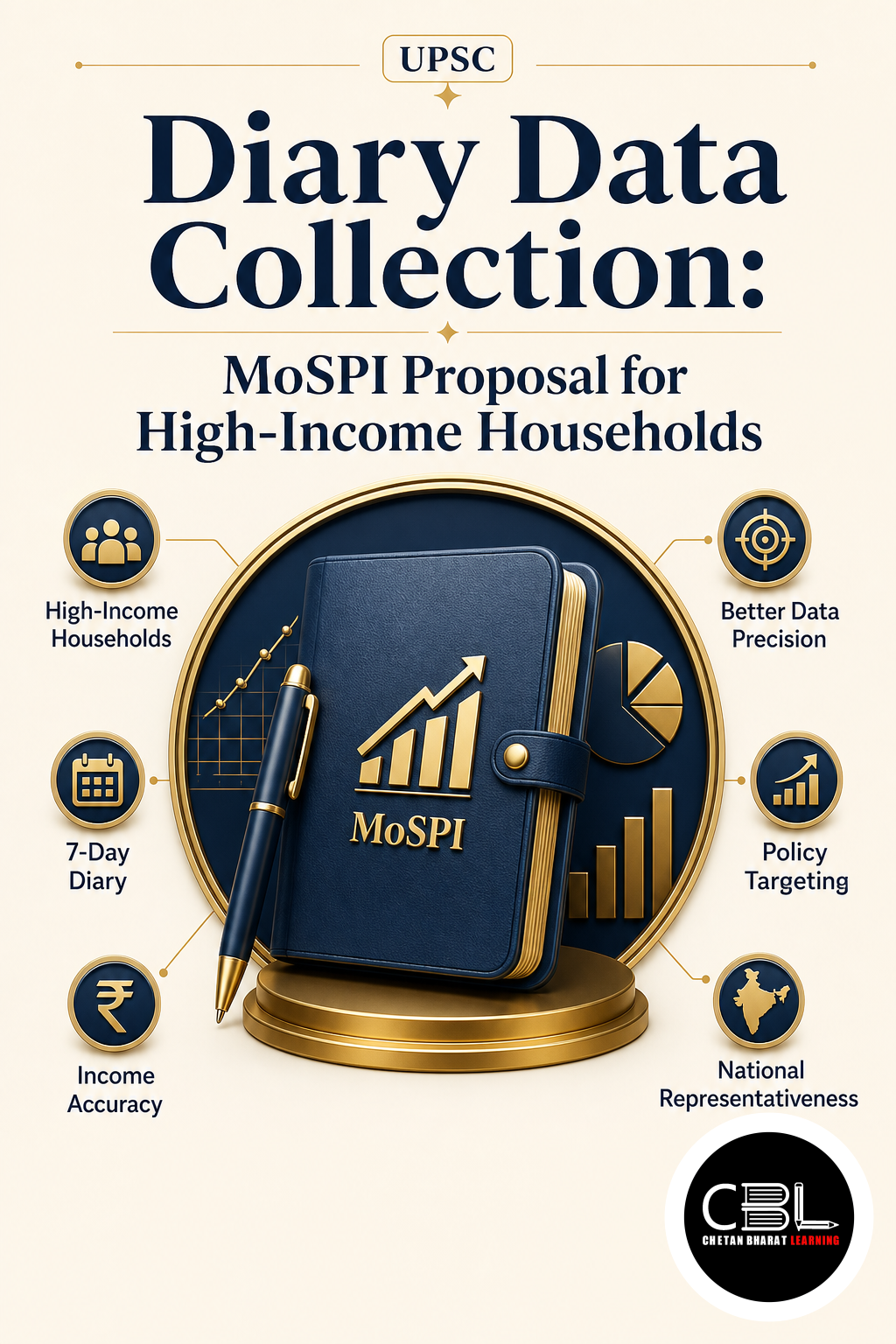
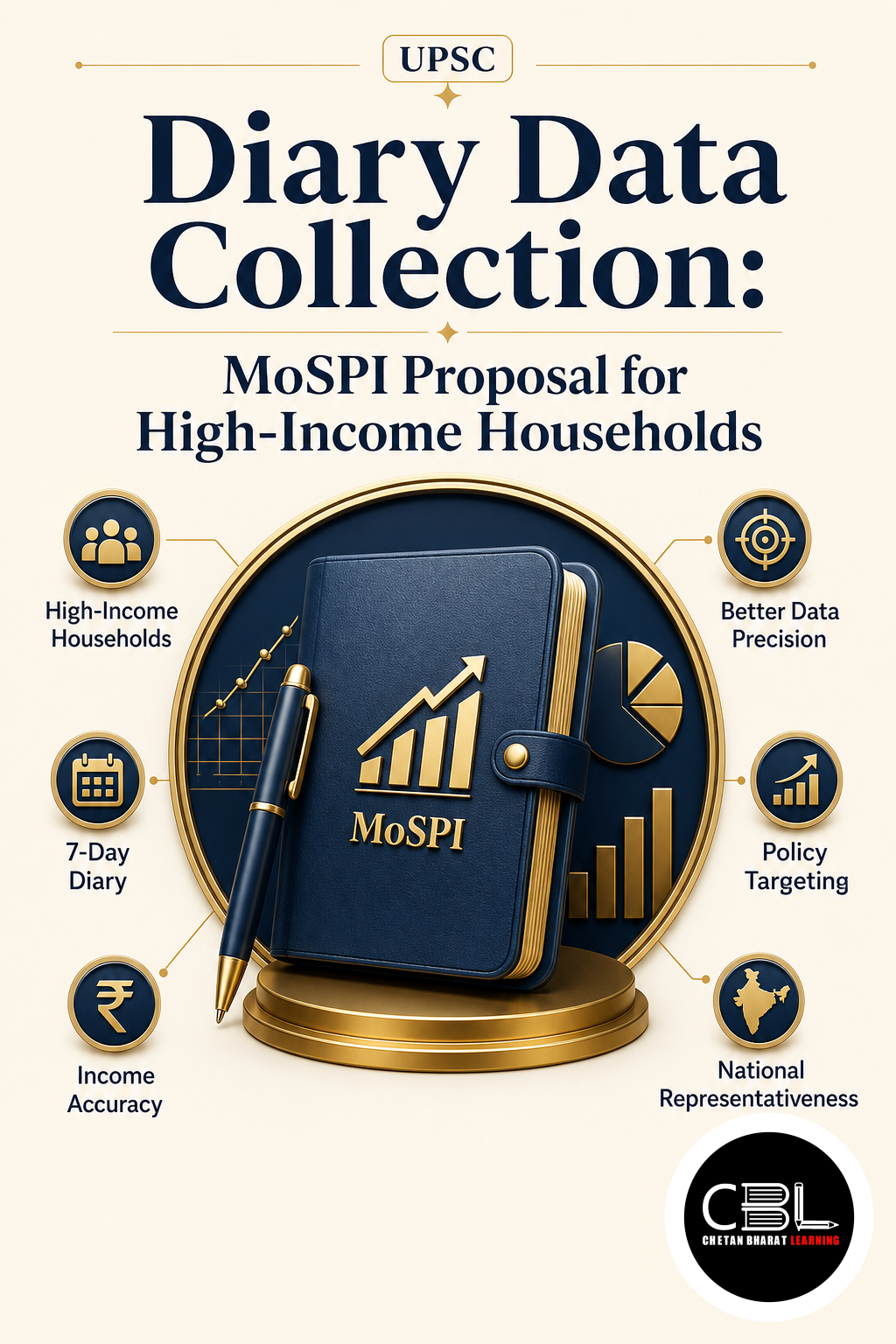
Diary Data Collection is a method where households record their expenditure in a diary or online system over a period, instead of relying on recall during a survey interview. The proposal by MoSPI targets high-income households in gated communities and RWAs, where traditional surveys face challenges like non-response, access restrictions, and difficulty recalling detailed expenditure.
The Household Consumption Expenditure Survey (HCES), conducted by the National Sample Survey Office (NSSO), is a key source of data for poverty estimation, inequality measurement, and CPI weights. A flawed consumption survey can produce flawed policy conclusions. The recall method has been criticised for under-reporting, especially for infrequent or high-value purchases.
Why is Diary Data Collection in News?
Diary Data Collection is in the news because MoSPI is considering introducing it for high-income households to address systematic non-response bias. High-income households are often less willing to participate in surveys, and their expenditure patterns are crucial for understanding inequality and consumption trends.
The shift to diary-based collection may improve data quality but also introduces new challenges—respondent burden, digital literacy, selection bias, and comparability of data across methods. For more details, refer to this PIB release.
Key Features of Diary Data Collection
- Target Group: High-income households in gated communities and RWAs.
- Method: Households record expenditure in a diary or online system.
- Purpose: Improve accuracy of consumption data and reduce recall errors.
- Challenges: Respondent burden, digital literacy, selection bias.
- Importance: Key for poverty estimation, inequality measurement, and CPI weights.
Challenges in Diary Data Collection
- Respondent Burden: Continuous recording of expenditure can be burdensome.
- Digital Literacy: Online diaries may favour tech-savvy households, introducing bias.
- Literacy and Compliance: Accuracy depends on regular and correct recording.
- Selection Bias: If used only for certain households, data may not be comparable.
- Method Effect: Different methods can produce different estimates even with the same actual consumption. For more on statistical challenges, visit the economy section.
Way Forward for Diary Data Collection
To effectively implement Diary Data Collection, MoSPI should pilot the method on a small scale to assess feasibility and comparability with the recall method. Providing clear instructions, simplified diaries, and digital literacy support can reduce respondent burden and bias.
Ensuring that the diary method is not applied in a way that creates selection bias is critical. Regular quality checks and cross-validation with other data sources can improve reliability. For international best practices, refer to the World Bank.
Prelims Practice Corner
Q1. Which organisation conducts the Household Consumption Expenditure Survey?
(a) RBI (b) NSSO (c) CMIE (d) CSO
Answer: (b) NSSO conducts the HCES.
Q2. What is a key problem with the recall method in surveys?
(a) Over-reporting (b) Under-reporting of expenditure (c) No errors (d) High participation
Answer: (b) The recall method often leads to under-reporting.
Q3. What is non-response bias?
(a) Everyone responds (b) Certain groups are systematically less likely to respond (c) Random errors (d) No errors
Answer: (b) Non-response bias occurs when non-respondents are systematically different.
Q4. What is a benefit of diary-based data collection?
(a) Lower cost (b) More accurate recording of expenditure (c) Higher response rates (d) Less time
Answer: (b) Diaries provide more accurate recording of expenditure.
Q5. What is the purpose of the Household Consumption Expenditure Survey?
(a) Measure inflation (b) Estimate poverty and inequality (c) Calculate GDP (d) Measure unemployment
Answer: (b) HCES is used for poverty estimation and inequality measurement.
Mains Practice Questions
Q1. Discuss the challenges in measuring household consumption expenditure in India and the potential of diary-based data collection to address them. (250 words, 15 marks)
Answer Structure:
- Intro: Introduce the HCES and the challenges of the recall method.
- Body: Discuss recall errors, non-response bias, and the need for better data. Analyse the diary method’s potential and challenges: respondent burden, selection bias, comparability. Suggest a phased approach.
- Conclusion: Emphasise the need for robust methodology to ensure accurate policy decisions.
Q2. What is non-response bias, and why is it a concern in household surveys? (150 words, 10 marks)
Answer Structure:
- Intro: Define non-response bias.
- Body: Explain that if certain groups (e.g., high-income households) are less likely to respond, survey results may be skewed. This can affect poverty estimates and policy decisions.
- Conclusion: Conclude that addressing non-response is crucial for reliable statistics.
FAQs on Diary Data Collection
What is diary data collection?
It is a method where households record their expenditure in a diary or online system over a period, instead of relying on recall.
Why is MoSPI considering it?
To improve data accuracy and address non-response among high-income households.
What are the concerns with diary data?
Respondent burden, digital literacy gaps, selection bias, and comparability issues with the recall method.
Related Current Affairs
Preparing for UPSC, PCS or HCS?
Talk to a mentor at Chetan Bharat Learning, Chandigarh. Free guidance on choosing the right exam and building a study plan.
Chat on WhatsAppCall 97793 53345UPSC / IAS / PCS coaching in Chandigarh · Trusted by aspirants across Punjab & Haryana
Leave a Reply
You must be logged in to post a comment.