
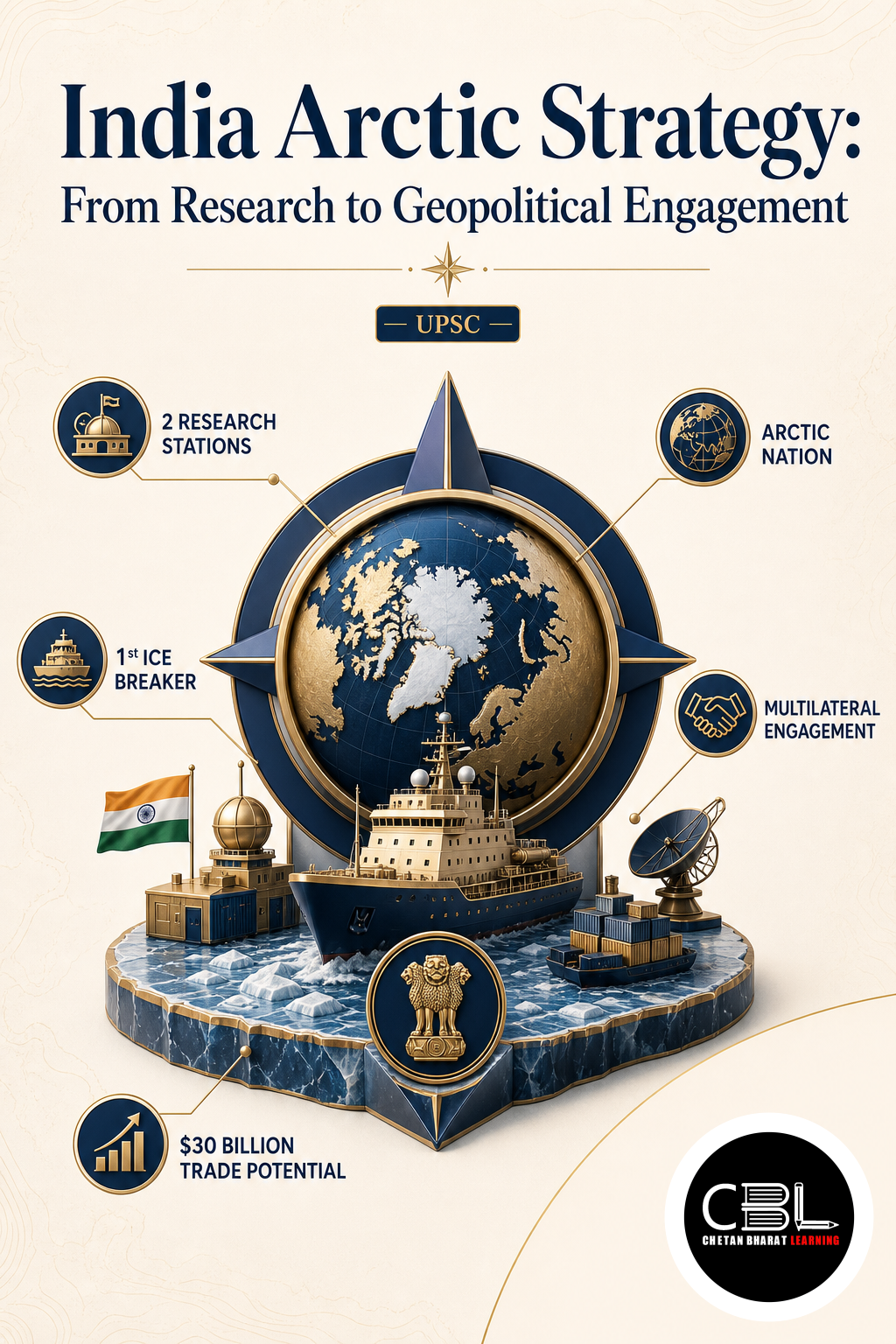
India Arctic Strategy requires a shift from solely scientific research to a broader engagement encompassing geopolitical, economic, and climate dimensions. India has a permanent research station, Himadri, in Svalbard, and has been an observer in the Arctic Council since 2013. However, there is a gap between ambition and capability, particularly the lack of a dedicated polar research vessel. For more such international relations updates, explore the international relations archive.
| Important For | |
|---|---|
| Prelims: International Relations & Science | Mains: GS Paper 2 (International Relations) & GS Paper 3 (Environment) |
| Arctic Council Status | Research Station | Key Gap |
|---|---|---|
| Observer (since 2013) | Himadri, Svalbard | No dedicated Polar Research Vessel |
What is India Arctic Strategy?
India Arctic Strategy encompasses India’s scientific research, diplomatic engagement, and economic interests in the Arctic region. The Arctic is changing rapidly due to climate change, with melting ice opening new shipping routes and resource opportunities. India’s engagement has been primarily scientific, but there is a growing recognition of the need for a broader strategy that includes geopolitical, economic, and environmental dimensions.
India’s Arctic policy, articulated in 2022, focuses on climate research, environmental protection, and participation in the Arctic Council. However, the lack of a dedicated polar research vessel limits India’s capacity to conduct sustained research and operational activities.
Why is India Arctic Strategy in News?
India Arctic Strategy is in the news because of the growing gap between India’s ambitions and its institutional and financial capabilities. Experts argue that India needs to move from a research-focused approach to a comprehensive strategy that addresses the geopolitical and economic implications of Arctic changes.
The Arctic’s melting ice is opening new shipping routes (Northern Sea Route) and access to resources like hydrocarbons and rare earth minerals. India’s absence of a polar research vessel is a major constraint, limiting its ability to conduct extended research and demonstrate its presence. For more details, refer to this PIB release.
Key Features of India Arctic Strategy
India Arctic Strategy has several distinctive features:
- Scientific Research: Himadri research station in Svalbard; participation in Arctic Council working groups.
- Climate Monitoring: Studying Arctic climate change and its impact on Indian monsoon and weather patterns.
- Economic Interests: Potential shipping routes (Northern Sea Route) and resource extraction (hydrocarbons, minerals).
- Geopolitical Engagement: Observer status in Arctic Council, bilateral cooperation with Arctic states.
- Institutional Gaps: Lack of a dedicated polar research vessel and limited funding for polar research.
Challenges in India Arctic Strategy
India Arctic Strategy faces several challenges:
- Limited Maritime Capability: No dedicated polar research vessel hampers sustained research.
- Funding Constraints: Polar research and infrastructure require significant investment.
- Institutional Coordination: Lack of a single nodal agency for Arctic affairs.
- Geopolitical Competition: Increasing rivalry among Arctic states (Russia, US, China) may limit India’s influence.
- Climate Change: The rapid pace of change requires adaptive and responsive strategies. For more on polar research, visit the science and technology section.
Way Forward for India Arctic Strategy
To strengthen India Arctic Strategy, India should invest in a dedicated polar research vessel to enhance research and operational capabilities. Establishing a nodal agency for Arctic affairs can coordinate scientific, diplomatic, and economic interests.
Expanding partnerships with Arctic states, particularly Russia and Norway, and engaging with non-Arctic states like China and Japan can enhance India’s influence. India should also explore sustainable economic opportunities in shipping and resources, balancing with environmental protection. For international best practices, refer to the Arctic Council.
Prelims Practice Corner
Q1. What is India’s status in the Arctic Council?
- (a) Permanent member
- (b) Observer
- (c) Ad hoc participant
- (d) No status
Answer
India has been an observer since 2013.
Q2. What is the name of India’s Arctic research station?
- (a) Bharati
- (b) Himadri
- (c) Maitri
- (d) Dakshin Gangotri
Answer
India’s Arctic research station is Himadri in Svalbard.
Q3. What is a key gap in India’s Arctic capabilities?
- (a) Lack of scientists
- (b) No dedicated polar research vessel
- (c) No Arctic policy
- (d) No diplomatic relations
Answer
India lacks a dedicated polar research vessel.
Q4. Why is the Arctic important for India’s climate?
- (a) It affects the Indian monsoon
- (b) It provides fresh water
- (c) It influences sea-level rise
- (d) All of the above
Answer
Arctic changes affect monsoon, sea-level, and weather patterns.
Q5. Which new economic opportunity is emerging in the Arctic?
- (a) Tourism
- (b) Northern Sea Route shipping
- (c) Fishing
- (d) All of the above
Answer
Melting ice is opening new shipping routes.
Mains Practice Questions
Q1. Discuss the strategic significance of the Arctic region for India and the gaps in India’s current engagement. (250 words, 15 marks)
Answer Structure
Intro: Introduce the Arctic’s changing geopolitical and climate significance.
Body: Discuss India’s scientific, economic, and diplomatic interests. Analyse gaps: polar research vessel, institutional coordination, funding. Suggest a comprehensive strategy.
Conclusion: Emphasise the need for a balanced approach—scientific, economic, and strategic.
Q2. What is the Arctic Council and what role does India play in it? (150 words, 10 marks)
Answer Structure
Intro: Define the Arctic Council as the leading intergovernmental forum for Arctic issues.
Body: India is an observer member, participating in working groups and scientific cooperation. Its role is primarily scientific, but it seeks to expand engagement.
Conclusion: Conclude that observer status allows India to influence Arctic governance without being a decision-maker.
FAQs on India Arctic Strategy
Why is the Arctic important for India?
The Arctic influences India’s climate (monsoon), offers new shipping routes, and holds untapped resources.
What is India’s Arctic policy?
India’s Arctic policy, released in 2022, focuses on climate research, environmental protection, and international cooperation.
What is the main limitation of India’s Arctic engagement?
The lack of a dedicated polar research vessel restricts sustained research and operational presence.
Related Current Affairs
Preparing for UPSC, PCS or HCS?
Talk to a mentor at Chetan Bharat Learning, Chandigarh. Free guidance on choosing the right exam and building a study plan.
Chat on WhatsAppCall 97793 53345UPSC / IAS / PCS coaching in Chandigarh · Trusted by aspirants across Punjab & Haryana
Leave a Reply
You must be logged in to post a comment.