
UPSC Mapping
| Exam | Section |
|---|---|
| Prelims | Polity & Criminal Law |
| Mains | GS Paper 2 (Constitutional Law & Criminal Justice) |
Quick Facts
| Method | Hanging (long-drop) |
|---|---|
| Key Article | Article 21 |
| Precedent | Deena v. Union of India (1983) |
What is Death Penalty Hanging?
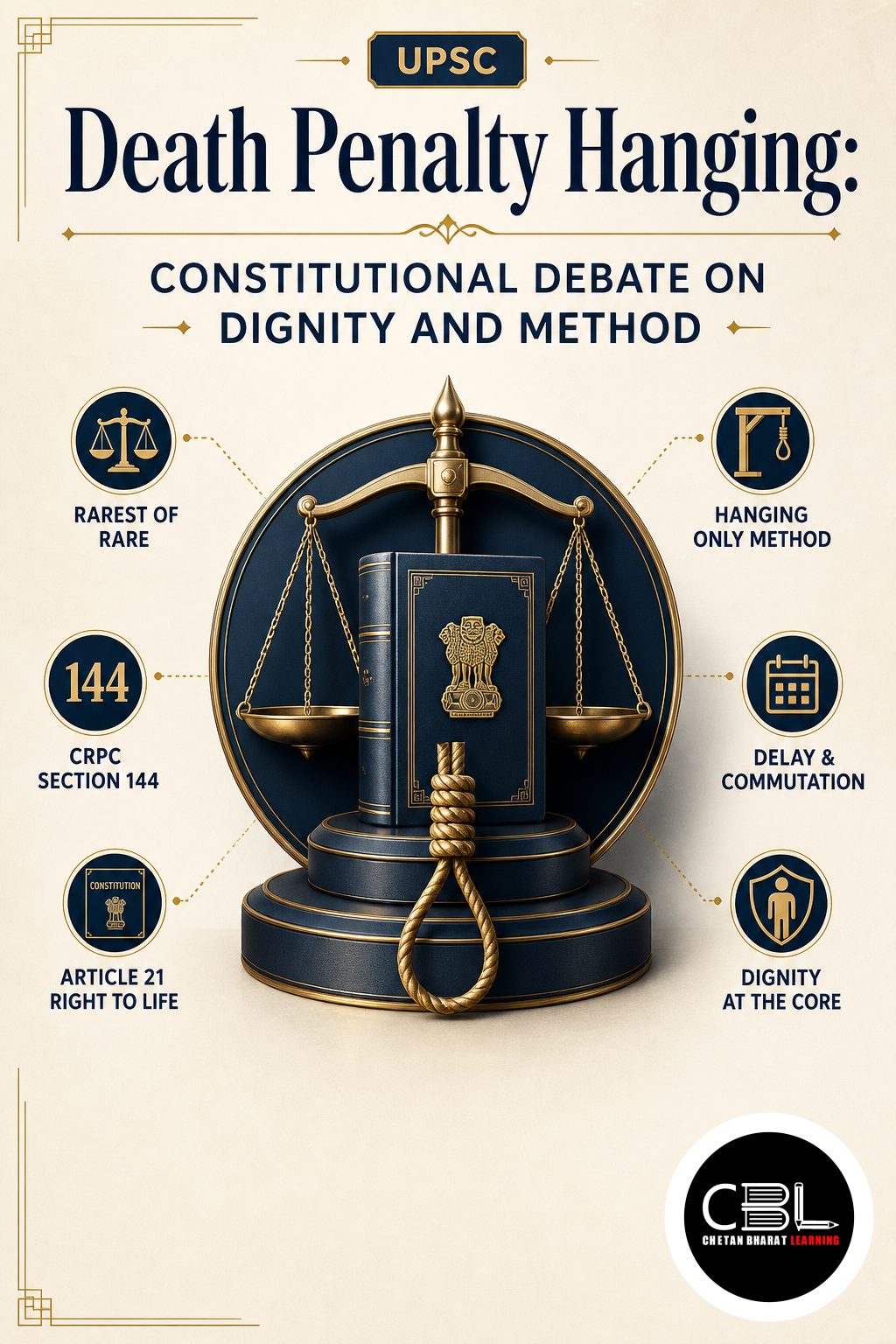
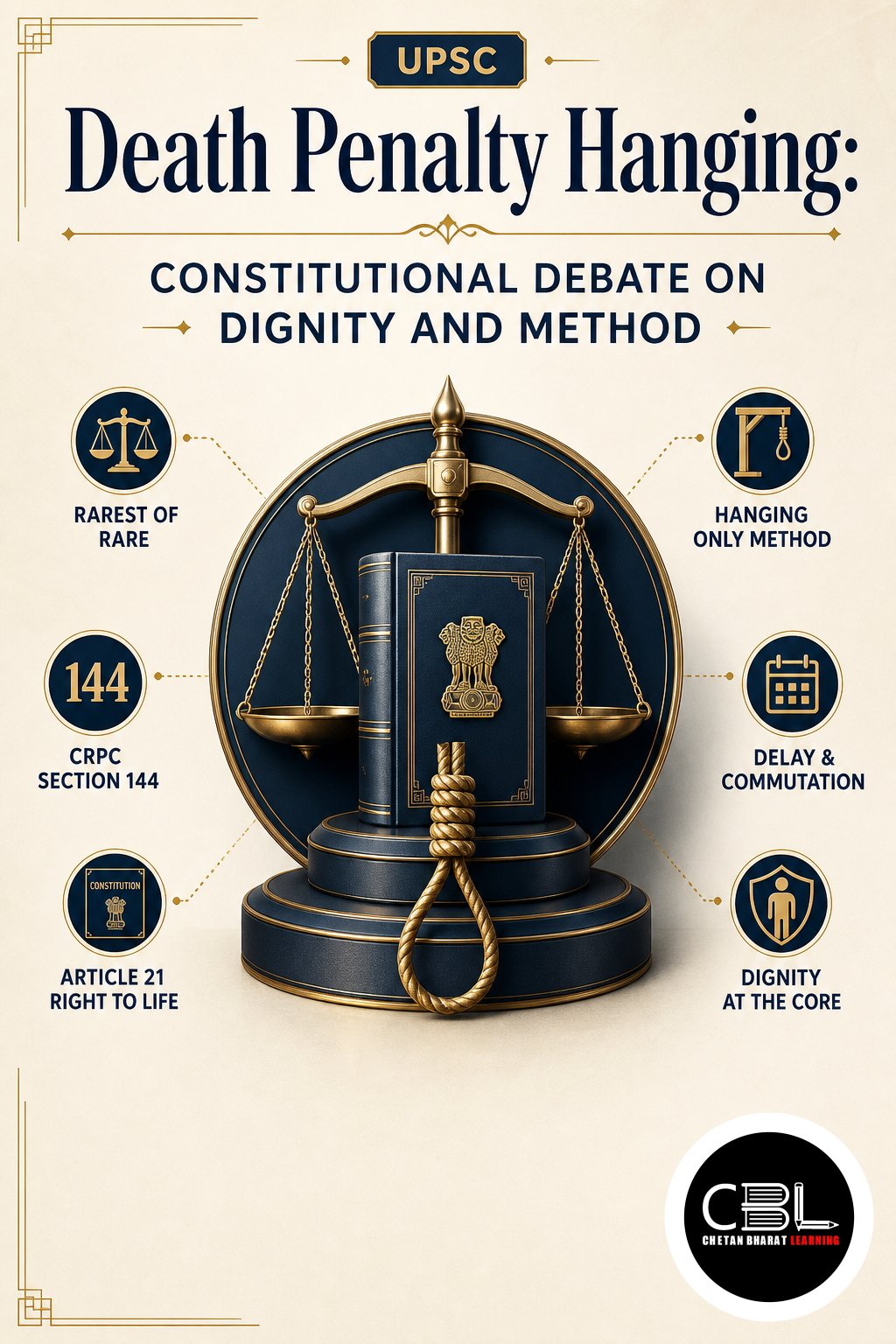
Death Penalty Hanging is the prescribed method of executing death sentences in India, inherited from British Common Law. Modern executions use the long-drop method, designed to break the second and third cervical vertebrae (C2 and C3), instantly rendering the person unconscious. The drop height must be calibrated to the individual’s weight and height; a drop too short can cause strangulation, while a drop too long risks decapitation.
The Supreme Court, in Deena v. Union of India (1983), upheld hanging as a constitutional mode of execution. The challenge to the method on grounds of cruelty and indignity under Article 21 was dismissed, with the court noting that Parliament retained hanging while enacting the Bharatiya Nagarik Suraksha Sanhita (BNSS).
Why is Death Penalty Hanging in News?
Death Penalty Hanging is in the news because a PIL challenged the method as scientifically unreliable and unconstitutional. The Supreme Court dismissed the petition, holding that the 1983 precedent and Parliament’s decision to retain hanging make the challenge untenable.
The debate has shifted from whether the death penalty should exist to how it should be carried out—whether hanging causes avoidable pain or indignity. The court observed that a death-row prisoner remains a rights-bearing individual until execution, but the method itself must be constitutionally permissible. For more details, refer to this PIB release.
Key Features of Death Penalty Hanging
- Long-Drop Method: Designed to break the neck instantly, causing unconsciousness and death.
- Calibration Required: Drop height depends on the prisoner’s weight and height; errors can cause suffering.
- Constitutional Precedent: Deena v. Union of India (1983) upheld hanging as constitutional.
- Statutory Retention: The BNSS retained hanging as the prescribed method.
- Article 21: The right to life and dignity applies even to death-row prisoners.
Challenges in Death Penalty Hanging
- Scientific Reliability: The method’s success depends on precise calibration; failure can cause prolonged suffering.
- Constitutional Dignity: Critics argue that hanging violates the right to a dignified death under Article 21.
- Irreversibility: The death penalty is irreversible, and errors in execution are irreversible.
- International Comparisons: Many countries have moved to methods like lethal injection, though some still use hanging.
- Ethical Debates: The debate overlaps with broader questions of capital punishment abolition. For more on constitutional law, visit the polity section.
Way Forward for Death Penalty Hanging
To address concerns over Death Penalty Hanging, India could consider adopting more scientific and humane methods, such as lethal injection, while ensuring transparency and legal safeguards. However, any change would require parliamentary legislation, given the statutory prescription of hanging.
The Supreme Court’s recent dismissal indicates that the method is constitutionally valid. However, ongoing research on execution methods and international human rights standards may influence future debates. The focus should remain on ensuring that executions, if carried out, are conducted with dignity and without avoidable suffering. For international best practices, refer to the Amnesty International.
Prelims Practice Corner
Q1. Which case upheld hanging as a constitutional method of execution?
- (a) Bachan Singh v. State of Punjab
- (b) Deena v. Union of India
- (c) Maneka Gandhi v. Union of India
- (d) Kesavananda Bharati
Answer: (b) Deena v. Union of India (1983) upheld hanging.
Q2. What is the long-drop method designed to do?
- (a) Asphyxiation
- (b) Break the neck and render unconscious
- (c) Electrocution
- (d) Poisoning
Answer: (b) The long-drop method aims to break the neck, causing instant unconsciousness.
Q3. Which Article of the Constitution protects the right to a dignified death?
- (a) Article 14
- (b) Article 19
- (c) Article 21
- (d) Article 22
Answer: (c) Article 21 protects life and personal liberty, including dignity.
Q4. What is the primary concern with the hanging method?
- (a) Cost
- (b) Lack of deterrent effect
- (c) Potential for error causing suffering
- (d) Public spectacle
Answer: (c) Errors in calibration can cause prolonged strangulation or decapitation.
Q5. What did the Supreme Court hold in the recent PIL on hanging?
- (a) Hanging is unconstitutional
- (b) The challenge is barred by precedent and statutory retention
- (c) Lethal injection should be adopted
- (d) The petition was admitted
Answer: (b) The court held that the challenge runs into the 1983 precedent and Parliament’s decision.
Mains Practice Questions
Q1. Discuss the constitutional and ethical dimensions of the debate over the method of execution in India. (250 words, 15 marks)
Answer Structure:
- Intro: Introduce the death penalty debate and the shift to method.
- Body: Discuss the constitutional framework (Article 21, Bachan Singh), the long-drop method, precedents, and challenges. Analyse the balance between state power and individual dignity.
- Conclusion: Suggest that any reform must ensure dignity and scientific reliability.
Q2. What is the ‘rarest of rare’ doctrine in the context of the death penalty? (150 words, 10 marks)
Answer Structure:
- Intro: Define the doctrine from Bachan Singh v. State of Punjab.
- Body: Explain that the death penalty is only for the ‘rarest of rare’ cases where the alternative of life imprisonment is unquestionably foreclosed. This ensures proportionality.
- Conclusion: Conclude that the doctrine restricts the use of capital punishment.
FAQs on Death Penalty Hanging
What is the prescribed method of execution in India?
Hanging by the neck until death is the prescribed method under the BNSS.
Why was the hanging method challenged?
It was challenged on grounds of scientific unreliability and violation of the right to a dignified death under Article 21.
What is the long-drop method?
A modern hanging method where the drop height is calibrated to break the neck and render the person unconscious instantly.
Related Current Affairs
Preparing for UPSC, PCS or HCS?
Talk to a mentor at Chetan Bharat Learning, Chandigarh. Free guidance on choosing the right exam and building a study plan.
Chat on WhatsAppCall 97793 53345UPSC / IAS / PCS coaching in Chandigarh · Trusted by aspirants across Punjab & Haryana
Leave a Reply
You must be logged in to post a comment.